
Flashcards
Enzyme Inhibition
Cards in this deck (21)
- 1What are the 2 types of enzyme inhibitors?Competitive inhibitor
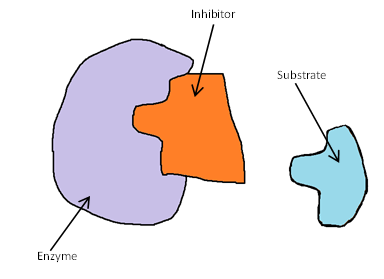
Non-competitive inhibitor - 2How do competitive inhibitors work?Competitive inhibitors have a similar shape to the substrates
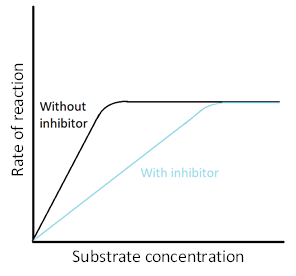
They compete with substrates to bind to the active site but no reaction takes place; they block the active site - 3What happens to competitive inhibition when the concentration of substrates increases?The effect is reversed and the substrate will out-compete the inhibitors
- 4How do non-competitive inhibitors work?Non-competitive inhibitors bind to the enzyme at the allosteric site.
This causes the active site to change shape so the substrate can no longer bind to it.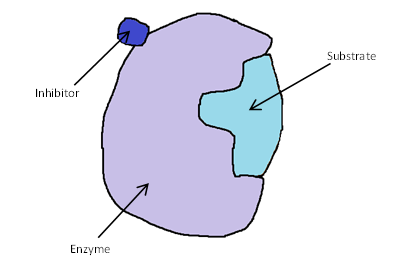
- 5What happens to non-competitive inhibition when the concentration of substrates increases?Increasing the substrate concentration will have NO EFFECT.
This is because non-competitive inhibitors do not "compete" with the substrates as they have a different shape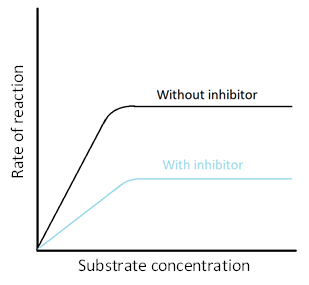
- 6Enzymes inhibitors can either be reversible or non-reversible. What does this depend on?The strength of the bonds between the enzyme and the inhibitor
- 7How do covalent bonds between the enzyme and inhibitor affect inhibition?Strong covalent bonds = inhibitor cannot be easily removed and inhibition is irreversible
- 8How do hydrogen/ionic bonds between the enzyme and inhibitor affect inhibition?Weaker hydrogen/ionic bonds = inhibitor can be removed and inhibition is reversible
- 9What is a metabolic pathway?A series of connected metabolic reactions. Each reaction is catalysed by a different enzyme
- 10How are metabolic pathways regulated?By end-product inhibition - many enzymes are inhibited by the product of the reaction they catalyse
- 11What is end-product inhibition?When the final product in a metabolic pathway inhibits an enzyme that acts earlier on in the pathway
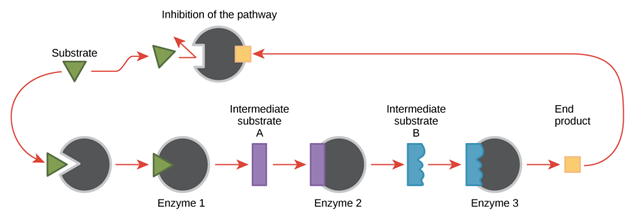
- 12Complete the sentences: End-product inhibition is ____________, so when the level of the end-product drops, _________drops and so more product can be made. This is a good way of ___________ the pathway and controlling the amount of ______-___________ that gets made. This is a ___________ ___________ mechanism.End-product inhibition is REVERSIBLE, so when the level of the end-product drops, INHIBITION drops and so more product can be made. This is a good way of REGULATING the pathway and controlling the amount of END-PRODUCT that gets made. This is a NEGATIVE FEEDBACK mechanism.
- 13What do metabolic poisons do?Metabolic poisons interfere with metabolic reactions (reactions that occur in cells), causing damage, illness or death
- 14Give examples of metabolic poisonsCyanide = non-competitive, irreversible inhibitor of cytochrome c oxidase (enzyme that catalyses respiration)
Arsenic = non-competitive inhibitor of pyruvate dehydrogenase (enzyme that catalyses respiration)
Malonate = competitive inhibitor of succinate dehydrogenase (catalyses respiration) - 15TRUE OR FALSE: Some medicinal drugs are enzyme inhibitorsTRUE
- 16Name examples of medicinal drugs which act as enzyme inhibitorsAspirin
ATPase inhibitors
ACE inhibitors
Protease inhibitors
Nucleoside reverse transcriptase inhibitors - 17How does aspirin act as an enzyme inhibitor?Aspirin binds to enzymes that catalyse the formation of prostaglandins
- 18How do ATPase inhibitors act as enzyme inhibitors?ATPase inhibitors inhibit sodium-potassium pumps in the cell membranes of heart-muscle cells, allowing more Ca²⁺ to enter cells (increases muscle contraction)
- 19How do ACE inhibitors act as enzyme inhibitors?ACE inhibitors inhibit angiotensin converting enzyme (ACE) to lower blood pressure and treat heart failure
- 20How do protease inhibitors act as enzyme inhibitors?Protease inhibitors are used to treat some viral infections. They prevent replication of the virus particles within host cells by inhibiting protease enzymes so viral coats cannot be made
- 21How do nucleoside reverse transcriptase inhibitors act as enzyme inhibitors?Nucleoside reverse transcriptase inhibitors are used to treat to treat HIV by inhibiting reverse transcriptase (catalyses replication of viral DNA)
Information
- Description
- User has deleted their subject information Flashcards on Enzyme Inhibition, created by Deleted user on 05/03/2018.
- Created by
- Deleted user · Mar 2018
- Updated
- Mar 5, 2018
- Views
- 27
- History
-
- Created by Yinka F · Jan 27, 2018
- Copied by Yinka F · Mar 5, 2018
- Rating