
Flashcards
Electrical Activity of the Heart and Electrocardiograms
Cards in this deck (16)
- 1Cardiac muscle is myogenic. What does that mean?It can contract/relax without nervous impulses
- 2Where is the sino-atrial node (SAN) located?In the wall of the right atrium
- 3What is the bundle of His?A group of muscle fibres
- 4What does AVN stand for?Atrioventricular node
- 5Outline the electrical system of the heart1. The SAN causes the right and left atria to contract. It acts as a pacemaker
2. A band of non-conducting tissue (collagen) prevents waves from being passed directly from the atria to the ventricles
3. Waves are transferred from the SAN to the AVN
4. The AVN passes the waves on to the bundle of His. BUT! There is a slight delay before the AVN reacts so that the atria have time to be emptied
5. The bundle of His conducts the waves to the purkyne tissue (finer muscle fibres - purkinje fibres - in the right and left ventricle walls)
6. Purkyne tissue carries the waves of electrical activity into the muscular walls of the right and left ventricles, causing them to contract from the bottom up - 6The SAN is like a pacemaker. What does that mean?The SAN sends regular waves of electrical activity over the atrial walls to set the rhythm
- 7Complete the sentences: The heart muscle ___________ (loses electrical charge) when it contracts, and ___________ when it relaxes. An _________________ records these changes in electrical charge.The heart muscle DEPOLARISES (loses electrical charge) when it contracts, and REPOLARISES when it relaxes. An ELECTROCARDIOGRAM records these changes in electrical charge.
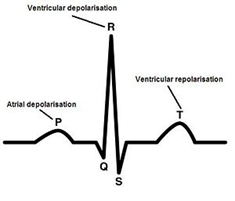
- 8What does a PQRST wave look like?
- 9What does the P wave indicate?Atrial systole (depolarisation)
- 10What does the QRS complex indicate?Ventricular systole (depolarisation)
- 11What does the T wave indicate?Diastole (repolarisation)
- 12What equation do you use to calculate heart beat (bpm)?60 / time taken for 1 heartbeat (s)
- 13What is tachycardia?Heartbeat is too fast (around 120bpm)
This is alright after exercise but at rest, it shows that the heart isn't pumping blood efficiently - 14What is bradycardia?Heartbeat is too slow (around 50bpm)
This is normal in trained athletes but in others it can indicate a problem (e.g. something preventing impulses from the SAN being passed on properly) - 15What is ectopic heartbeat?An 'extra' heartbeat that interrupts the regular rhythm
Occasional ectopic heartbeats in a healthy person don't cause a problem - 16What is fibrillation?A really irregular heartbeat
The atria or ventricles completely lose their rhythm and stop contracting properly
This can result in anything from chest pain and fainting to lack of pulse and death
Information
- Description
- User has deleted their subject information Flashcards on Electrical Activity of the Heart and Electrocardiograms, created by Deleted user on 05/03/2018.
- Created by
- Deleted user · Mar 2018
- Updated
- Mar 5, 2018
- Views
- 20
- History
-
- Created by Yinka F · Feb 1, 2018
- Copied by Yinka F · Mar 5, 2018
- Rating