
Flashcards
Environmental Science - FINAL - Human Populations
Cards in this deck (17)
- 1Population Growthhuman population is at 7.2 Billion
it took all of human history to reach 1 billion
in 1930, 130 years later, we reached 2 billion
the most recent billion was added in 12 years (now at 1.2% annual growth rate) - 2Causes and Repercussions of the Increasing Human Populationpopulation growth results from technology, sanitation, food
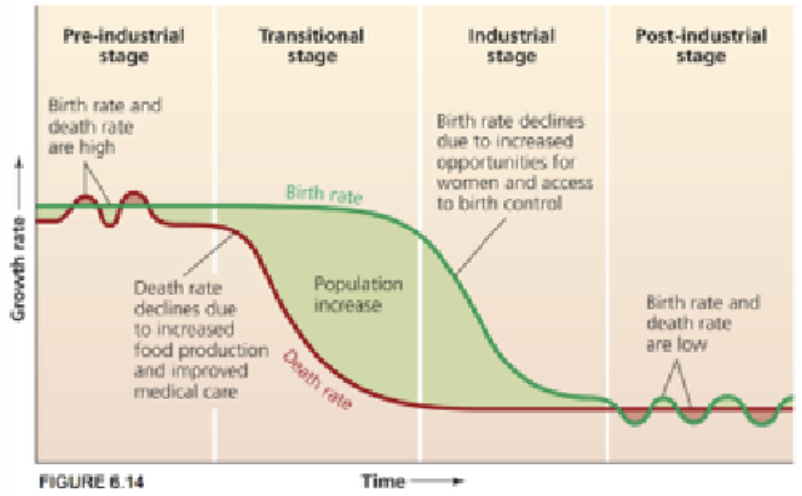
(death rates drop, but birth rates don't)
more recently, population is much more correlated with poverty than with wealth
many people do not see this as a problem, however, the quality of life will suffer with unchecked growth (less food, less space, less wealth per person).
even though the growth rate declines, the absolute increase of people continues
Also, there are many resources that can be depleted, therefore the concept of carrying capacity is applied to the human species/world - 3Why would Governments Fear Falling Population?policymakers believe growth increases economic, political and military strength
- 4Raising the Carrying Capacity: The Cornucopian Viewbefore 100 000 years ago, we would have to spend most of our time struggling for food.
Agriculture helped to produce more food than needed for one person, which gave people more time.
Industrial revolution helped to increase the efficiency of agriculture
Medical revolution leads to increasing life spans, and decreasing death rates - 5What is the IPAT model?IPAT : I = P x A x T x S
our total impact (I) on environment results from the population (P), Affluence (A), Technology (T), and Sensitivity (S)
Population = individuals need space & resources
Affluence = greater per capita resource use
Technology = increased exploration of resources
Sensitivity = how sensitive an area is to human pressure - 6What Have we Learned from Papa Nui?island was covered in trees, the society became experts in gathering resources from sea
resulted in a major decline in tree populations (relied on trees for food, agriculture, shelter)
when they used them all up, they lost all their capabilities, it created erosion, lands became degraded - 7Population Size & DensityPopulation size is only one factor
Highest population density is in temperate, subtropical and tropical climates - 8Population DistributionHumans are unevenly distributed over the globe
unpopulated areas tend to be environmentally sensitive (has a high S value on the IPAT equation) - 9How does age structure affect future population dynamics?having many individuals in young age groups results in high reproduction and rapid population growth
- 10What factors play on population growth?Rates of birth, death, and migration
(birth and immigration adds individuals, deaths removes individuals)
Technological advances led to dramatic decline in human death rates
Total Fertility Rate - 11What is Total Fertility Rate and what factors affect it?Total Fertility Rate (TFR) = average number of children born per female during lifetime
(replacement fertility = the TFR that keeps population size stable)
increasing urbanization decreases TFR (children more expansive, more security for older pop. means we dont need children as much, women work = less time for kids) - 12Demographic Transitionsa model of economic an cultural change that explains why there is a decline in death AND birth rates in developed nations
- 13Is the Demographic Transition Universal?It has occurred in Europe, U.S, Canada, Japan, and other nations in the past 200-300 years.
However, the transition could fail in cultures that :
1) place greater value on childbirth
2) grant women fewer freedoms - 14How much resources would we need for all people to have the material standard of living of North Americans?we would need the natural resources of 4.5 more Earths
- 15How is poverty correlated with population growth?poorer societies have higher growth rates than wealthier societies, this is due to the fact that they have higher fertility rates than death rates, with lower contraceptive use.
99% of the next billion people added will be born in poor, less developed regions that are least able to support them - 16How does the consumption from affluence create environmental impacts?Affluent societies have enormous resource consumption and waste production
people in these societies use resources from other areas, as well as from their own
the addition of 1 Canadian to the impacts the environment as much as 6 Chinese, or 12 Indians, or 40 Somalians - 17Conflicts with the wealth gapthe richest 20% use 86% of the worlds resources
that leaves only 14% of the resources for 80% of the worlds people to share
more than 1/2 of the worlds population lives with less than 2$ a day
Information
- Description
- User has deleted their subject information Flashcards on Environmental Science - FINAL - Human Populations, created by Deleted user on 01/04/2018.
- Created by
- Deleted user · Apr 2018
- Updated
- Apr 1, 2018
- Views
- 15
- History
-
- Created by abby Radske · Mar 19, 2018
- Copied by abby Radske · Apr 1, 2018
- Rating