
Quiz
AS Level Physics U4 Dynamics : Force-Time Graphs & Impulse Quiz
Questions in this quiz (7)
1A 10-kg box, initially at rest, moves along a frictionless horizontal surface. A horizontal force to the right is applied to the box. The magnitude of the force changes as a function of time as shown.
Which of the following impulse calculations is correct?
I. The impulse for the period from 0 to 2 seconds is 4 Ns.
II. The impulse for the period from 2 to 5 seconds is 6 Ns.
III. The impulse for the period from 5 to 8 seconds is Ns.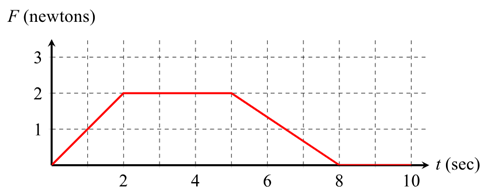
- AI only.
- BII only.
- CIII only.
- DI and II.
2A 10-kg box, initially at rest, moves along a frictionless horizontal surface. A horizontal force to the right is applied to the box. The magnitude of the force changes as a function of time is shown in the top graph.
A student draws the bottom graph for the momentum of this 10-kg box as a function of time during this 10-second interval.
Which statements describe what is correct about the second graph and/or describe changes that could be made to correct the graph? Select two answers.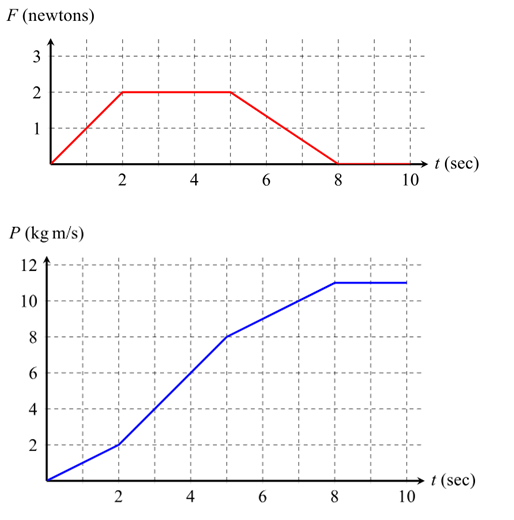
- AFrom 0 – 2 seconds, the graph should be curved upward and from 5 – 8 seconds, the graph should be curved downward.
- BFrom 0 – 2 seconds, the graph should be curved downward and from 5 – 8 seconds, the graph should be curved upward.
- CThe graph is correct between 0 – 2 seconds and 5 – 8 seconds.
- DThe graph is correct between 2 – 5 seconds and 8 – 10 seconds.
3A 10-kg box, initially at rest, moves along a frictionless horizontal surface. A horizontal force to the right is applied to the box. The magnitude of the force changes as a function of time as shown.
Rank the impulse (greatest to least) applied to the box by this force during each 2-second interval indicated below:
a. 0 to 2 s
b. 2 to 4 s
c. 4 to 6 s
d. 6 to 8 s
e. 8 to 10 s- Ab > c > d > a > e
- Bb > c > a > d > e
- Cb > a > c > d > e
- DEach slope is straight so the impulse applied to the box during each of the intervals is zero.
4A 6 kg sphere collides with a stationary 30 kg sphere on a frictionless and horizontal surface at t = 0 s as shown below.
A plot of the force exerted on the 30 kg sphere by the 6 kg sphere as a function of time is also shown.
What is the impulse applied to the 30 kg sphere?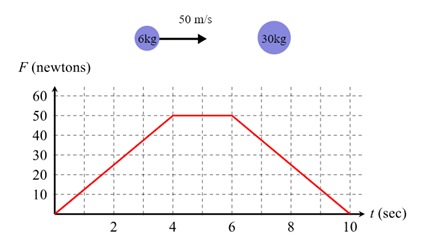
- A100 kg m/s
- B250 kg m/s
- C300 kg m/s
- D500 kg m/s
5For the collision shown ahttps://www.goconqr.com/assets/icons/image-plus-md.pngt the left, the impulse on the 6 kg sphere is:
- Athe same magnitude, but opposite in direction compared to the impulse on the 30 kg sphere.
- Bthe same magnitude and direction compared to the impulse on the 30 kg sphere.
- Cfive times the magnitude, but opposite in direction compared to the impulse on the 30 kg sphere.
- Dzero.
6For the collision shown, what is the speed of the 30 kg sphere immediately after the collision?
- A0 m/s
- B10 m/s
- C50 m/s
- D100 m/s
7For the collision , how do the magnitudes of change in momentum and change in velocity compare for the two objects?
- AThe 6 kg object has a greater magnitude of momentum change and a greater magnitude of velocity change.
- BThe two objects have the same magnitude of momentum change, and the 30 kg object has greater magnitude of velocity change.
- CThe two objects have the same magnitude of momentum change, and the same magnitude of velocity change.
- DThe two objects have the same magnitude of momentum change, and the 6 kg object has greater magnitude of velocity change.
Information
- Description
- Quiz on force-time graphs and impulse for Cambridge AS Level Physics.
- Author
- Jeffrey Piggott
- Language
- English
- Views
- 2,672
- History
- Created on 14 Sep 2018 · updated on 14 Sep 2018
- Tags
- Rating
- No ratings yet Rate this quiz