
Notes
To Kill a Mockingbird - Themes, Motifs & Symbols
Content of the notes (1)
Page 1
To Kill a Mockingbird - Themes, Motifs & Symbols
The Existence of Social Inequality
Differences in social status are explored largely through
the overcomplicated social hierarchy of Maycomb, the ins and outs
of which constantly baffle the children. The relatively well-off
Finches stand near the top of Maycomb’s social hierarchy, with most
of the townspeople beneath them. Ignorant country farmers like the
Cunninghams lie below the townspeople, and the white trash Ewells
rest below the Cunninghams. But the black community in Maycomb, despite
its abundance of admirable qualities, squats below even the Ewells,
enabling Bob Ewell to make up for his own lack of importance by
persecuting Tom Robinson. These rigid social divisions that make
up so much of the adult world are revealed in the book to be both
irrational and destructive. For example, Scout cannot understand
why Aunt Alexandra refuses to let her consort with young Walter
Cunningham. Lee uses the children’s perplexity at the unpleasant
layering of Maycomb society to critique the role of class status
and, ultimately, prejudice in human interaction.
Motifs - recurring structures, contrasts, and literary
devices that can help to develop and inform the text’s major themes.
Gothic Details
The forces of good and evil in To Kill a Mockingbird seem
larger than the small Southern town in which the story takes place.
Lee adds drama and atmosphere to her story by including a number
of Gothic details in the setting and the plot. In literature, the
term Gothic refers to a style of fiction first popularized in eighteenth-century
England, featuring supernatural occurrences, gloomy and haunted
settings, full moons, and so on. Among the Gothic elements in To
Kill a Mockingbird are the unnatural snowfall, the fire
that destroys Miss Maudie’s house, the children’s superstitions
about Boo Radley, the mad dog that Atticus shoots, and the ominous
night of the Halloween party on which Bob Ewell attacks the children. These
elements, out of place in the normally quiet, predictable Maycomb,
create tension in the novel and serve to foreshadow the troublesome
events of the trial and its aftermath.
Small-Town Life
Counterbalancing the Gothic motif of the story is the
motif of old-fashioned, small-town values, which manifest themselves
throughout the novel. As if to contrast with all of the suspense
and moral grandeur of the book, Lee emphasizes the slow-paced, good-natured
feel of life in Maycomb. She often deliberately juxtaposes small-town
values and Gothic images in order to examine more closely the forces
of good and evil. The horror of the fire, for instance, is mitigated
by the comforting scene of the people of Maycomb banding together
to save Miss Maudie’s possessions. In contrast, Bob Ewell’s cowardly
attack on the defenseless Scout, who is dressed like a giant ham
for the school pageant, shows him to be unredeemably evil.
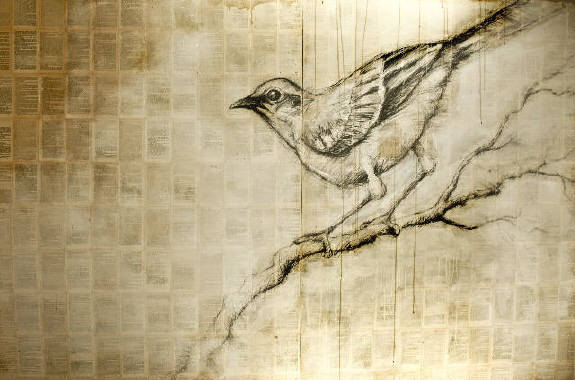
MockingbirdsThe title of To Kill a Mockingbird has
very little literal connection to the plot, but it carries a great
deal of symbolic weight in the book. In this story of innocents
destroyed by evil, the “mockingbird” comes to represent the idea
of innocence. Thus, to kill a mockingbird is to destroy innocence.
Throughout the book, a number of characters (Jem, Tom Robinson,
Dill, Boo Radley, Mr. Raymond) can be identified as mockingbirds—innocents
who have been injured or destroyed through contact with evil. This
connection between the novel’s title and its main theme is made
explicit several times in the novel: after Tom Robinson is shot,
Mr. Underwood compares his death to “the senseless slaughter of
songbirds,” and at the end of the book Scout thinks that hurting
Boo Radley would be like “shootin’ a mockingbird.” Most important,
Miss Maudie explains to Scout: “Mockingbirds don’t do one thing
but . . . sing their hearts out for us. That’s why it’s a sin to
kill a mockingbird.” That Jem and Scout’s last name is Finch (another
type of small bird) indicates that they are particularly vulnerable
in the racist world of Maycomb, which often treats the fragile innocence
of childhood harshly.
Boo Radley
As the novel progresses, the children’s changing attitude
toward Boo Radley is an important measurement of their development from
innocence toward a grown-up moral perspective. At the beginning
of the book, Boo is merely a source of childhood superstition. As
he leaves Jem and Scout presents and mends Jem’s pants, he gradually
becomes increasingly and intriguingly real to them. At the end of
the novel, he becomes fully human to Scout, illustrating that she has
developed into a sympathetic and understanding individual. Boo,
an intelligent child ruined by a cruel father, is one of the book’s most
important mockingbirds; he is also an important symbol of the good
that exists within people. Despite the pain that Boo has suffered,
the purity of his heart rules his interaction with the children. In
saving Jem and Scout from Bob Ewell, Boo proves the ultimate symbol
of good.
Symbols- objects, characters, figures, and colors
used to represent abstract ideas or concepts.
The moral voice of To Kill a Mockingbird is
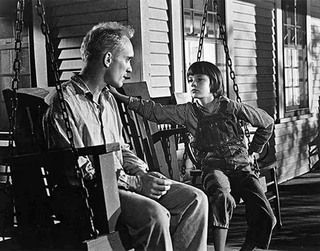
embodied by Atticus Finch, who is virtually unique in the novel
in that he has experienced and understood evil without losing his
faith in the human capacity for goodness. Atticus understands that,
rather than being simply creatures of good or creatures of evil,
most people have both good and bad qualities. The important thing
is to appreciate the good qualities and understand the bad qualities
by treating others with sympathy and trying to see life from their
perspective. He tries to teach this ultimate moral lesson to Jem
and Scout to show them that it is possible to live with conscience
without losing hope or becoming cynical. In this way, Atticus is
able to admire Mrs. Dubose’s courage even while deploring her racism.
Scout’s progress as a character in the novel is defined by her gradual
development toward understanding Atticus’s lessons, culminating
when, in the final chapters, Scout at last sees Boo Radley as a
human being. Her newfound ability to view the world from his perspective
ensures that she will not become jaded as she loses her innocence.
The Importance of Moral Education
Because exploration of the novel’s larger moral questions
takes place within the perspective of children, the education of
children is necessarily involved in the development of all of the
novel’s themes. In a sense, the plot of the story charts Scout’s
moral education, and the theme of how children are educated—how
they are taught to move from innocence to adulthood—recurs throughout
the novel (at the end of the book, Scout even says that she has
learned practically everything except algebra). This theme is explored
most powerfully through the relationship between Atticus and his
children, as he devotes himself to instilling a social conscience
in Jem and Scout. The scenes at school provide a direct counterpoint
to Atticus’s effective education of his children: Scout is frequently
confronted with teachers who are either frustratingly unsympathetic
to children’s needs or morally hypocritical. As is true of To
Kill a Mockingbird’s other moral themes, the novel’s conclusion
about education is that the most important lessons are those of
sympathy and understanding, and that a sympathetic, understanding
approach is the best way to teach these lessons. In this way, Atticus’s
ability to put himself in his children’s shoes makes him an excellent
teacher, while Miss Caroline’s rigid commitment to the educational
techniques that she learned in college makes her ineffective and
even dangerous.
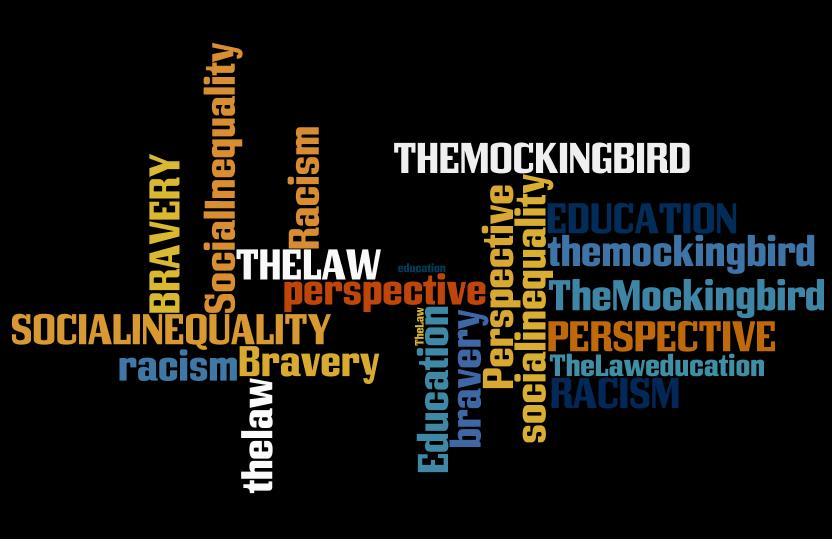
Themes - the fundamental and often universal ideas
explored in a literary work.
The Coexistence of Good and Evil
The most important theme of To Kill a Mockingbird is the book’s exploration of the moral nature of human beings—that is, whether people are essentially good or essentially evil. The novel approaches this question by dramatizing Scout and Jem’s transition from a perspective of childhood innocence, in which they assume that people are good because they have never seen evil, to a more adult perspective, in which they have confronted evil and must incorporate it into their understanding of the world. As a result of this portrayal of the transition from innocence to experience, one of the book’s important subthemes involves the threat that hatred, prejudice, and ignorance pose to the innocent: people such as Tom Robinson and Boo Radley are not prepared for the evil that they encounter, and, as a result, they are destroyed. Even Jem is victimized to an extent by his discovery of the evil of racism during and after the trial. Whereas Scout is able to maintain her basic faith in human nature despite Tom’s conviction, Jem’s faith in justice and in humanity is badly damaged, and he retreats into a state of disillusionment.
Information
- Description
- GCSE English (GCSE ) Note on To Kill a Mockingbird - Themes, Motifs & Symbols,
- Created by
- Landon Valencia · Mar 2015
- Updated
- Jan 25, 2017
- Views
- 1,263
- Tags
- Rating