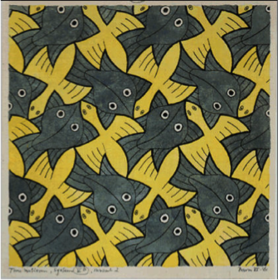
MC Escher
Slides in this set (8)
-
- •Traveled
- to Italy and began drawing sketches of the trees and vistas.
- •Fascinated
- with structure and light
- •Paid
- careful attention to details of the roof shingles and the cobblestone path ways
-
- In 1920 Escher enrolled in the School for Architecture and Design in
- Haarlem, studying graphic arts.
- Afterwards, he concentrated on landscapes and townscapes in Italy.
- He traveled widely, and visited Spain in June 1922. He was inspired by
- the Alhambra, a 14th
- century Moorish castle in Granada.
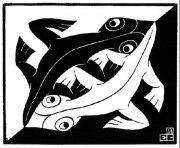
- He was fascinated by the geometric patterns of the tiles, but was
- disappointed by the lack of recognizable figures.
-
- His works began to take on a more mathematical approach, and in 1945,
- they were featured in a science museum, not art.
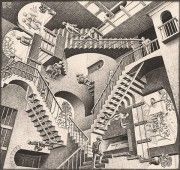
- From 1944 onwards Escher became a surrealist, often creating impossible
- landscapes and expanding the division of the plane into three dimensions.
- His fame began to spread in the 1950’s, and he was inundated with
- requests to give lectures all over the world.
-
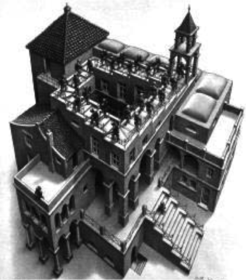
- Escher was fascinated by topology, which had only began to be
- studied in his lifetime. He used what he knew to create the “impossible” etchings, such as Waterfall.
- The mathematical accuracy and the attention to details that Escher gave
- his works provided them with a highly believable sense of realism that sharply
- contrasts with the unreal aspects.
-
- “What I give form to in daylight
- is only one per cent of what I have seen in darkness.”
- -Escher
- ”…to portray something that doesn’t exist, one must present it in a perfectly ordinary everyday way.”
- -Escher
- ”I try to bear witness that we are
- living in a beautiful, ordered world, and not in a chaos without standards, as
- it sometimes seems.”
- -Escher
-
- Escher died in 1972 at the age of 73. Over his lifetime, he made 448
- lithographs, woodcuts, and wood engravings, and over 2000 drawings and
- sketches. His art continues to amaze millions of people throughout the world
- today.
-
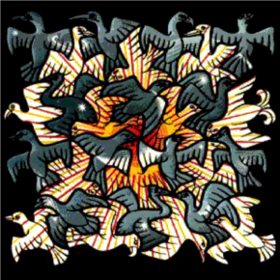
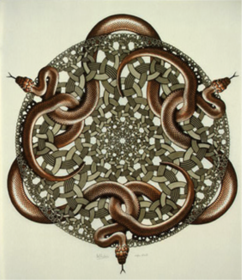
- •Though
- the Moor Civilization was forbidden from using living creatures in their art,
- Escher took a great interest in using these figures
- •Used
- mainly birds, lions, and fish