
PHYSICS- kinematics
Slides in this set (12)
-
- key words:
- - displacement: distance moved in a particular direction
- - speed: average speed is distance moved in time taken
- - mean speed: total distance traveled over total time taken
- - acceleration: the rate of change of velocity (rate means divided by time)
- - velocity: speed of something in a given direction
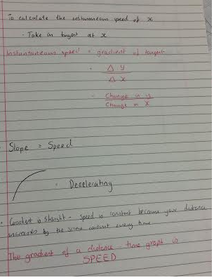
- - instantaneous speed: value of the speed off an object at a particular time
- if a question said " determine the speed at 6.0s " you would draw a tangent at that point and work out the speed
- by using change in y/ change in
- CHANGE IN DIRECTION > CHANGE IN VELOCITY > CHANGE IN ACCELERATION
- + A change in speed, direction means that the object has a change in velocity
- + in physics if you turn a corner , and your speed is constant-- your velocity still changes.
- + To maximize your velocity you displace more from your original position
-
-
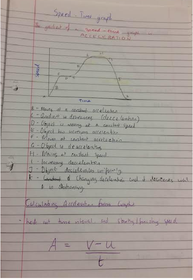
- method for working out instantaneous acceleration:
- >draw a tangent at a specific point
- =change in y/change in x
- the gradient will be the acceleration
- Method for working out the distance travelled
- >area under the curve
- X x Y/2 (for a triangle)
- X x Y (for a rectangle)
- speed x time = distance
-
- displacement is the distance of how far the object has moved from the original position
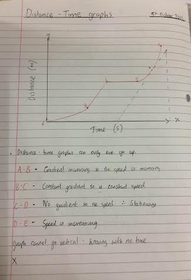
- a displacement time graph represents how the position of an object relative to a fixed position changes as time progresses
- ~the gradient of a displacement time graph is VELOCITY
- A d-t is a curve
- The area under the curve has no meaning
- it shows the amount it has displaced from its original position, even if it is going towards the position it is still displacing itself.
-
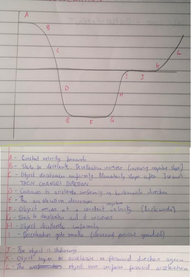
- The gradient of a velocity time graph is ACCELERATION
- >the steeper the slope the higher acceleration
- >FORWARDS (positive numbers)- if the slope is + its accelerating
- - if the slope is - its decelerating
- >BACKWARDS(negative numbers)-if the slope is + its decelerating
- - if the slope is -, it is accelerating
- >CHANGES DIRECTION WHEN IT CROSSES X AXIS
-
- logic that all freely falling objects ( in the absence of air resistance) accelerate to earth with the same acceleration.
- ACCELERATION DUE TO GRAVITY- 9.1ms-1
-
- ~~ these are only used when acceleration is constant~~
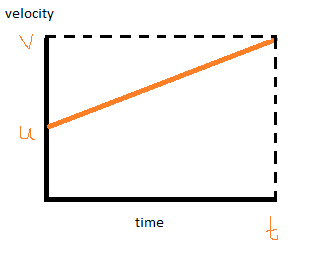
- Acceleration = change in velocity
- time taken
- A=V-U
- T
- We can rearrange this formula to make V the subject of the formula
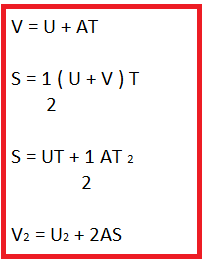
- V= U + AT
- the area under the curve is DISPLACEMENT=(area of trapezium)
- S= 1 ( U + V ) x T
- 2
-
- we can combine
- V = U + AT and S = 1 ( U + V ) x T
- 2
- substitute v= u + at into the other formula
- S = 1 (U + U + AT) x T
- 2
- S = 1 (2U + AT) x T
- 2
- S = 1 (2U + AT ^2) S = 1 2 UT + 1 AT^2
- 2 2 2
- S= UT + 1 AT ^2
- 2
- now we can combine S= UT + 1 AT ^2
- 2
- and V = U + AT to make V^2 = U^2+ 2AS
- V^2 = (U + AT)^2
- = U^2 + 2U AT + A^2 T^2
- = U^2 +2A( UT +1/2 AT^2)
- = U^2 +2AS
- V= FINAL VELOCITY
- U= INITIAL VELOCITY
- A= ACCELERATION
- S= DISPLACEMENT
- T= TIME
-
-
- SUVAT is a technnique used that applies all the four different equations of motion
- S= dislacement (m) sometimes called X in exams
- U= inital speed (ms-1)
- V= final speed (ms-1)
- A= acceleration (ms-2)
- T= time (s)
-
converting from v-t to d-t graphs
- on a velocity time graph when it passes through the origin it means it chnaged direction BUT on a d-t graph it doesnt matter if it changes direction it is still moving and accelerating.
- >if it is decelerating the curve on the d-t graph will just flatten out
Information
- Description
- AS - Level Physics Slide Set on PHYSICS- kinematics, created by Caitlin Davies on 29/10/2015.
- Created by
- Caitlin Davies · Oct 2015
- Updated
- Jun 7, 2016
- Views
- 60
- Rating