
Notes
Section 1: forces and motion c) forces, movement and shape
Content of the notes (1)
Page 1
Kilogram (kg)
Metre (m)
Metre/second (m/s)
Metre/second2 (m/s2)
Newton (N)
Second (S)
Kilogram metre/second (Kg m/s)
Newton per kilogram (N\kg)
Units(1.1):
1.9 describe the effects of forces between bodies such as changes in speed, shape or direction Changes in speed
When an object is stationary it has an equal force pushing down and up. The downward force being gravity and the upward force being the surface the object is on. The object is not floating but it is not going into the ground.
When an object is accelerating it has the upwards and downwards forces but it also has forwards and backwards forces (drag and friction). The forward force is larger than the backward force when an object is accelerating.
When an object is going at a constant speed it has downward and upward forces as well as forward and backward forces. The forward and backward forces are equal, so the speed doesn't change even though the object is moving.
When an object is decelerating it has the equal upward and downward forces as well as forward and backward forces, but the backward force is larger than the forward one, slowing the object down.
Changes in shape
changes in shape affect momentum. Force= change in momentum/ time taken. An example of this is crumple zones in car decrease the force on the passengers.
Changes in direction
Which ever direction the force is greatest in will be the direction the object travels in.
Forces:
electrostatic
push
pull
friction
magnetic- two magnets placed near each other
upthrust- cork placed in water
Air resistance- feather dropped from a height, weight ar slowing it.
elastic
Gravity; acting downwards
Up thrust; acting upwards
Drag; acting against the movement
A force is a push or pull. A force can cause an object to accelerate or change shape.
Force is measured in Newton's(N) with a newton meter.
There are many types or force. Contact force occurs when two bodies touch each other.
Friction is a force vector quantity, it has magnitude and direction.
Vectors: has size and dircetion
Force
Displacement
Velociy
Scalars: has size no direction
Speed
Mass
Energy
Distance
1.12 understand that force is a vector quantity Force has magnitude, it is measured in newtons but it acts in a direction.
For example 3N drag
is an amount of force acting backwards.
1.13 find the resultant force of forces that act along a line Resultant force is the overall force acting in a direction on an object. It is best explained by digrams which show that the resulatnt force is the overall force given individual forces acting along a line.
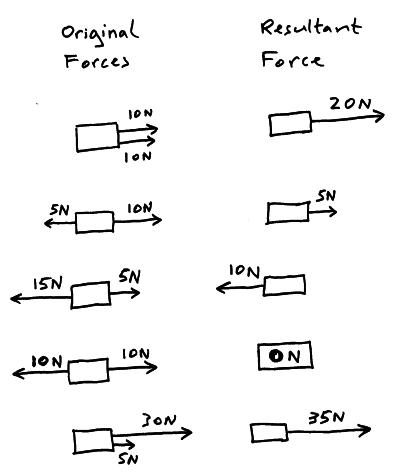
Balanced and unbalanced forces: resultant force
Balanced forces:
Resultant force= 0
Object stays at rest, or continuous at the same speed in the same direction.
Unbalanced forces:
The object speeds up or slows down in the resultant force.
newton's second law of motion:
Force = mass x alcceleration
New Page
Information
- Description
- physics Note on Section 1: forces and motion c) forces, movement and shape, created by e.bains on 22/12/2013.
- Created by
- e.bains · Dec 2013
- Updated
- Oct 22, 2016
- Views
- 396
- Tags
- Rating