
Unit A past papers jan 2011
Slides in this set (20)
-
- January 2011 Section A
-
- A large public limited company (plc) has recently experienced a fire and explosion resulting in multiple fatalities and extensive environmental damage.
- (a) Outline a range of consequences that may affect the company as a result of this incident.
- There will be both direct and indirect financial costs to the business,
- some of these cost may be covered by insurance, dependant on the results of any investigations.
- Insurance premiums may increase in future causing further financial burdens to the business.
- Immediate consequences would be the lack of fulfillment of customers orders and loss of future business.
- The business would either have to provide in- house resources or contract in resources to begin a full clean up of the site and surrounding area. Once the business is relocated / recovered and they may find that people do not want to work with them due to the incident and the perceived higher risk due to the incident.
-
- (b) As a result of the incident, shareholders in the company have
- raised concerns about the risk management arrangements that
- are in place and have called into question the Board’s annual
- statement that was provided as part of compliance with the
- Turnbull/Financial Reporting Council guidelines on ‘internal
- control’.
- Explain the purpose of these guidelines and why they are
- relevant to this type of incident.
- The purpose of the guidelines are to ensure that good risk management practices are in place to safeguard the shareholders investments and organisations assets. they are also there to to minimise losses and improve profitability and to help with compliance with the company's legal obligations.
- They are relevant to this type of incident as if the guidelines are followed and complied with the likely hood of this type of incident would be dramatically reduced through the implementation of appropriate procedures in relation to Health and safety management, business continuity, financial stability and customer relations
-
- Explain the ‘domino’ and ‘multi-causality’ theories of accident causation,
- including their respective uses and possible limitations in accident
- investigation and prevention
- The domino theory was initially created by Bill Heinrich in 1931 and consisted of 5 aspects which were:-
- Ancestry and social Environment
- Fault of Person
- Unsafe act of condition
- Accident
- Injury
- this was later expanded by loftus and Bird and and redesigned with the following aspects
- Management - Lack of control
- Origins - Basic concepts
- Symptoms - Immediate causes
- Contact - Accident
- Loss - Injury / Damage
- .
-
- The key aspects of the multi causal model is that it identifies that an incident can have more than one single cause. and these separate causes can combine with each other in a random and complex manner with major consequences. Each of these contributory causes can indeed have multiple causes of their own.
- . The value of the model in accident investigation and prevention is that it encourages and emphasises the need for more in depth investigation to search for multiple underlying failures and enables the likelihood of accidents to be predicted. It also encourages the use of more systematic accident analysis techniques such as fault tree and event tree analysis. However, it tends to be a complex process, is more difficult to understand, requires more time and resources to identify the full causation picture and there are practical difficulties in reaching a decision on the extent of an investigation
-
- A twin-engine aircraft crashed following the partial failure of one of its
- engines. Although the aircraft could have landed safely on the one good
- engine the pilot mistakenly shut down the good engine instead of the
- failed engine. The aircraft was equipped with a new electronic instrument
- display in which the traditional analogue gauges with mechanical pointers
- had been replaced by less clear electronic readouts. Vibration levels for
- each engine were displayed on two separate gauges in the instrument
- cluster and investigation suggested that the pilot may have confused
- which of the gauges related to which engine.
- Outline design features of the aircraft display system which could help to
- avoid similar or other errors in reading the instrumentation.
- Design features of the aircraft display system which could help to avoid confusion
- resulting in errors in reading the instrumentation would initially involve separating the
- instrumentation for each engine and locating them on the logical side in the instrument
- cluster.
- The most important displays should be positioned more centrally and care
- taken to ensure that they could easily be read from the pilot position while computer
- displays should be designed to have the same clarity as traditional gauges.
- Other design features would include the use of analogue gauges or electronic displays
- to indicate change and the use of digital gauges to show precise values; marking
- danger zones on analogue gauges using an appropriate colour; arranging for
- analogue or electronic pointers to be in a similar position for normal circumstances;
- providing audible or flashing warnings for safety critical conditions; minimising the
- number of gauges and displays and ensuring that those provided are clearly labelled;
- the provision of lighting for gauges and displays ensuring that the standard provided is
- adequate to meet different cockpit conditions and that it avoids reflection and glare
- from the instruments and finally and importantly ensuring the consistency of design
- across aircraft.
- There was a tendency amongst candidates not to answer the question that had been
- set, with some referring to the design of the cockpit and the aircraft controls rather
- than the instrument display system. Others discussed issues such as training and the
- use of flight simulators which were not display design issues. Some recognised the
- incident as the Kegworth air crash and dealt with wider issues relating to the incident
- rather than answering the question as written.
-
- Give the meaning of the term ‘safety culture’.
- an acceptable meaning of the term ‘safety culture’ would have been the
- shared attitudes, perceptions, beliefs, behaviour patterns and values that members of
- an organisation have in the area of safety.
- Outline a range of organisational issues that may act as barriers
- to the improvement of the safety culture of an organisation.
- Organisational issues that
- could act as barriers to the improvement of the safety culture of an organisation such
- as, for example, the lack of management commitment resulting in a lack of trust and
- confidence in the management team by the employees; a failure to allocate adequate
- resources to support improvement; the absence of effective means of communication
- with employees to secure their involvement and ownership of safety issues; high staff
- turnover making cultural improvement difficult to embed; a history of poor employment
- relations; the existence of a blame culture and the lack of positive decision making by
- management on the level of priority accorded to safety leading to uncertainty among
- the workforce; the existence of a dominant pre-existing negative culture and the
- effects of unsupportive peer pressure and workforce cultural issues such as language
-
- Describe the statutory procedures for making regulations under
- the Health and Safety at Work etc Act 1974.
- Section 15 of the HASAWA contains the provision for the making of regulations to the Secretary of State providing the regulation falls within the requirements of schedule 3 of the HASAWA.
- The procedure for introducing new regulations requires consultation by the secretary of state with HSE and the relevant government and other bodies. The proposal must go before the both the houses of parliament for 40 days and are passed as regulations dependant on the both houses voting for them.
- If either or both of the house's vote against them they are annulled. This is a key aspect of HSE legislation
- Outline the purpose and principles of cost-benefit analysis as it
- applies to proposed regulations.
- A fundamental aspect of the cost benefit analysis is to identify the overall value to society of the proposed regulation by comparing the implementation costs against the benefits of the regulations.
- The outcome of the exercise should identify the monetary value of both the cost and benefits by following established protocols in relation to the costings in terms of the prevention of death, damage, injury and ill health.
- Adjustments are required to be allow for the differing timescales over which the costs and benefits may occur and the actual implementation cost are estimated.
- Costs are
- adjusted to allow for the different timescales over which costs and benefits may occur
- or accrue and implementation costs are
-
- Your company employs 900 people at a warehousing and distribution
- site. Your site manager has asked for a set of summary information to be
- provided each month for its executive meetings in order to monitor the
- overall health and safety performance of the site.
- Outline the possible contents of that set of information.
- Reactive information would deal with matters such as the number of lost time
- accidents and near miss incidents with detail provided only on those that were serious
- or potentially so; the current frequency or incident rates; the observed trends and
- patterns; the level of ill-health and sickness absence; and other relevant reactive
- information such as enforcement or civil actions taken and complaints received either
- from the workforce or from clients and the community.
- As for the proactive measures being taken by the company, the executive would need
- to be given summary data on the monitoring exercises being carried out such as
- audits, inspections and behavioural observations; information on any relevant
- performance measures such as the number of risk assessments completed or
- reviewed; progress made in reaching site or departmental safety targets; a summary
- of the results of health surveillance and/or atmospheric sampling exercises and
- benchmarking data to enable a comparison to be made with the performance of other
- similar organisations.
- Most answers to this question were to an acceptable standard but those candidates
- who did not do so well had often ignored the fact that this was summary information
- for senior executives and suggested contents which were far too detailed for the
- purpose
-
- Potential modifications to reduce the risk of ignition can include:-
- replacement of the power feed with a slurry in a conducting liquid.
- Selecting and using material with higher flashpoints to reduce flammable atmosphere
- redesigning inert gas blanketing system to improve reliability
-
- A chemical reaction vessel is partially filled with a mixture of highly
- flammable liquids. It is possible that the vessel headspace may contain a
- concentration of vapour which, in the presence of sufficient oxygen, is
- capable of being ignited. A powder is then automatically fed into this
- vessel.
- Adding the powder may sometimes cause an electrostatic spark to occur
- with enough energy to ignite any flammable vapour. There is therefore
- concern that there may be an ignition during addition of the powder.
- To reduce the risk of ignition, an inert gas blanket system is used within
- the vessel headspace designed to keep oxygen below levels required to
- support combustion. In addition, a sensor system is used to monitor
- vessel oxygen levels. Either system may fail. If the inert gas blanketing
- system and the oxygen sensor fail simultaneously, oxygen levels can be
- high enough to support combustion.
- Probability and frequency data for this system are given below.
- Failure type / Event Probability
- Vessel headspace contains concentration
- of vapour
- capable of being ignited 0.5
- Addition of powder produces spark with
- enough
- energy to ignite vapour 0.8
- Inert gas blanketing system fails 0.2 per year
- Oxygen system sensor fails 0.1
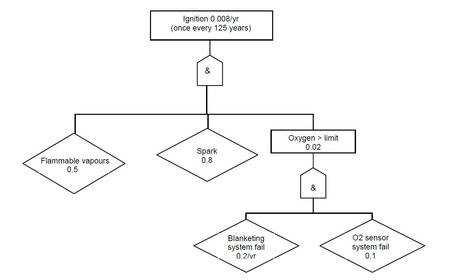
- (a) Draw a simple fault tree AND using the above data calculate the
- frequency of an ignition.
- (b) Outline TWO plant or process modifications that you would
- recommend to reduce the risk of an ignition in the vessel
- headspace. (4)
- To Calculate the frequency of ignition the oxygen system sensor failure (0.1) ust be multiplied by the gas blanket system failure ( 0.2) to give a probability of the oxygen > limit of 0.02.
- The flammable vapour (0.5) is multiplied by the spark (0.8) and the oxygen > limit ( 0.02) to give an overall probability of 0.5*0.8*0.02 = 0.008
- in fault tress if it is AND it is multiplied if it iis or it is added together.
-
-
- A small company formulating a range of chemical products operates from
- a site on which it employs about 50 staff. Although not falling within the
- scope of the Control of Major Accident Hazards Regulations 1999, the
- site poses a risk to employees, the neighbouring community and the
- environment
- (a) Outline the types of emergency procedure that a site of this
- nature may need to put in place in order to deal with incidents
- affecting the safety of site personnel.
- emergency procedures that should be implemented should include:-
- Procedures to deal with chemical spillage and / or release to atmosphere
- Fire evacuation
- full site evacuation
- first aid procedures
- Bomb Scare / threat
- Terror attack
- Sabotage both by external third party and by internal ( staff )
-
- (b) Identify the factors that should be considered during the development of a major incident procedure AND outline the arrangements that should be in place to ensure that such a procedure is effective
- The plan requires to be carefully developed with input from not only the key internal stakeholders but external stakeholders ( local emergency services and local authorities). Factors which would be required to be considered would include the nature of the chemicals, the potential for release and, the people who may be affected by any release and the environmental issues involved in any uncontrolled release, the current guidance and standards associated with the industry and the availability of the local emergency services being able to respond to an emergency or indeed be capable of responding to the emergency.
- From the plan it will identify the relevant risks / potential events that require a suitable procedure to be created to manage it each event / risk to ensure effective implementation of the plan. The effect that any incident may have on the local community must also be addressed with the potential of a briefing document being produced to provide to the local media and residents in the event of an incident.
- An incident control centre will need to be identified and dependant on the level of identified risk an off site control centre may need to be identified and arranged. With the these control centres the key and critical documentation must be readily available to all. These documents would include the Major incident plan / Business continuity plan, evacuation procedures, site plans, drainage plans list of key contacts, inventory list and location of chemical stores, call out procedures for off site staff, procedure for the provision of hiring / purchasing equipment.
- Within the incident control centre there would also be a requirement for critical equipment which would include appropriate methods of communications between key staff members or response team members, PPE to be able to deal with chemical spill / release. This PPE could be as specialised as Breathing apparatus which requires specialist training.
- To ensure that the major incident plan is suitable and effective it would need to be tested at regular intervals
-
- A manager in a manufacturing business calls out an engineer from their
- equipment supplier to repair and reset a piece of production equipment.
- After the repair there are difficulties in resetting the equipment. To help
- resolve this, the manager removes a fixed guard from the equipment to
- allow easier visibility and quicker adjustment. The engineer employed by
- the equipment supplier is subsequently injured on a piece of moving
- machinery that should have been protected by the guard.
- Possible breaches by manufacturing business
- HASAWA Section 2(1) - Failing to ensure the safety of their employees
- HASAWA Section 2(2)(a) failing to provide safe plant and equipment
- Additional breaches by the manufacturing business:-
- HASAWA Sections 3 & 4 as they failed to ensure the safety of non- employees , the equipment engineer, by removing the guard and subsequently permitting the use of unsafe equipment.
- HASAWA Section 7 / 8 as the manager removed the guard and in doing so interfered with something which was provided in the interest of safety.
- HASAWA Section 36 Due to the fact that the manager of the manufacturing business carried out a deliberate act in removing the guard and in turn placed both employees and non employees at risk.
- Possible breaches by Engineering business
- HASAWA Section 2(1) - Failing to ensure the safety of their employees
- HASAWA Section 2(2)(a) failing to provide safe plant and equipment
- HASAWA Section 7 As the engineer failed to take care of his own safety by working on equipment with the guard removed.
-
- (b) The manufacturing business is subsequently prosecuted under Section 3 of the Health and Safety at Work etc Act and it attempts to defend itself by blaming the acts of the manager about which it knew nothing. Explain, with legal reasons, whether this defence could be successful. Make reference to case law where appropriate.
- The defence would be unlikely due to Regulation 23 of the MHSWR where it clearly states that nothing in the relevant statutory provisions shall operate so as to afford an employer a defence in any criminal proceedings for a contravention of those provisions by reason of any act or default of an employee or someone appointed by the employer as per the ruling in R v British Steel PLC (1995) where British Steel were convicted due to the fact the senior managers ( controlling minds) of the business were not involved and could not demonstrate this.
- The previously successful defence based on of R V Nelson Group Services Maintenance Ltd (1998) where it was found that the employer had done all that was reasonably practicable in the controlling of their employees. Would not be appropriate as the provisions of the MHSWR were implemented after this ruling.
-
- An employee suffered a fractured skull when he fell three metres from
- storage racking as he was loading cartons onto a pallet held on the forks
- of a lift truck. A subsequent investigation found that the managers of the
- company were aware that it was common practice for employees to be
- lifted up on the forks of the vehicle and for them to climb up the outside of
- the racking.
- (a) Outline the legal actions that might be available to the injured
- person in a claim for compensation AND the tests that would
- have to be made for the actions to succeed.
- For the claim to be successful in regards to negligence, the claimant is required to be able to prove that a duty of care was owed to him and that this duty was breached, that his injuries occurred as a result of the breach and that the type of injury was reasonably foreseeable. In this case the employer had not done everything that he could as there was no safe system of work in place to carry out this activity. Previous cases with regards to the requirement of safe system of work include Wilson & Clyde coal V Wilson and Speed V Thomas swift.
- The claimant would also be able to pursue an action for the breach of statutory duty. The claimant would need to be able to prove that he was an employee acting the course of his employment and that the injury was of the type that the statute was intended to prevent. the claimant would also need to prove that a duty was placed on the defendant which was not met and that the injury sustained was as a direct cause of this duty not being met as per the ruling in Corn v Weirs glass (1960)
- As part of the action being pursued the claimant would need to demonstrate that the working at height regulations, the management of health and safety at work regulations and Provision and use of Work equipment regulations were breached and resulted in the injury.
-
- (b) Explain the meaning of ‘general’ and ‘special’ damages that may
- be awarded in the event of a successful claim AND give
- examples of the factors that are considered in calculating their
- value.
- General Damages are where no exact sum is calculable , are estimate based and are such things are loss of future income, pain and suffering, reduction in the claimant's quality of life as a result of the injury, lack of mobility, inability to continue to play sports / hobbies and interests.
- Special damages may be awarded where the exact sum is calculable such as
- itemised legal expenses, the loss of earnings prior to trial and the costs that have
- accrued in making alterations to property as a direct result of a disability resulting
- from the workplace accident.
- This part of the question was not well answered with only a few candidates able to
- explain the meaning of general and special damages. Some listed all possible
- damages which might be awarded without attempting to classify them
-
- (a) Outline the meaning of ‘skill-based’, ‘rule-based’ AND
- ‘knowledge-based’ behaviour.
- ‘skillbased’
- behaviour involves a low level, pre-programmed sequence of actions where
- employees carry out routine operations, often as though they were on ‘automatic pilot’.
- ‘Rule-based’ behaviour involves actions based on recognising patterns or situations
- and then selecting actions based on a learned set of rules. Finally,
- ‘knowledge-based’
- behaviour is involved at the higher problem-solving level, when there are no set rules
- and a decision on the appropriate action to be taken is based on knowledge of the
- system.
-
- (b)With reference to practical examples or actual incidents, explain how EACH of these types of operating behaviour can give rise to human error AND, in EACH case, explain how human error can be prevented.
- In
- the case of ‘skill-based’ behaviour, errors may arise if a similar routine is incorrectly
- selected, if there is interruption or inattention causing a stage in the operation to be
- omitted or repeated or if checks are not carried out to verify that the correct routine
- has been selected. Preventive measures would be directed at designing routines and
- controls so that they are distinct from each other, using feedback signals to warn
- when the wrong course of action is being taken, allowing adequate work breaks or job
- rotation to maintain attention and introducing training, competence assessment and a
- high level of supervision. Signals passed at danger on the railway may be a result of
- skill-based errors.
- ‘rule-based’ behaviour, errors may occur where, for example, the diagnosis is
- based only on previous experience or where sufficient training has not been given to
- enable employees to make an accurate diagnosis, where there is a tendency to apply
- the usual rule or solution even if it is inappropriate or where simply there is a failure to
- remember the rule that should be applied. Preventive measures include clear
- presentation of information, logical and easy to follow rule sets, systems designed to
- highlight infrequent or unusual events and the provision of training and competence
- assessment.
- Examples (if properly explained) could have included the Kegworth air
- crash, Piper Alpha or Three Mile Island
- In the case of ‘knowledge-based’ behaviour errors will occur if there is a lack of
- knowledge or inadequate understanding of the system, if there is insufficient time to
- carry out a proper diagnosis and if the problem is not properly thought through or
- evidence is ignored. Preventive measures would again involve training particularly in
- risk and hazard assessment, the provision of adequate resources in terms of
- information and time and the use of supervision and checking systems such as group
- or peer review.
- Flixborough and Port Ramsgate provide examples of this type of error.
- There were candidates who had difficulty in matching errors with the correct type of
- behaviour whilst others were unable to explain how human error might be prevented.
Information
- Description
- User has deleted their subject information Slide Set on Unit A past papers jan 2011, created by Deleted user on 07/02/2017.
- Created by
- Deleted user · Feb 2017
- Updated
- Feb 7, 2017
- Views
- 49
- History
-
- Created by Garry Lamond · Jan 5, 2016
- Copied by Garry Lamond · Jan 5, 2016
- Copied by Sajjad Idris · Feb 7, 2017
- Rating