
Mind map
2.1.4 The ultrastructure of eukaryotic cells: membrane-bound organelles

Map content
2.1.4 The ultrastructure of eukaryotic cells: membrane-bound organelles
Eukaryotic cells
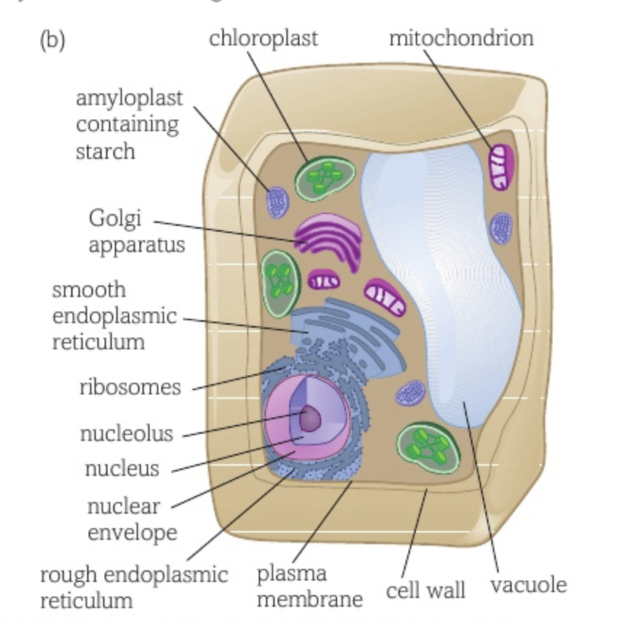
- All animal, plant, fungal and protoctist cells
- Means they have:
- Nucleus-> surrounded by nuclear envelope -> containing DNA wound into linear chromosomes
- Nucleolus inside nucleus-> contains RNA, chromosomes unwed and involved in making ribosomes
- Jelly like cytoplasm -> organelles are suspended
- Cytoskeleton= network of protein filaments within cytoplasm which move organelles around the cell, allows some cells to move and contraction of muscle cells
- Plasma membrane
- Membrane bound organelles
- Small vesicles
- Ribosomes-> without membranes where protein is assembled
Organelles
- Cells are the building blocks of living organisms
- Within cells there are various organelles with specific functions -> allows division of labour which means every cell carries out its functions efficiently
Membrane bound organelles
- Most organelles within eukaryotic cells are membrane bound= covered in a membrane
- This keeps organelles separate from the rest of the cell = discrete compartment
- ONLY eukaryotic cells have membrane bound organelles
- This keeps organelles separate from the rest of the cell = discrete compartment
- Electron microscopy enabled scientist to ascertain structures of these organelles by making and examining sections to build a 3D image
- Biochemistry research -> enabled scientists to find function of organelles
- Most organelles within eukaryotic cells are membrane bound= covered in a membrane
Nucleus
- Structure:
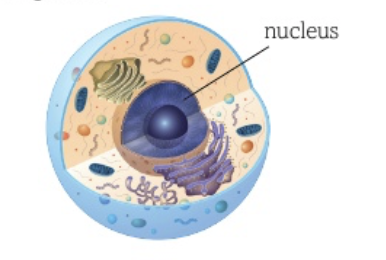
- Surrounded by a double membrane = nuclear envelope, which has pores
- Nucleolus (inside nucleus) does not have a membrane, contains RNA
- Genetic material= chromatin, consists of DNA wound around host one proteins. When cell isn't dividing chromatin spreads out, when cell is dividing chromatin condensed and coils into chromosomes. These make up nearly all the genome
- Nucleolus (inside nucleus) does not have a membrane, contains RNA
- Surrounded by a double membrane = nuclear envelope, which has pores
- Function:
- Nuclear envelope= separates contents of nucleus from the rest of the cell
- When outer and inner membranes fuse some dissolved substances and ribosomes can pass through
- Pores enable larger substances e.g. mRNA to leave and some e.g. steroid hormones to enter from cytoplasm
- Nucleolus= where ribosomes are made
- Chromosomes contain organisms genes
- In summary, the nucleus:
- Control centre of cell
- Stores organisms genome
- Transmits genetic info
- Provides instructions for protein synthesis
- Transmits genetic info
- Stores organisms genome
- Control centre of cell
- In summary, the nucleus:
- Chromosomes contain organisms genes
- Nucleolus= where ribosomes are made
- Pores enable larger substances e.g. mRNA to leave and some e.g. steroid hormones to enter from cytoplasm
- When outer and inner membranes fuse some dissolved substances and ribosomes can pass through
- Nuclear envelope= separates contents of nucleus from the rest of the cell
- Structure:
Endoplasmic reticulum
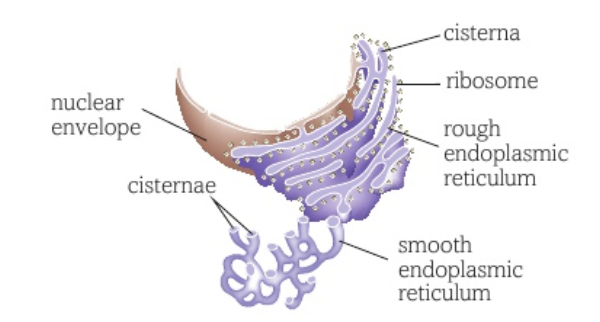
- A system of membranes, containing fluid filled cavities (cisternae) continuous with the nuclear membrane
- RER= rough endoplasmic reticulum
- Coated with ribosomes
- Function:
- RER is the intercellular transport system. Cisternae from channels for transporting substances around the cell
- Provides large SA for ribosomes= assemble amino acids into proteins. These proteins actively pass through the membrane into cistern and transported to Golgi apparatus for packing and modification
- RER is the intercellular transport system. Cisternae from channels for transporting substances around the cell
- SER= smooth endoplasmic reticulum
- Don't have ribosomes on its surface
- Function:
- SER contains enzymes that catalyse reactions for lipid metabolism. These include: synthesis of cholesterol, (phosphorus)lipids and steroid hormones
- Involved in absorption, synthesis and transport of lipids
- SER contains enzymes that catalyse reactions for lipid metabolism. These include: synthesis of cholesterol, (phosphorus)lipids and steroid hormones
- RER= rough endoplasmic reticulum
- A system of membranes, containing fluid filled cavities (cisternae) continuous with the nuclear membrane
Golgi apparatus
- Structure:
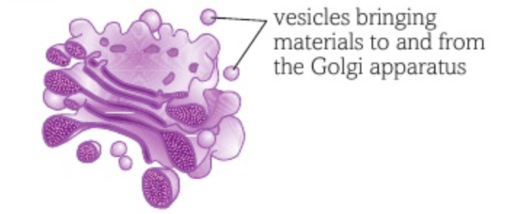
- Stack of membrane bound flattened sacs
- Secretory vesicles bring materials to and from Golgi apparatus
- Stack of membrane bound flattened sacs
- Function:
- Proteins are modified by: adding sugar to make glycoproteins, lipids to make lipoproteins and being folded into their 3D shape
- Proteins are packaged into vesicles that are pinched off and then stored in the cell or moved to plasma membrane to be incorporated or exported
- Proteins are modified by: adding sugar to make glycoproteins, lipids to make lipoproteins and being folded into their 3D shape
- Structure:
Mitochondria
- Structure:
- May be spherical, rod shaped or branched, 2-5um long
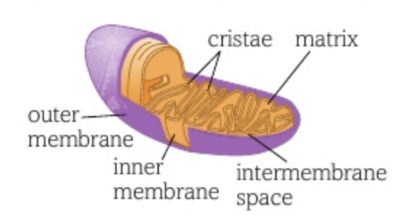
- Surrounded by 2 membranes= fluid filled space between. Inner membrane is highly folded into cristae
- Inner part of mitochondrion is a fluid filled matrix
- Surrounded by 2 membranes= fluid filled space between. Inner membrane is highly folded into cristae
- May be spherical, rod shaped or branched, 2-5um long
- Function:
- Site of ATP production during aerobic respiration
- Self replicating - can make more if needed
- Abundant in cells where much metabolic activity takes place e.g. synapses between neurones
- Self replicating - can make more if needed
- Site of ATP production during aerobic respiration
- Structure:
Chloroplasts
- Function:
- Site of photosynthesis
- First stage of photsynthesis= light energy is trapped by chlorophyll, used to make ATP= occurs in granum
- Second stage= H reduces CO2 using energy from ATP to make carbohydrates = occurs in stroma
- Chloroplasts are abundant in leaf cells especially palisade mesophyll layer
- Site of photosynthesis
- Structure:
- Large organelles, 4-10um long
- Found only in plants (SOME protoctists)
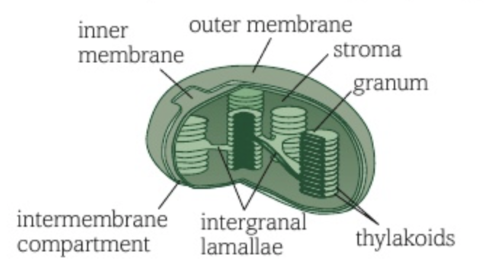
- Surrounded by double membrane. Inner membrane is continuous with stacks of flattened membrane sacs (thylakoids) which contain chlorophyll
- Each stack of thylakoids is a granum
- Fluid filled matrix= stroma
- Contains loops of DNA and starch grains
- Surrounded by double membrane. Inner membrane is continuous with stacks of flattened membrane sacs (thylakoids) which contain chlorophyll
- Found only in plants (SOME protoctists)
- Large organelles, 4-10um long
- Function:
Cilia and undulipodia
- Structure:
- Protrusions from the cell and surrounded by plasma membrane
- Each contain microtubules and are formed from centrioles
- Protrusions from the cell and surrounded by plasma membrane
- Function:
- Epithelial cells lining airways have many cilia which beat the mucus
- Cilium can act as an antenna as it contains receptors which allow cells to detect signals on immediate environment
- Only sperm have undulipodium which enables it to move
- Cilium can act as an antenna as it contains receptors which allow cells to detect signals on immediate environment
- Epithelial cells lining airways have many cilia which beat the mucus
- Structure:
Lysosomes
- Structure
- Small bags formed from the Golgi apparatus, each surrounded by a single membrane
- Contains powerful hydrolytic enzymes
- Abundant in phagocytic cells like neutrophils and macrophages which ingest pathogens
- Contains powerful hydrolytic enzymes
- Small bags formed from the Golgi apparatus, each surrounded by a single membrane
- Function:
- Keep powerful hydrolytic enzymes separate from the rest of the cell
- Can engulf old cell organelles and foreign matter, digest and return components for reuse
- Keep powerful hydrolytic enzymes separate from the rest of the cell
- Structure
Vacuole
- Structure:
- Surrounded by a membrane (tonoplast) and contains fluid
- Function:
- Only found in plant cells, Large permanent vacuole
- Filled with water and solute= maintains cell stability = when full it pushes against cell wall making the cell turgid
- If all plant cells are turgid it helps support the plant
- Filled with water and solute= maintains cell stability = when full it pushes against cell wall making the cell turgid
- Only found in plant cells, Large permanent vacuole
- Structure:
Images and files in the map
Information
- Description
- User has deleted their subject information Mind Map on 2.1.4 The ultrastructure of eukaryotic cells: membrane-bound organelles, created by Deleted user on 16/04/2017.
- Created by
- Deleted user · Apr 2017
- Updated
- Apr 16, 2017
- Views
- 46
- History
-
- Created by Aleena Sheraz · Mar 7, 2017
- Copied by Aleena Sheraz · Apr 16, 2017
- Rating