
Flashcards
126 - Bacterial Genetics
Cards in this deck (38)
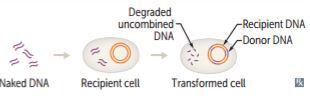
- 1What are competent bacteria able to bind and import?Short pieces of environmental naked bacterial chromosomal DNA (from bacterial cell lysis).
- 2The transfer and expression of newly transferred genes is called what?Transformation
- 3Transformation is a feature of many bacteria, especially what bacteria?A feature of many bacteria, especially S
pneumoniae, H influenzae type B, and
Neisseria
(Mnemonic - SHiN). - 4What DNA can be used for Transformation?Any DNA can be used.
- 5What would cause no transformation to be seen?Adding deoxyribonuclease to environment
will degrade naked DNA in medium leading to no transformation seen. - 6—Transformation
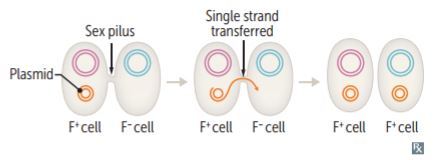
- 7F+ plasmid contains genes required for what?F+ plasmid contains genes required for sex pilus and conjugation.
- 8Bacteria without F+ plasmid are termed what?Bacteria without this plasmid
are termed F– - 9Explain F+ × F- ConjugationF+ plasmid contains genes required for sex pilus
and conjugation. Bacteria without this plasmid are termed F–. Sex pilus on F+ bacterium contacts F− bacterium. A single strand of plasmid DNA is transferred across the conjugal bridge (“mating bridge”). No transfer of chromosomal DNA. - 10—F+ × F- Conjugation
- 11—Hfr × F– Conjugation
- 12Explain the transfer of chromosomal DNA in F+ × F- ConjugationNo transfer
of chromosomal DNA. - 13In F+ × F– Conjugation, A single strand of what is transferred across the conjugal bridge (“mating bridge”)A single strand of plasmid DNA is transferred across the conjugal bridge (“mating bridge”)
- 14In F+ × F– Conjugation, A single strand of plasmid DNA is transferred across what?A single strand of plasmid DNA is transferred across the conjugal bridge (“mating bridge”)
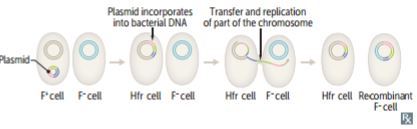
- 15In Hfr × F– Conjugation, F+ plasmid can become incorporated into what?F+ plasmid can become incorporated into bacterial chromosomal DNA, termed highfrequency recombination (Hfr) cell.
- 16In Hfr × F– Conjugation, there is transfer of what?Transfer of leading part of plasmid and a few flanking chromosomal genes.
- 17In Hfr × F– Conjugation, High-frequency recombination may do what?High-frequency recombination may integrate some of those bacterial genes
- 18In Hfr × F– Conjugation, what is the end result for the recipient cell?The recipient cell remains F–
but now may have new bacterial genes. - 19What is described below? Sex pilus on F+ bacterium contacts F− bacterium. A single strand of plasmid DNA is transferred across the conjugal bridge (“mating bridge”). No transfer of chromosomal DNA.F+ × F– Conjugation
- 20What is described below? Transfer of leading part of plasmid and a few flanking chromosomal genes. High-frequency recombination may integrate some of those bacterial genes. The recipient cell remains F– but now may have new bacterial genes.Hfr × F– Conjugation
- 21Generalized Transduction is what kind of event?A “packaging” event.
- 22Specialized Transduction is what kind of event?An “excision” event.
- 23In Generalized Transduction, what infects bacterium, leading to cleavage of bacterial DNA?Lytic phage infects bacterium, leading to cleavage of bacterial DNA.
- 24In Generalized Transduction, Lytic phage infects bacterium, leading to what?Lytic phage infects bacterium, leading to cleavage of bacterial DNA.
- 25In Generalized Transduction, what may happen to parts of bacterial chromosomal DNA?Parts of bacterial chromosomal DNA
may become packaged in phage capsid. - 26In Generalized Transduction, Parts of bacterial chromosomal DNA may become packaged in what?Parts of bacterial chromosomal DNA
may become packaged in phage capsid. - 27In Generalized Transduction, phage infects what? Resulting in what?Phage infects another bacterium, transferring these genes.
- 28—Generalized Transduction
A “packaging” event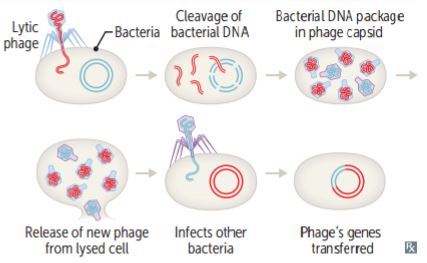
- 29—Specialized Transduction
An “excision” event.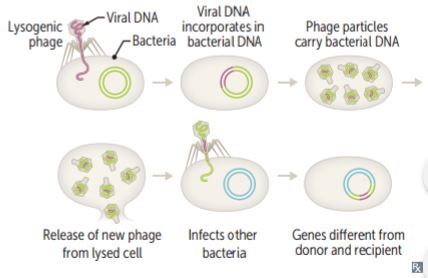
- 30In Specialized Transduction, Lysogenic phage infects what, and viral DNA incorporates into what?Lysogenic phage infects
bacterium; viral DNA incorporates into
bacterial chromosome. - 31In Specialized Transduction, When phage DNA is excised, what may be excised with it?When phage DNA is excised, flanking bacterial genes may be excised with it.
- 32In Specialized Transduction, DNA is packaged into what and can infect another bacterium?DNA is packaged into phage capsid and can infect another bacterium.
- 33In Specialized Transduction, Genes for what 5 bacterial toxins are encoded in a lysogenic phage?Group A strep erythrogenic toxin, Botulinum toxin, Cholera toxin, Diphtheria toxin, Shiga toxin.
(Mnemonic- ABCD'S) - 34Recall the image for Transformation
- 35Recall the image for F+ × F- Conjugation
- 36Recall the image for Hfr × F– Conjugation
- 37Recall the image for Generalized Transduction
- 38Recall the image for Specialized Transduction
Information
- Description
- User has deleted their subject information Flashcards on 126 - Bacterial Genetics, created by Deleted user on 15/05/2017.
- Created by
- Deleted user · May 2017
- Updated
- May 15, 2017
- Views
- 35
- History
-
- Created by Victoria Wright · May 11, 2017
- Copied by Victoria Wright · May 15, 2017
- Rating