
Flashcards
127 - Bacterial Genetics
Cards in this deck (46)
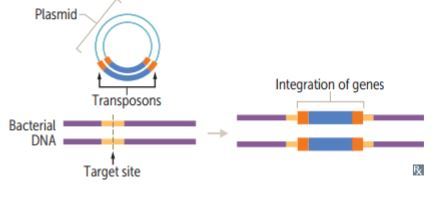
- 1Transposition Segment of DNA (eg, transposon) that can “jump” (excision and reintegration) from one location to another, can transfer genes from what to what and vice versa?Segment of DNA (eg, transposon) that can
“jump” (excision and reintegration) from
one location to another, can transfer genes
from plasmid to chromosome and vice versa. - 2Transposition When excision occurs, it may include some what, which can be incorporated into a plasmid and transferred to another bacterium?When excision occurs, may include some flanking chromosomal DNA, which can be incorporated into a plasmid and transferred to another bacterium (eg, vanA gene from vancomycin-resistant Enterococcus to S aureus).
- 3—Transposition
- 4Recall the image for Transposition
- 5What are examples of spore-forming bacteria?Bacillus anthracis - Anthrax
Bacillus cereus - Food poisoning
Clostridium botulinum - Botulism
Clostridium difficile - Pseudomembranous colitis
Clostridium perfringens - Gas gangrene
Clostridium tetani - Tetanus - 6Some bacteria can form spores - when?Some bacteria can form spores A at the end of the stationary phase when nutrients are limited
- 7Some bacteria can form spores at the end of the stationary phase when what are limited?Some bacteria can form spores at the end of the stationary phase when nutrients are limited.
- 8Spores are highly resistant to what?Spores are highly resistant to heat and
chemicals. - 9What do spores have in their core?Have dipicolinic acid in their core.
- 10What is the metabolic activity of spores?Have no metabolic activity
- 11What must be done to potentially kill spores?Must autoclave to potentially kill spores (as is done to surgical equipment) by steaming at 121°C for 15 minutes.
- 12Exotoxins or Endotoxin? Source: Certain species of gram ⊕ and gram ⊝ bacteriaExotoxins
- 13Exotoxins or Endotoxin? Source: Outer cell membrane of most gram ⊝ bacteriaEndotoxin
- 14Exotoxins or Endotoxin? Secreted from CellExotoxins
- 15Exotoxins or Endotoxin? Not secreted from cellEndotoxin
- 16Exotoxins or Endotoxin? Chemistry: PolypeptideExotoxins
- 17Exotoxins or Endotoxin? Chemistry: Lipid A component of LPS (structural part of bacteria; released when lysed)Endotoxin
- 18Exotoxins or Endotoxin? Location of genes: Plasmid or bacteriophageExotoxins
- 19Exotoxins or Endotoxin? Location of genes: Bacterial chromosomeEndotoxin
- 20Exotoxins or Endotoxin? Adverse effects: High (fatal dose on the order of 1 μg)Exotoxins
- 21Exotoxins or Endotoxin? Adverse effects: Low (fatal dose on the order of hundreds of micrograms)Endotoxin
- 22Exotoxins or Endotoxin? Clinical effects: Fever, shock (hypotension), DICEndotoxin
- 23Exotoxins or Endotoxin? Mode of action: Induces TNF, IL-1, and IL-6Endotoxin
- 24Exotoxins or Endotoxin? Antigenicty: Induces high-titer antibodies called antitoxinsExotoxins
- 25Exotoxins or Endotoxin? Antigenicty: Poorly antigenicEndotoxin
- 26Exotoxins or Endotoxin? Vaccines: Toxoids used as vaccinesExotoxins
- 27Exotoxins or Endotoxin? Vaccines: No toxoids formed and no vaccine availableEndotoxin
- 28Exotoxins or Endotoxin? Heat stability: Destroyed rapidly at 60°C (except staphylococcal enterotoxin and E coli heatstable toxin)Exotoxins
- 29Exotoxins or Endotoxin? Heat stability: Stable at 100°C for 1 hrEndotoxin
- 30Exotoxins or Endotoxin? Typical diseases: Tetanus, botulism, diphtheriaExotoxins
- 31Exotoxins or Endotoxin? Typical diseases: Meningococcemia; sepsis by gram ⊝ rodsEndotoxin
- 32What is the source of Exotoxins?Certain species of gram ⊕ and gram ⊝ bacteria
- 33What is the source of Endotoxins?Outer cell membrane of most gram ⊝ bacteria
- 34What is the chemistry of Exotoxins?Polypeptide
- 35What is the chemistry of Endotoxin?Lipid A component of LPS (structural part of bacteria; released when lysed)
- 36What is the location of genes for Exotoxins?Plasmid or bacteriophage
- 37What is the location of genes for Endotoxins?Bacterial chromosome
- 38What are the clinical effects of Endotoxin?Fever, shock (hypotension), DIC
- 39What is the mode of action for Endotoxins?Induces TNF, IL-1, and IL-6
- 40What is the antigenicity of Exotoxins?Induces high-titer antibodies called antitoxins
- 41What is the antigenicity of Endotoxins?Poorly antigenic
- 42What are the vaccines for Exotoxins?Toxoids used as vaccines
- 43What are the vaccines for Endotoxins?No toxoids formed and no vaccine available
- 44What is the heat stability of Exotoxins?Destroyed rapidly at 60°C (except staphylococcal enterotoxin and E coli heatstable toxin)
- 45What is the heat stability of Endotoxins?Stable at 100°C for 1 hr
- 46—
Information
- Description
- User has deleted their subject information Flashcards on 127 - Bacterial Genetics, created by Deleted user on 15/05/2017.
- Created by
- Deleted user · May 2017
- Updated
- May 15, 2017
- Views
- 27
- History
-
- Created by Victoria Wright · May 11, 2017
- Copied by Victoria Wright · May 15, 2017
- Rating