
Evolution of the Atomic Model
Slides in this set (5)
-
George Dalton's Atomic Theory (1807)
- George Dalton was the first person to propose an atomic theory. His model stated:
- All matter is made up of tiny hard spheres known as atoms.
- Atoms cannot be created or destroyed.
- Atoms cannot be broken down into smaller particles.
- All the atoms in an element are identical.
-
J.J. Thomson's Discovery of the Electron (1897)
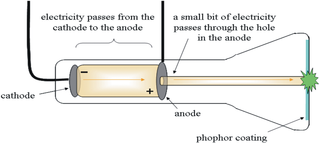
- Performed many experiments involving applying high voltages across vacuum tubes - which causes the tube to glow.
- These vacuum tubes are known as cathode ray tubes.
- Thomson measured the mass of the particles in these rays.
- Found that they were much lightest than the smallest atom and therefore must consist of sub-atomic particles .
-
Rutherford's Discovery of Nucleus (1909)
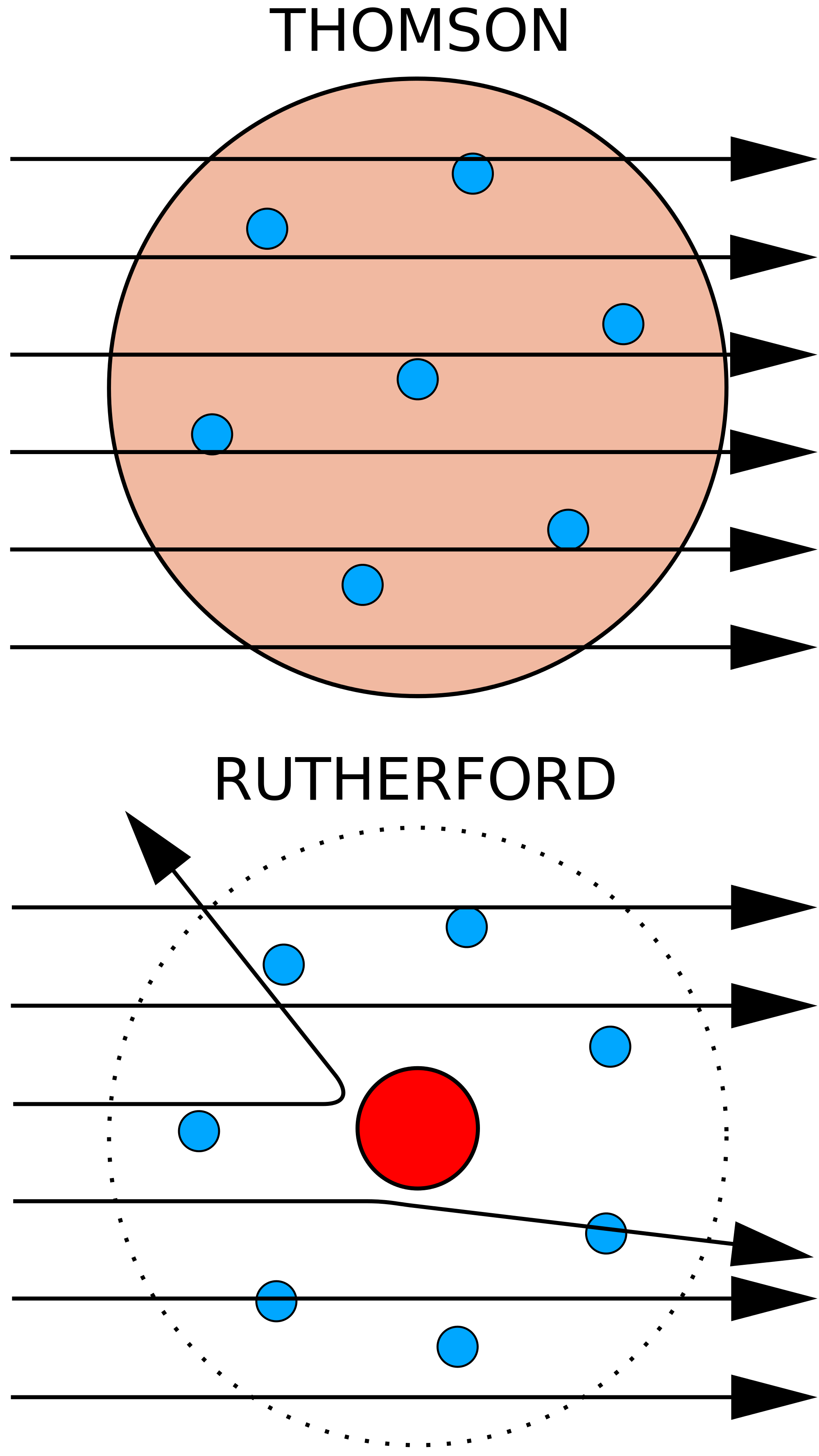
- Before Rutherford's experiments: The atom was considered using the Thomson's Plum Pudding Model - a sphere of positive charge with electrons distributed randomly in it .
- Rutherford's experiments: Involved bombarding gold foil with positively charged particles known as alpha particles.
- What the atomic model at the time would have predicted: Most of the alpha particles would be deflected straight back.
- What actually happened: Most of the alpha particles passed straight through, some were slightly deflected and a very small number bounced straight back.
- Rutherford's conclusions: The atom must be mostly empty space, with a positive central nucleus that contains most of the mass.
- This is sometimes known as the Geiger and Marsden experiment as it was carried out by two of Rutherford's assistant with those names.
-
Chadwick's Discovery of the Neutron (1932)
- James Chadwick discovered the neutron in 1932.
- This led to the discovery of isotopes and thus, nuclear energy.
-
- By firing neutrons at U-235, a nucleus can be split in a process called nuclear fission.
- Produces new elements and transfers large amounts of energy.
- This energy is used to produce electricity in nuclear power plants.

Information
- Description
- User has deleted their subject information Slide Set on Evolution of the Atomic Model, created by Deleted user on 29/06/2017.
- Created by
- Deleted user · Jun 2017
- Updated
- Jun 29, 2017
- Views
- 21
- History
-
- Created by Niamh Ryan · Jun 26, 2017
- Copied by Niamh Ryan · Jun 27, 2017
- Copied by Niamh Ryan · Jun 29, 2017
- Rating