
Notes
Titration
Content of the notes (1)
Page 1
Titration
Titrations are a useful method by which the exact equivalence point of a neutralisation reaction can be determined. They can also be used to accurately determine the concentration of either the acid or the base if the concentration of the other is known.
Tips:
To remember where the acid and base go, remember Base in the Basement, Acid in the Attic
Method:
1. Use the pipette to place \(25cm^3\) of base into the conical flask and add a few drops of indicator
2. Use a funnel to fill the burette with acid, adjusting with the tap until the bottom of the meniscus sits on the zero mark
3. Slowly add acid to the base, noting the point at which the indicator just changes colour. This is when the neutralisation has occured.
4. Repeat the above steps again, but this time slow down the rate at which acid is added close to the previously recorded neutralisation point. You may wish to add the acid dropwise around this point until the indicator changes colour.
5. Repeat the procedure again until you get two values within \(0.2cm^3\) of each other. This is the exact equivalence point.
Diagram:
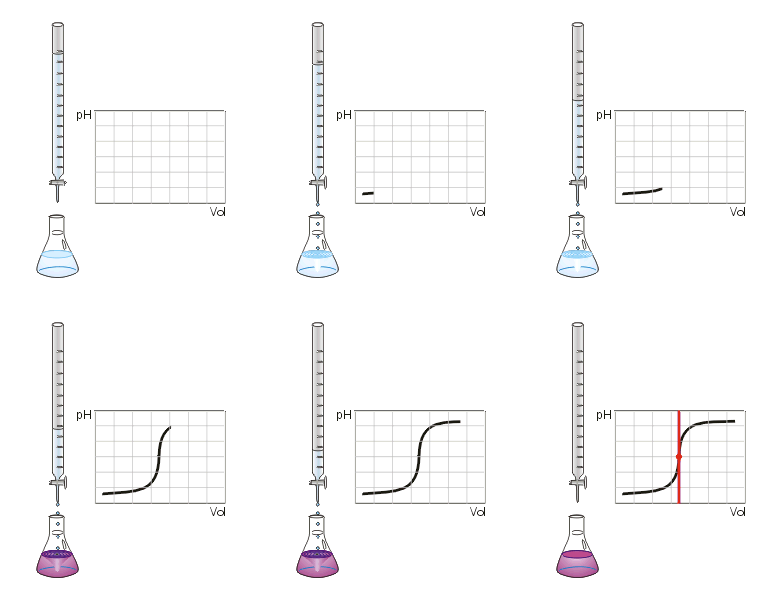
Calculations:
To determine the concentration of the acid:
\(\text{Concentration of alkali x}\frac{25cm^3}{\text{Volume of acid used, cm^3}}\)
Information
- Description
- User has deleted their subject information Note on Titration, created by Deleted user on 30/06/2017.
- Created by
- Deleted user · Jun 2017
- Updated
- Jun 30, 2017
- Views
- 13
- History
-
- Created by Niamh Ryan · Jun 28, 2017
- Copied by Niamh Ryan · Jun 30, 2017
- Rating