
Notes
Ionic Bonding and Compounds
Content of the notes (3)
Page 1
How does Ionic Bonding work?
Ionic bonding involves the complete transfer of electrons from one atom to another.
It is based around the principle of the Octet Rule. The Octet Rule states that it is most favourable for atoms to have a full outer shell. When an ionic bond is formed, one atom gives away one or more electrons so as to empty its outermost shell, and another atom accepts those electrons so that its outermost shell will be complete.
The diagram below shows the formation of sodium chloride, commonly known as table salt.
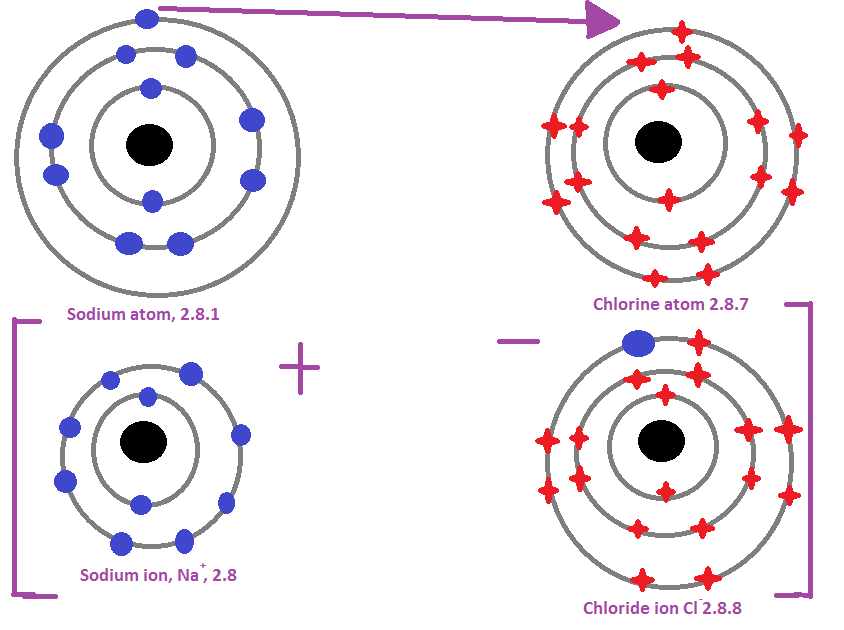
When they exist as individual atoms, both sodium and chlorine are in unfavourable arrangements. Sodium would like to get rid of its outermost electron, leaving its second shell as a full outer shell. Chlorine would like to gain one electron to make its third shell a full outer shell. Sodium donates its unwanted electron to chlorine. As sodium loses an electron, it becomes positively charged. Chlorine gains an electron, so it becomes a negatively charged ion called chloride. The two ions have opposite charges, so they attract each other. The strong electrostatic attraction between the ions is known as an ionic bond.
Page 2
More about Ionic Compounds
Ions with different charges
The sodium ion is \(Na^+\) so only one chloride ion is needed to stabilise it.
However, all the metals in Group 2 form 2+ ions and so need two halides to stabilise them.
For example, sodium will form \(NaCl\) but calcium will form \(CaCl_2\). The calcium atom gives away two electrons, one to each chlorine.
The formulae of some ions can be found in the flashcards section - it is important that you learn these off by heart.
Formation of lattices
Ionic compounds form lattices, known as giant ionic structures
Millions of ions are held together in a regular repeating structure
Ions in the sodium chloride lattice are arranged in a cubic structure - each ion has six nearest neighbours of the opposite charge
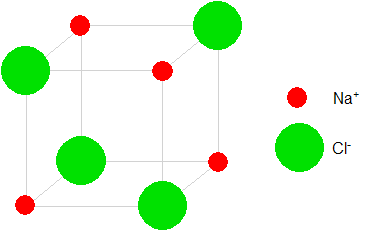
This is the unit cell of sodium chloride.
Page 3
Properties of Ionic Compounds
Form giant ionic structures - see previous page
High melting points - Large amount of energy needed to overcome strong attractive force between oppositely charged ions
Do not conduct electricity in their solid forms - Ions are held in fixed positions in lattice so movement of charge is not possible
Conduct electricity when they are molten or dissolved in water - Lattice breaks down and ions can move freely
Brittle - If a stress is applied to the crystal, the ion layers move slightly, bringing like charges in contact with each other. These repel each other, causing the crystal to fracture.
Information
- Description
- User has deleted their subject information Note on Ionic Bonding and Compounds, created by Deleted user on 06/07/2017.
- Created by
- Deleted user · Jul 2017
- Updated
- Jul 6, 2017
- Views
- 15
- History
-
- Created by Niamh Ryan · Jul 4, 2017
- Copied by Niamh Ryan · Jul 6, 2017
- Rating