
Notes
Germany 1890-1918
Content of the notes (4)
Page 1
Prussian Militarism
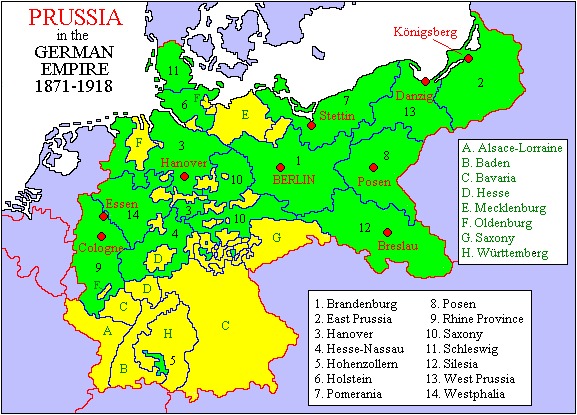
During the early 19th century, Prussia was the only German state that could match the power and influence of the Austrian empire. Austria was opposed to the idea of German unification, as they saw it as a threat to their own empire.
Throughout the 19th century, Prussia developed into the most militarised state in Europe. Then, Otto Von Bismarck the Prussian Chancellor took on the role of uniting all German states under Prussian rule.
Unification occurred after 1866
Bismarck wanted to build up Prussia's army
He needed money to do this; the Prussian parliament refused to allow money to be raised for Bismarck's military reforms
Bismarck ignored the Reichstag and collected the money for army reforms through general taxation
Bismarck protected German unification from outside influence through participating in wars and signing treaties
Bismarck's contribution to unification:
He made sure that army reforms took place
He isolated other countries by making them appear like aggressors
He made Prussia to be the defender of the German state structure and rights
Aggressive Prussian militarism had been regarded as the product of Bismarck's policies and old Prussian tradition, that represented both the Junker (members of the landed nobility in Prussia) class and big industrialists of the time. Wilhelm II took over the German state after forcing him to resign.
Page 2
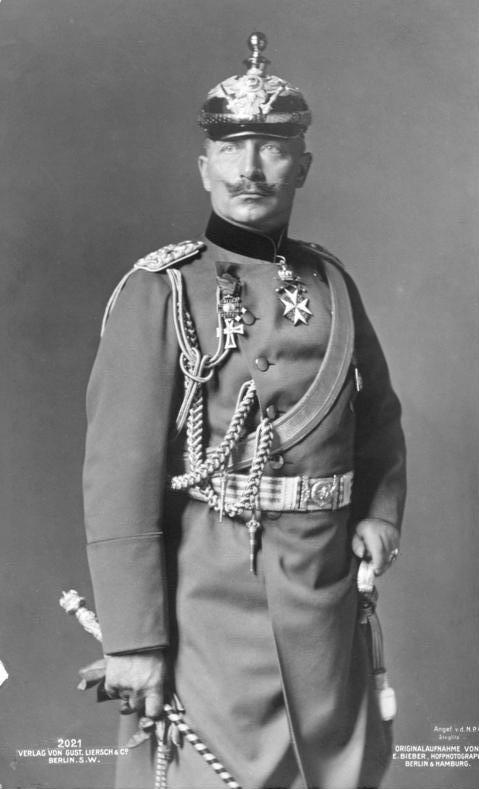
Kaiser Wilhelm II (1859-1941)
Kaiser Wilhelm II ruled Germany from 1888-1918, until his death in the Netherlands in 1941. Wilhelm played an important role in the development of the German state.
He was determined to expand Germany’s power
He set out to improve the country’s economy
He wanted to create a naval force that could rival that of the British Royal Navy
In 1890 Wilhelm forced the chancellor, Bismarck, to resign and he took control of Germany’s foreign and domestic policies
In 1918 rumours spread that Germany was planning to surrender to the Allies and questions arose regarding Wilhelm's hold on power
9 November 1918 - German chancellor, von Baden, preempted Wilhelm’s abdication and proclaimed publicly that Wilhelm had surrendered his powers.
Page 3
Politics, Economy and Society
Politics:
With the downfall of Bismarck, Germany was pursuing rapid social and economic modernisation, while avoiding any reforms of the authoritarian political system
Kaiser Wilhelm II led a highly militaristic regime in Germany
Political organisations, such as the Navy League and Farmers League, were all authoritarian in their politics and aggressive in expansionist foreign policy
Prussia's Junker, military and bureaucratic elites stood in firm opposition to any democratisation of the electoral system
Reform to democracy came about under the Reich after World War One
Some historians argue Wilhelm II was driven to pursue an aggressive foreign policy in order to gain support from agrarian and middles classes in order that these classes might oppose the Social Democrats
Socialism:
By 1890, the Social democrats were growing in numbers received more seats than any other party
With each election going into the 20th century, the Social democrats grew in numbers
The Socialist's were the strongest party in 1912; able to win some improvements in living conditions for working-class Germans
Rise in membership from 384,327 in 1905/06 to 1,085,905 in 1913/14
1913 - Social democrat parliamentarians' votes helped to bring in new tax laws affecting the wealthy, which were necessary due to the increase in military spending
Economy and society:
Speed of industrial maturity after 1890 was substantial
1895-1907 - there was a doubling of the number of workers in machine building
There was also a huge drop in the number of people emigrating from Germany
The application of intensive agricultural techniques led to the value of farm products doubling and a sharp decline in the rural population
40% of Germans lived in rural areas in 1910
The German working class grew rapidly in the late 19th century and early 20th century
Total union membership reached 3.7 million in 1912; 2.5 million were associated with socialist unions
German factories were also larger and more modern than those of Britain and France; these were in the industrial regions of Berlin and the Ruhr valley
Page 4
The Naval Laws
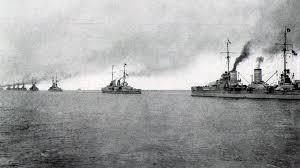
These were five separate laws passed by the German Empire in 1898, 1900, 1906, 1908 and 1912.
The aim was to have a navy capable of competing with the Royal Navy of the United Kingdom
The First Naval Law, introduced in 1897, outlined the composition of fleet by vessels and number of shops to be constructed by 1904
It authorised a fixed number of battleships that could not be altered by parliamentary vote
The law passed in 1898 was opposed by the Conservative Party and Social Democratic Party, who were against spending vast amounts of money on naval warfare
In the lead up to World War One, more funding was pumped into the German army
In 1911, the Navy budget had been 54% of the army budget
These naval laws prepared Germany for war, while producing mass amounts of employment
Information
- Description
- User has deleted their subject information Note on Germany 1890-1918, created by Deleted user on 11/07/2017.
- Created by
- Deleted user · Jul 2017
- Updated
- Jul 11, 2017
- Views
- 268
- History
-
- Created by Andrew Burke · Jul 6, 2017
- Copied by Andrew Burke · Jul 11, 2017
- Rating