
Notes
Calorimetry (Eduqas Chem, AQA CHem, OCR B Chem)
Content of the notes (2)
Page 1
Introduction to Calorimetry
Calorimetry is a technique used to compare the different amounts of heat released by substances when they are burnt.
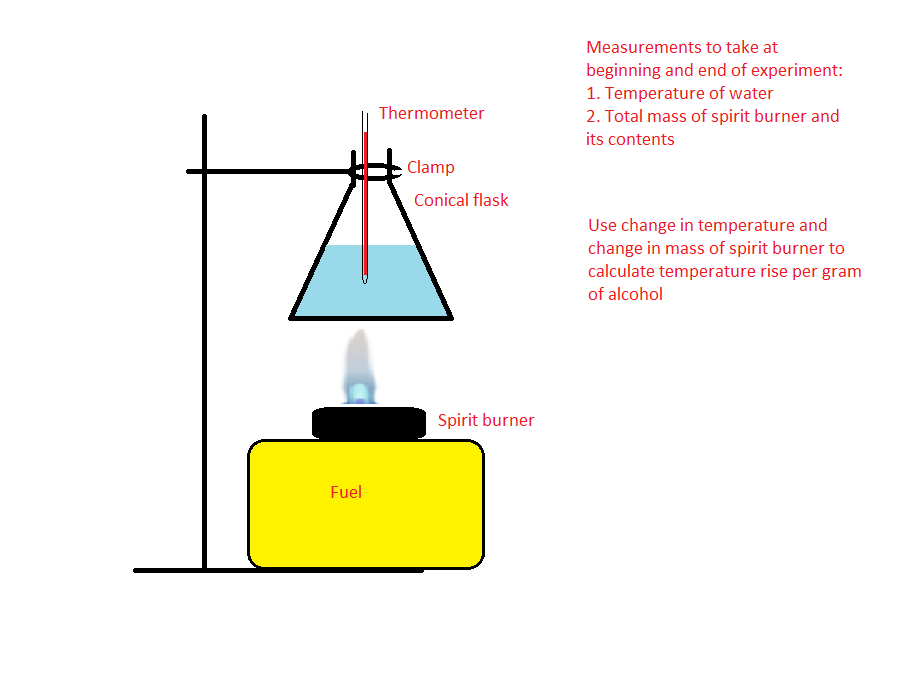
It involves measuring the temperature change in a glass or metal container of water.
Energy is usually measured in joules(J), but can also be measured in calories.
\(4.184cal = 1J\)
(You do not need to remember this conversion factor)
Heat capacity: The amount of energy required to change the temperature of an object by 1 degree.
Therefore, if we know the heat capacity of the water and container, and we measure its temperature change, we can calculate the energy given out by burning a substance.
\(c\times \Delta \Theta = \text{Energy change}\)
\(c\) is the heat capacity of the water and its container
\(\Delta \Theta\) (Pronounced 'del-ta thee-ta') Temperature change of the water, measured in degrees
The energy released by the substance when it is burnt can then be quoted in kJ or calories for a given mass or amount of
substance, eg calories per gram, kJ per mole or kJ per gram.
Energy released by a Chemical Reaction
The amount of energy released or absorbed by a chemical reaction in solution can be calculated from the measured temperature change of the
solution when the reagents are mixed in an insulated container. This method can be used for reactions of solids with water or for neutralisation reactions.
Page 2
Energy released when burning a fuel
Information
- Description
- User has deleted their subject information Note on Calorimetry (Eduqas Chem, AQA CHem, OCR B Chem), created by Deleted user on 24/07/2017.
- Created by
- Deleted user · Jul 2017
- Updated
- Jul 24, 2017
- Views
- 32
- History
-
- Created by Niamh Ryan · Jul 21, 2017
- Copied by Niamh Ryan · Jul 24, 2017
- Rating