
Religion and Crime
Slides in this set (5)
-
- From c.1500 to c.1700, crime was viewed in a similar way to how it was in the Middle Ages. However, with the changes that occurred in religion across Europe, new crimes arose regarding beliefs and activities within religions. Europe was unstable and religious conflict was rampant at this time. This stems from events, such as Martin Luther (German priest) nailing the 95 theses to the church in Wittenberg, that complained about the corruption of the Catholic Church.
- People who followed the claims of Luther became known as Protestants. Protestantism began to expand across Europe as people called for a reform of the Catholic Church. This period of history is called the Reformation.
- The problem in Early Modern England, during the 16th and 17th centuries, was monarchs at different times were committed to either Catholicism or Protestantism. Whatever religion a monarch chose the subjects were expected to follow their lead. With the changes in religion, there came changes in law. The monarch had absolute power in deciding what consisted of criminal activity, therefore, the definition of crime altered as the person on the throne changed. Everyday religious activities of Protestants and Catholics were at various points classified as criminal acts.
-
- This was one of the most serious crimes attached to religious changes at the time. Why was heresy so bad a crime to commit?
- Heresy was seen both a crime against the institution of the Church and an offence towards God. Those who committed heresy were labelled heretics. They were seen as dangerous people as their false beliefs might affect other people and lead them towards acts of heresy also.
- Punishment:
- This is the worst part of heretical crime; being burned at the stake. People were tied to a wooden post and a fire was lit beneath them. Not everyone who was accused of heresy was punished in this manner. Moreover, most people took the chance to recant (public declaration that you have changed your religious beliefs). After this, they had to take wooden sticks to the place they would have been burned. Then, the sticks were burned to symbolise the seriousness of the crime.
-
- Treason was when someone challenged the authority of the monarch in power. In the early modern period, it became connected with the concept of heresy as all monarchs after Henry VIII were the head of the English Church.
- Therefore, if someone challenged the ruler's authority as head of the church they would be committing treason.

-
The Puritans - Early Modern Saints
- Oliver Cromwell (Lord Protector) governed England from 1653-1658. He led the parliamentary forces to victory in the English Civil War and took over after the execution of Charles I.
- Cromwell was seen as a radical Protestant, a follower of the Puritan tradition (seen as excessively strict regarding religious and moral matters). Cromwell wanted people to live pure lives and follow simple forms of religious doctrine and worship.
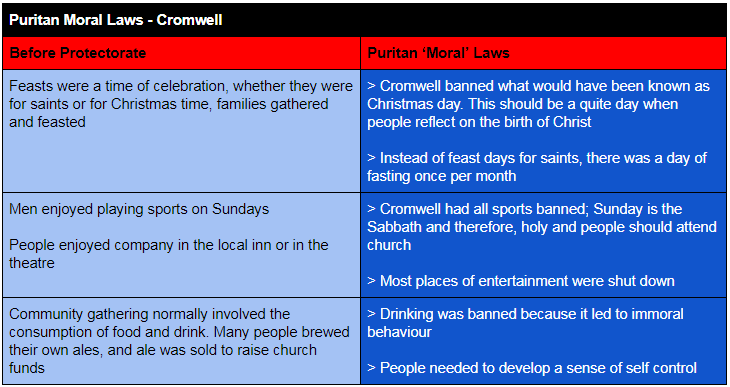
- Under Cromwell's reign some restrictions came in terms of activities and entertainments in the 17th century. The demonstrates the central role that government has in classifying crime. Laws passed under the Protectorate banned and criminalised very ordinary acts (see next slide). Once the Protectorate was over the banned activities became legal again.
-
The Puritans - Early Modern Saints
Information
- Description
- User has deleted their subject information Slide Set on Religion and Crime, created by Deleted user on 09/08/2017.
- Created by
- Deleted user · Aug 2017
- Updated
- Aug 9, 2017
- Views
- 22
- History
-
- Created by Andrew Burke · Aug 3, 2017
- Copied by Andrew Burke · Aug 9, 2017
- Rating