
Notes
Law Enforcement and Punishment
Content of the notes (5)
Page 1
Town Life - Law Enforcement
As we already know, the growth of towns during the 16th and 17th century brought about changes regarding crime. Additionally, communities and authorities in towns needed to find new means of enforcing laws, as previous methods became ineffective. However, the locals of villages and towns were expected to take the lead in taking down suspected criminals.
The population of England from 1500 to 1700 increased from around 2.5 million to between 5-6 million. Urban areas became more populated, for example, London's population reached roughly 600,000 in 1700. In these bigger urban areas, community bonds were weaker and less people knew each other. Crimes, like theft and fraud, became very prevalent as more valuable goods passed through towns.
Moreover, greater rural populations moved to the towns unable to support themselves. Increasing numbers of people turned to a life of crime.
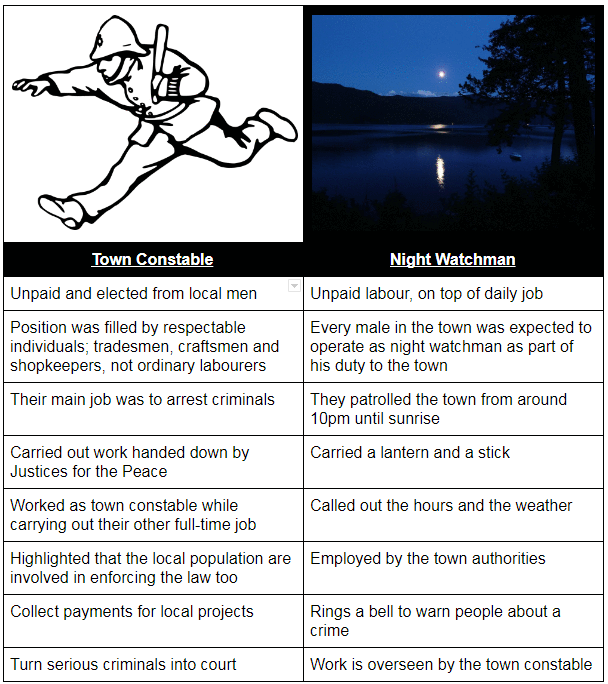
Town Constables and Night Watchman:
Constables and night watchmen were the brave souls who attempted to tackle growing crime rates. Law enforcement during the early modern period was not organised on a national scale, therefore, the quality of enforcement varied from town to town. Wealthy members of society were able to collectively organise and hire armed guards to protect them and their property (early steps of professionally paid police).
Page 2
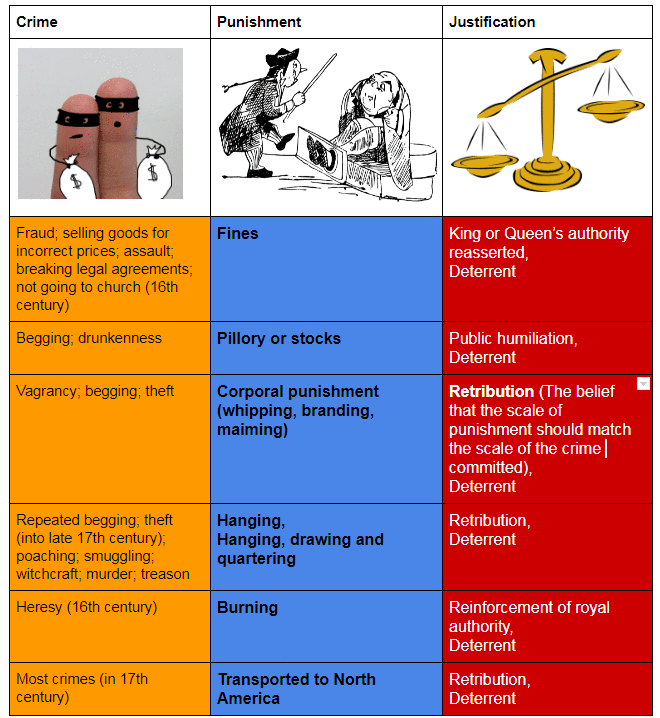
Early Modern Punishment
Many of the punishments that existed in the Middle Ages carried over to the early modern period. The emphasis of punishment was still deterrence and retribution. In the late 17th century, as seen below, some new punishments surfaced.
Page 3
Early Prison System
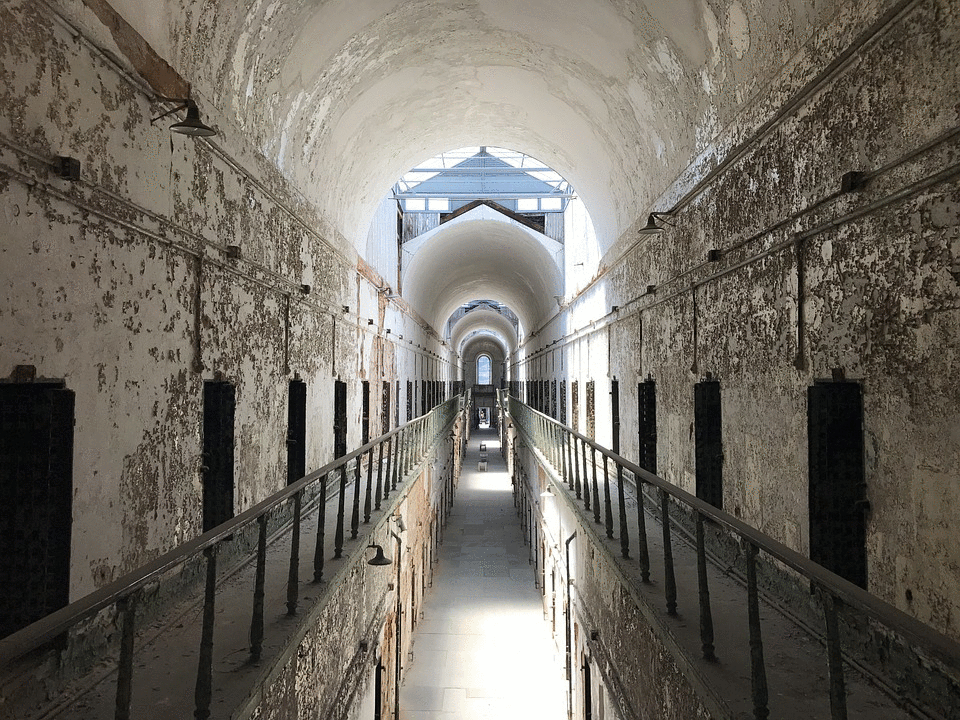
In the 16th century, prisons were seldom used for punishment purposes. Prisons acted as a waiting place before people stood trial or received there punishment. They often were used to store petty criminals, such as vagabonds, drunks and disorderly offenders. Moreover, the first prisons were just a secure room in a local castle of gatehouse (a building forming a gateway to the entrance of the town with a number of rooms).
Prisons were in very poor condition. There was sanitation problems and disease spread easily between people. People who were held in prisons had to pay for food and basic needs, if they did not they would have to do without.
Moreover, all prisoners were housed in the same place; petty criminals with serious criminals. Serious criminals influenced petty criminals into pursuing a life of crime.
In 1556, the first purposeful prison opened in London. This was known as Bridewell prison:
Utilised to punish poor people who broke the law
Housed poor, orphan children
Inmates had to take part in 'hard labour' to pay for their stay
Page 4
Punishment
The 'Bloody Code':
This is the name given to a series of cruel laws that were introduced from 1500-1750 that carried the death penalty with them. The types of crimes that carried the death penalty with them are known as capital crimes. In 1688, there was 50 capital crimes in England. This was a severe punishment for minor crimes like poaching rabbits or fish for food.
Execution took place in public for these crimes to act as a strong form of deterrence
The main reason for increasing capital crimes was to cope with increasing crime rates
The 'Bloody Code' system was ultimately flawed:
People often committed a crime out desperation e.g. a mother trying to feed her kids did not think about the consequences of stealing food
Penalties were severe, but execution was not always implemented. It was possible for criminals to be pardoned (does not receive punishment for a crime they committed), if they could prove that they were a good person.
The opportunity of being pardoned made the point of the Bloody Code uncertain
As time went on the more crimes were added to the capital crimes list and this began to reveal the limitations of the Bloody Code. Interestingly, women were able to often avoid the death penalty. A woman could claim she was pregnant and then receive an examination from a doctor. If she was deemed pregnant the punishment would be delayed until after the birth of the child. After the birth, women were often commuted of the previous punishment or even pardoned.

Page 5
Transportation to America
Furthermore, during his reign, James I introduced transportation to North America as a new form of punishment. Prisoners who were brought over to America were they carried out tough manual labour for a certain period of time. Those who were transported over normally served for a time period of fourteen years. Those who had committed less severe crimes served for a period of seven years.
When it came to the end of the term of service, people often did not have the money to return to home and spent the rest of their lives away from England. The question is why did James I introduced such a policy:
An effective option for deterrence
England wanted permanent colonies in North America this time - criminals populated and worked the land in these colonies
The country lacked an extensive prison system
Rehabilitation (helping individuals return to normal pattern of life after crime) - criminals had a chance to reflect on their past far away from home
Criminals were far away from the conditions that drew them to a life of crime in the first place
Living in North America would be a new start to a life free of crime
Many historians estimate roughly between 50,000-80,000 people were transported to America up until 1770. Men, women and children all made their way across. Further, James I during his reign allowed the arrest of vagabond children in London in order for them to be sent to North America. The children sent over were termed 'duty boys' (girls were sent over too). Authorities believed children could begin a new life, however, many of them died on the journey over or when attempting to settle into colonies.

Information
- Description
- User has deleted their subject information Note on Law Enforcement and Punishment, created by Deleted user on 09/08/2017.
- Created by
- Deleted user · Aug 2017
- Updated
- Aug 9, 2017
- Views
- 21
- History
-
- Created by Andrew Burke · Aug 4, 2017
- Copied by Andrew Burke · Aug 9, 2017
- Copied by Andrew Burke · Aug 9, 2017
- Rating