
Notes
Hot Desert Landforms
Content of the notes (14)
Page 1
Aeolian Erosion - Deflation Hollows
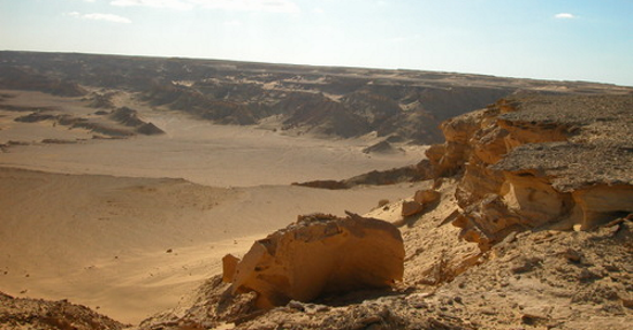
Deflation hollows are depressions made in sand or light soil by strong aeolian erosion.
The removal of particles creates a depression in the surface.
These features can form around desert plants or around rock structures as they anchor sediment.
Example: Qattara Depression, Egypt
Page 2
Aeolian Erosion - Desert Pavements
A desert pavement is a desert surface covered with closely packed, angular rocks and sediment.
These form due to the gradual removal of finer sand and silt, leaving the larger clasts behind.
The larger clasts are shaken into place through the forces of rain, wind, gravity and thermal expansion.
Desert pavement surfaces are often coated with desert varnish, a dark brown, sometimes shiny coating that contains clay minerals.

Page 3
Aeolian Erosion - Ventifacts
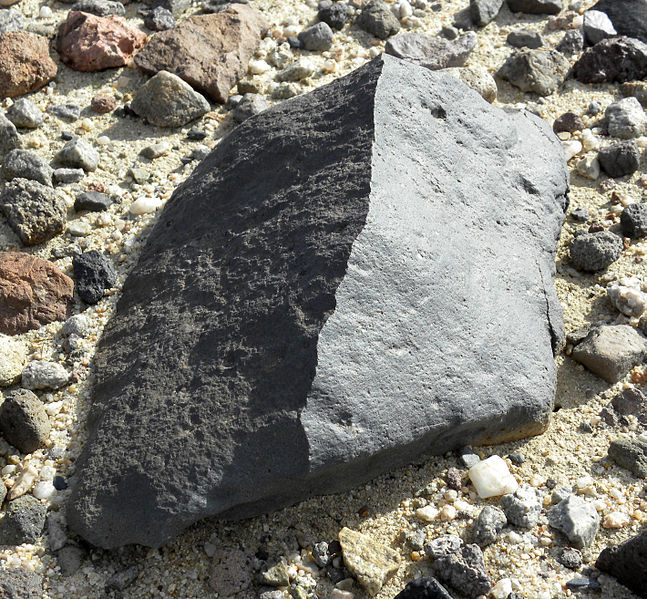
A ventifact is a stone shaped by the erosive action of wind-blown sand.
Ventifacts are typically angular on one side with scratches and grooves from being abraded by sand.
These features occur where there is a steady supply of sand and strong winds.

Page 4
Aeolian Erosion - Yardangs
Yardangs form where weak rock lies beside strong rock.
Wind abrasion concentrates on weaker rock; leaving harder material upstanding.
Yardangs are elongated features, typically three or more times longer than wide.
Yardangs form where there are uni-directional winds.
The eroded area between yardangs is called a trough.

Page 5
Aeolian Erosion - Zeugen
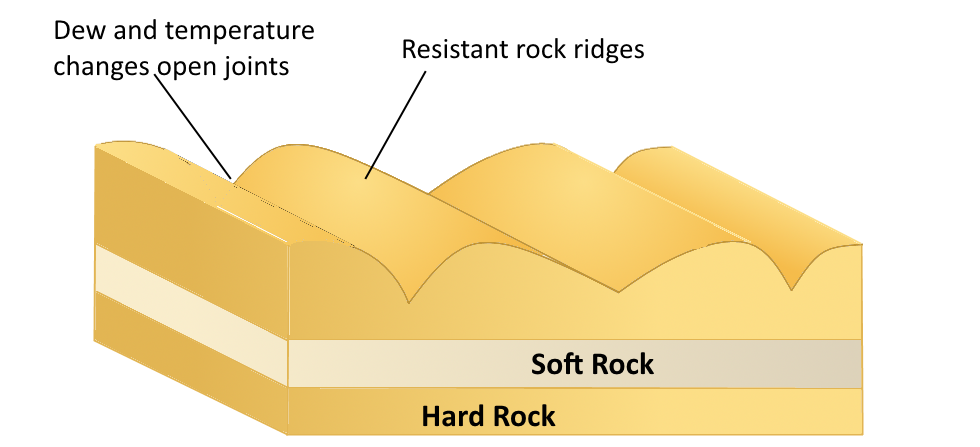
Zeugen (singular: zeuge) are parallel, flat-topped ridges of hard rock.
Zeugen form where there are horizontal bands of hard and soft rock.
They form when joins in hard rock are opened by weathering and enlarged by abrasion.
Zeugen can be up to 30m high and can fall if they become unsupported.
Page 6
Aeolian Erosion - Pedestal Rocks
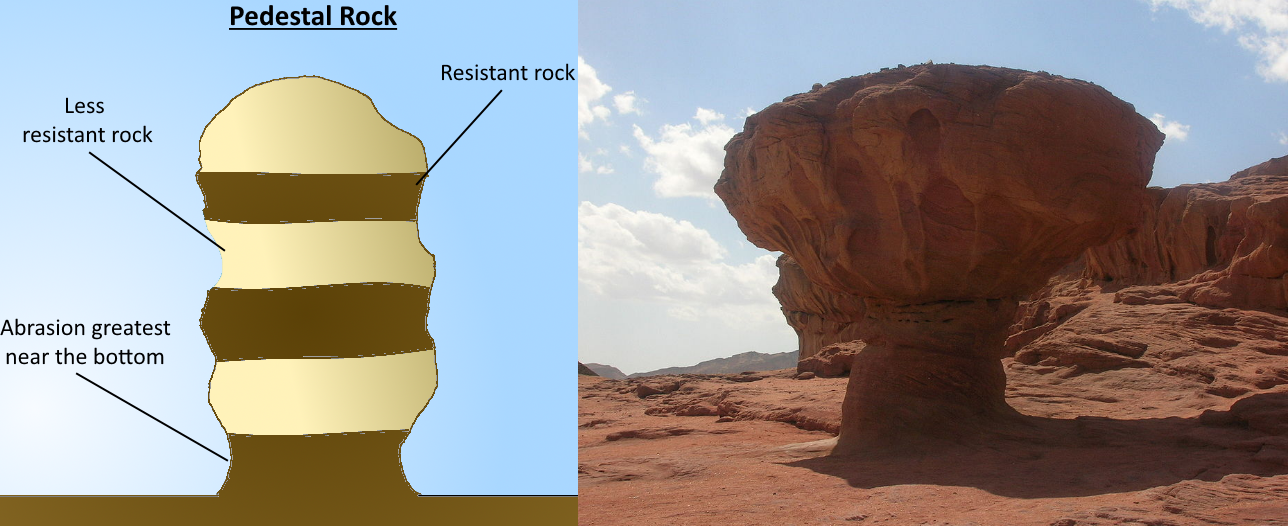
A pedestal rock is a type of isolated zeuge; a mushroom-shaped rock that is undercut at the base. They are also called mushroom rocks due to their shape.
These form when the wind erodes stratified rock into pedestals.
Wind erosion generally concentrates a few feet over the ground - wind speeds increase with height, but sediment load reduces.
This means that the combination of highest sediment loads and fastest wind speed exist a few feet over the ground, leading to the characteristic narrowing of the bottom of the pedestal rock.
Page 7
Aeolian Erosion - Inselbergs
An inselberg is an isolated rock hill that rises abruptly from a gently sloping or virtually level surrounding plain.
If the inselberg is dome-shaped and formed from granite or gneiss, it can also be called a bornhardt, though not all bornhardts are inselbergs.
Wind attacks the original surface leaving round-topped inselbergs. The material removed has a deep-seated ‘decay’ origin and may display extensive subsurface weathering.

Page 8
Aeolian Deposition - Sand Dunes
A sand dune is a hill made by the wind on the coast or in a desert. There are several different types of sand dune:
Barchan Dune:
Barchan dunes are crescent shaped and form when the wind blows in one direction only.
The slipface is on the dune's concave side.
Barchan dunes have an angle of repose of 34°.
Accumulations of sand build into mounds and ridges, they become a dune when the slip face is about 30 cm high.
Barchans are active dunes, meaning that they migrate in the direction of the wind.
Linear Dune:
Linear dunes are generally straight or slightly sinuous in shape.
They are mostly found in sets and can be up to 160km long.
They form in bi-directional wind regimes where wind directions converge.
Star Dune:
Star dunes are pyramidal sand mounds with slipfaces on three or more arms that radiate from the high center of the mound.
They occur in areas that have wind blowing in multiple directions.
Star dunes grow upward rather than laterally.
Transverse/Barchanoid Dune:
Transverse dunes are large, symmetrical, elongated dunes that form at right angles to the prevailing wind direction.
Transverse dunes have a gently sloping windward side and a steeply sloping leeward side.
They generally form in areas of sparse vegetation and abundant sand.
They can often reach over 100m in height.

Page 9
Features formed by Water - Wadis
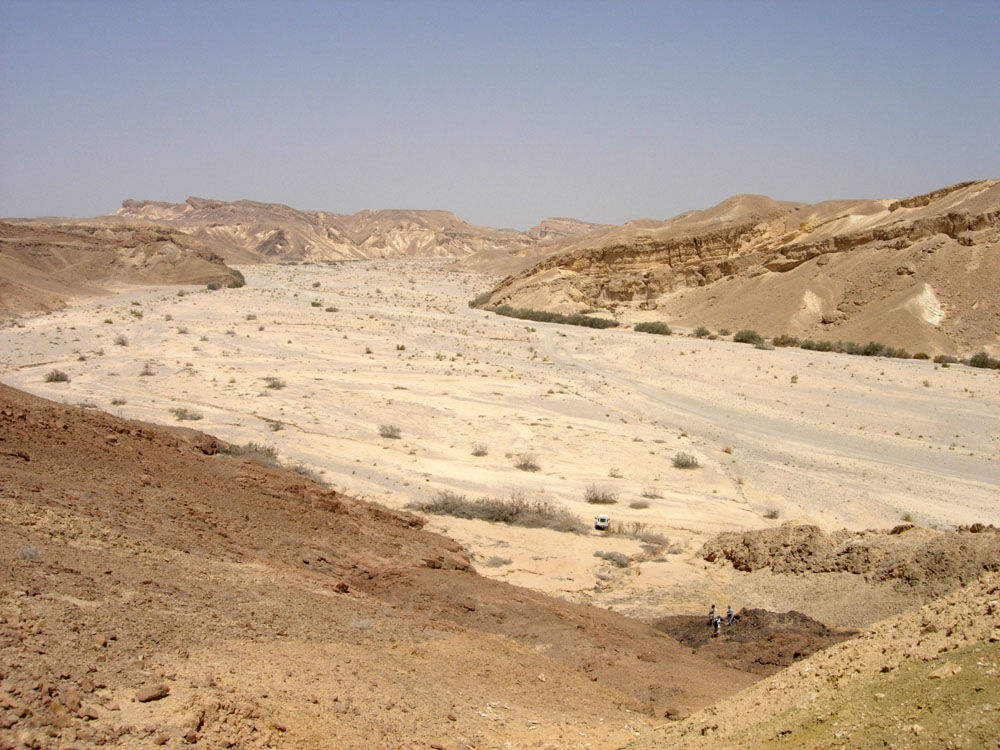
A wadi is a dry riverbed that only contains water during heavy rainfall.
Wadis are located on the gently sloping, nearly flat parts of deserts.
Wadis usually have braided stream patterns because of the deficiency of water and abundance of sediment.
Wadis fill quickly during flash floods.
Page 10
Features formed by Water - Pediments
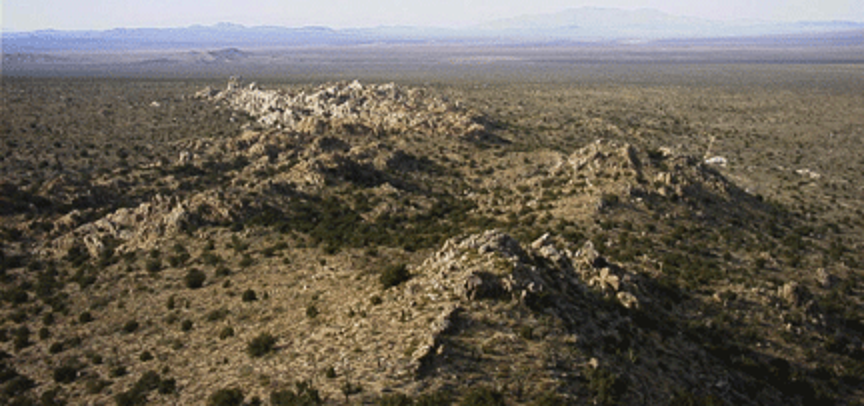
A pediment is a very gently sloping, inclined bedrock surface.
These develop when sheets of running water wash over raised rock in intense rainfall events.
These usually form at the base of a cliff or mountain.
The angle of a pediment’s slope is generally from 0.5° to 7°.
Page 11
Features formed by Water - Playas
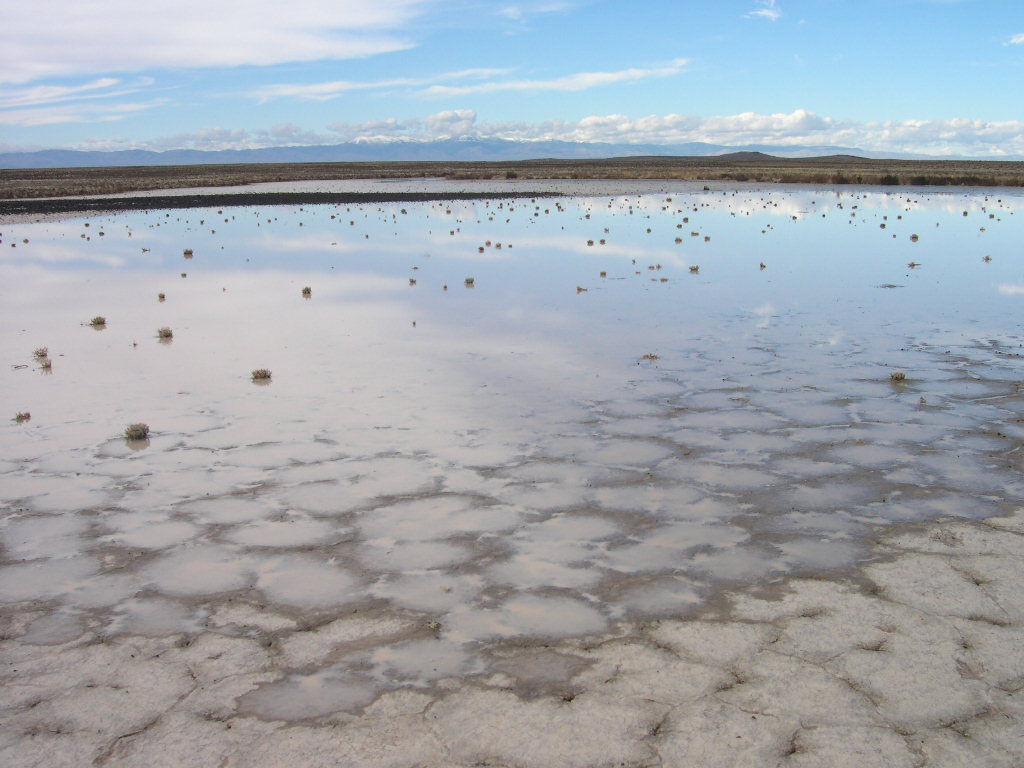
Playas are areas of very dry, flat land that are found below the sea level. They form when evaporation from lakes exceeds precipitation.
During the dry season the surface of the lake is usually hard and rough, where as in the rainy season it gets wet and soft.
Rapid evaporation in playas leads to a buildup of salt.
A famous example is The Racetrack Playa in California.
Page 12
Features formed by Water - Bajadas (Bahadas)
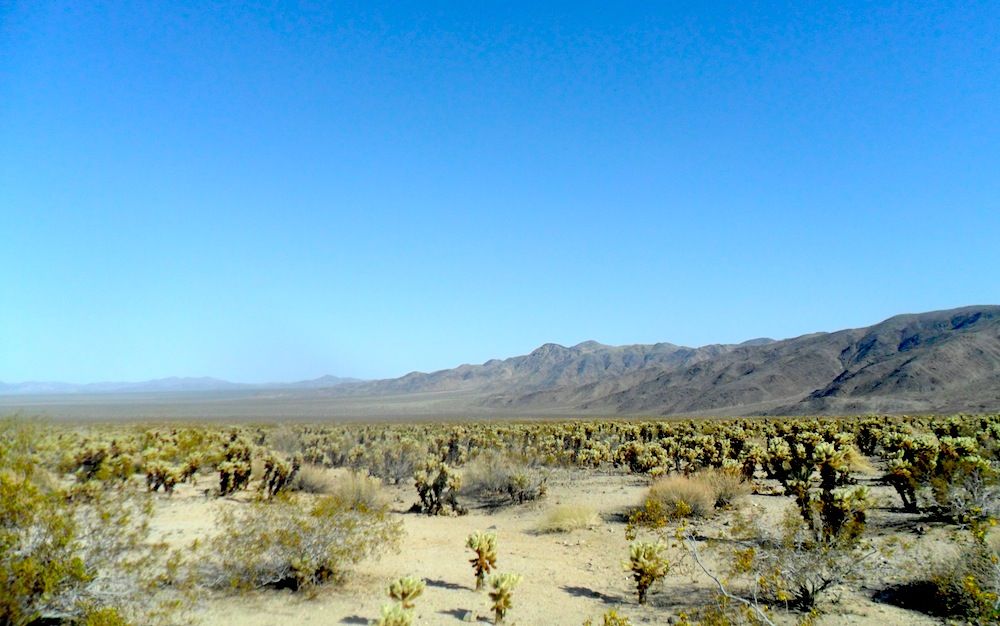
A bajada is an alluvial plain formed at the base of a mountain by the coalescing of several alluvial fans.
Bajadas frequently contain playa lakes.
Deposition after a flash flood is the most important source of sediment in the formation of bajadas.
Some of the material from the bajada can wash forward over pediments, levelling the landscape with unconsolidated deposits.
Page 13
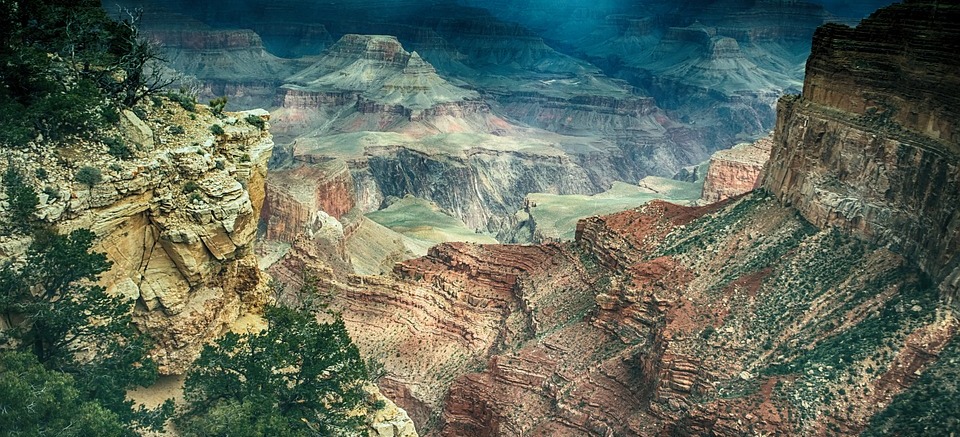
Features formed by Water - Canyons
A canyon is a deep cleft between escarpments or cliffs resulting from weathering and the erosive activity of a river.
Canyons are usually dry due to the high levels of evaporation.
The cliffs in the canyon form as they are more resistant to erosion.
The most famous example of a canyon is the Grand Canyon in Arizona, USA.
Page 14
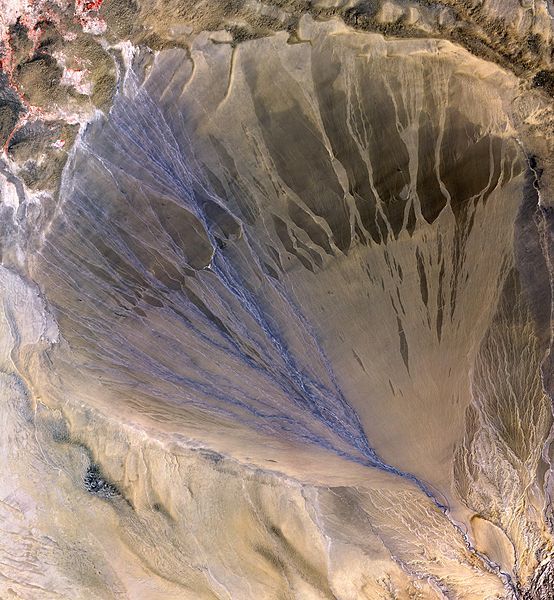
Features formed by Water - Alluvial Fans
An alluvial fan is a fan-shaped deposit of sediment built up by streams.
These features are generally formed during flash floods.
The water creating alluvial fans usually comes from a canyon.
Information
- Description
- User has deleted their subject information Note on Hot Desert Landforms, created by Deleted user on 17/08/2017.
- Created by
- Deleted user · Aug 2017
- Updated
- Aug 17, 2017
- Views
- 476
- History
-
- Created by Antonia Blankenberg · Aug 15, 2017
- Copied by Antonia Blankenberg · Aug 17, 2017
- Rating