
Notes
Shapes of Molecules and Ions
Content of the notes (5)
Page 1
Valence Shell Electron Pair Repulsion Theory (VSEPR)
The shape of a simple molecule or ion is determined by the repulsion between the electron pairs that surround the central atom.
The VSEPR states:
The shape of a molecule or ion is caused by repulsion between the pair of electrons, both bond pairs and lone pairs that surround the central atom
Electron pairs arrange themselves around the central atom in order to minimise repulsion
Lone pair - Lone pair > Lone pair - Bond pair > Bond pair - Bond pair in order of repulsion
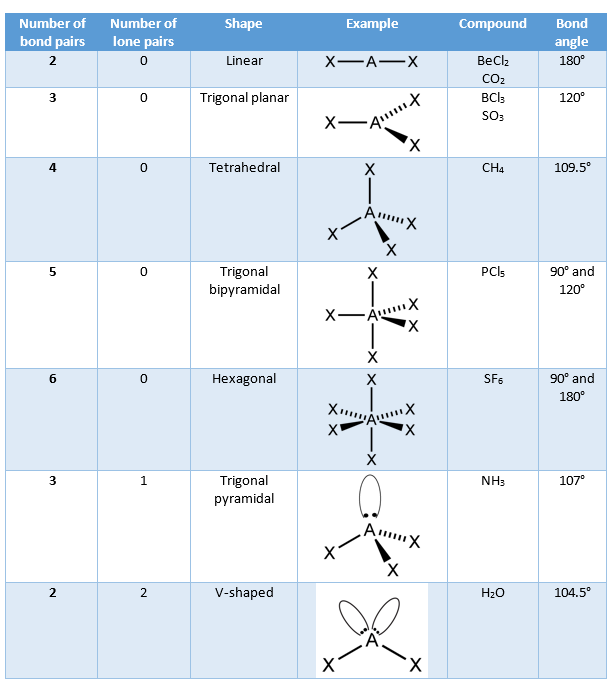
This table can be used to predict the shape of a molecule.
Count the number of bond pairs and lone pairs that a molecule will have - these determine its shape. Alternatively, atoms from the same group as those shown above will have the same shape.
For example, consider \(BCl_3\) and \(AllF_3\). Boron and aluminium are in the same group, as are chlorine and fluorine. Boron chloride has a trigonal planar shape, so will aluminium fluoride.
Alternatively, boron has no lone pairs and forms three bonds with chlorine. Aluminium has no lone pairs and forms three bonds with fluorine.Therefore, we can conclude that both molecules will have the same shape.
Page 2
Polarity of molecules
Dipole: A dipole is said to exist when two charges of equal magnitude but opposite signs are separated by a small distance.
The overall dipole in a molecule depends on:
The electronegativity of the elements in the molecule
If there is a large electronegativity difference between the elements in the molecule, this will increase the magnitude of the dipole
The relative angles of the bonds
If the molecule is symmetrical in all directions, the individual dipoles will cancel each other out and the molecule will be non-polar.
If the molecule is not symmetrical in all directions, then the dipoles will reinforce each other, the molecule will possess an overall dipole and is said to be polar.
Page 3
Diatomic Molecules
Non-polar diatomic molecules
Hydrogen and chlorine
Two atoms in each molecule are the same, same electronegatvity
Distribution of electron density of the bonding electrons in either molecule is totally symmetrical
Bond in each is therefore symmetrical, making the molecules non-polar
Polar diatomic molecules
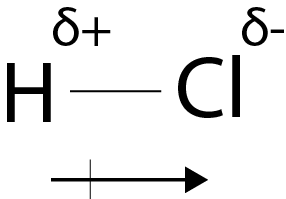
In the case where there is an electronegativity difference between the two atoms in a diatomic molecule, it will be a polar molecule.
The arrow with the line through it represents a dipole.
Example: The electronegativity of chlorine is greater than that of hydrogen, so the hydrogen chloride molecule will have a permanent dipole.
Page 4
Polyatomic molecules (1)
1. Linear molecules
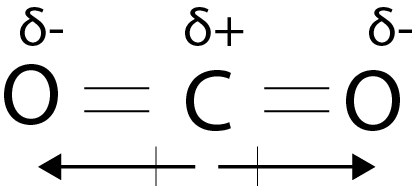
If the atoms attached to the central atom are both the same, then this will be an example of molecules that are symmetrical in all directions, as mentioned earlier.
Both of the bonds may be polar, but overall they cancel each other out, making the molecule non-polar
Example: Carbon dioxide
2. Trigonal Planar Molecules
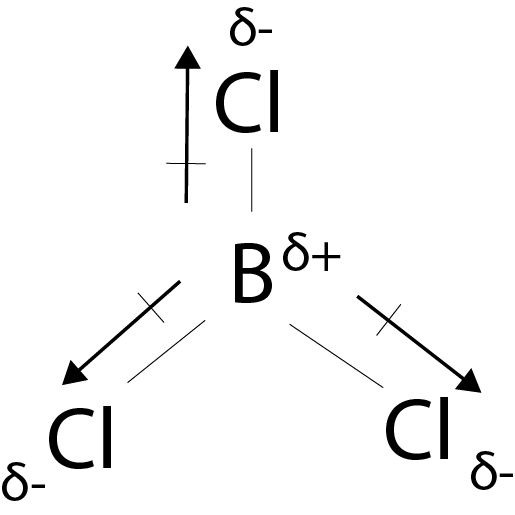
Again, the bonds may be polar, but because the molecule is symmetrical, their dipoles cancel each other out
The molecule is non-polar
Example: Boron chloride
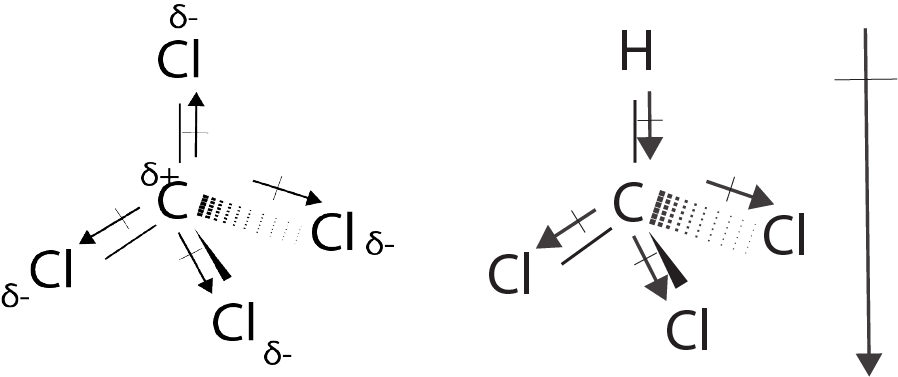
3. Tetrahedral molecules
If all four substituents are of the same element, then the molecule will be symmetrical. The bonds will be polar but the molecule will possess no overall dipole.
Example: Tetrachloromethane
If the substituent atoms are not the same then the dipoles may reinforce each other, leading to a polar molecule.
Example: Trichloromethane
Page 5
Polyatomic molecules (2)
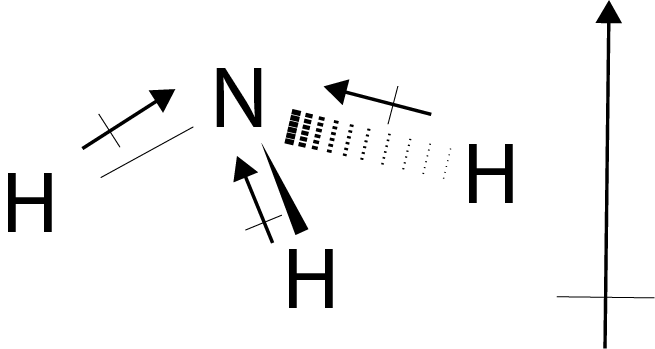
4. Trigonal Pyramidal Molecules
This molecule is not symmetrical in all directions.
All three bonds are polar, and so their dipoles reinforce each other.
Overall, molecule is polar
Example: Ammonia
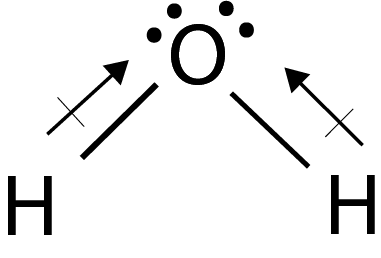
5. V-shaped molecules
Not symmetrical in all direction
Bonds are polar, so dipoles reinforce each other
Polar molecule
Example: Water
Information
- Description
- User has deleted their subject information Note on Shapes of Molecules and Ions, created by Deleted user on 21/08/2017.
- Created by
- Deleted user · Aug 2017
- Updated
- Aug 21, 2017
- Views
- 83
- History
-
- Created by Niamh Ryan · Aug 16, 2017
- Copied by Niamh Ryan · Aug 21, 2017
- Rating