
Notes
Key Nationalist Thinkers
Content of the notes (5)
Page 1
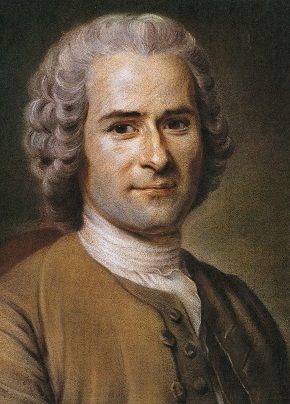
Jean Jacques Rousseau (1712 - 1778)
"Man is born free, and everywhere he is in chains. One man thinks himself the master of others, but remains more of a slave than they are."
Civilisation and modernity have resulted in being destructive on the once innocent and happy primitive state of man. People became plagued by vice and sin when the left the state of nature for society.
‘Noble savage’ - an idealised concept that relates to uncivlized man. Man is seen as innately good before being exposed to the corrupting influence of civilisation.
In his Social Contract (1762), Rousseau contends that freedom and authority are not in contradiction, since legitimate laws are founded upon the general will of the people. Obeying the law means that an individual citizen is simply obeying his position in a political community.
We understand that during Rousseau’s lifetime, the sovereign was often seen as an absolute monarch. However, the Social Contract gives sovereignty a new meaning. In a healthy republic, Rousseau defines the sovereign as all the individual citizens acting together collectively. These people voice the general will and make the laws of the state:
Only the peoples speaking together collectively can be counted sovereign
The government’s role overall is to both respect and enforce the sovereign will of the people and should not repress or dominate the general will of the people
Rousseau is believed to have rejected the idea of a representative assembly as his doctrine rested in sovereignty and representation of the people:
Rousseau rejected the Hobbesian idea that a people’s legislative will can rest in the hands of some group or individual that acts with authority to rule over them
Rousseau assumes that handing over one’s right to rule oneself to another body or person is a form of slavery
This means laws made by such an assembly would bind citizens to a law that they themselves in reality never agreed to
Nationalism:
The nation can be seen as a collection of people who share strong bonds that create a shared sense of citizenship, contrary to other ethnic, cultural and other loyalties that people may have.
Rousseau was seen as the ‘father of modern’ nationalism - Rousseau did not directly address the idea of nationalism, but he touched on the idea of popular sovereignty, which is evident in the ‘general will’ (for further explanation look at the video below) of the people. The general will seeks out the common good of society. This was part of the nationalist beliefs during the 1798 French Revolution.
Further, Rousseau developed a powerful criticism of monarchy and aristocratic privilege in his writings, proclaiming governance should be based on the ‘general will’. Sovereign power for Rousseau was to rest in the hands of the ‘French nation'.
Many argue that Rousseau was the first to put forward ideas that connect up with the concept of civic nationalism - this form of nationalism is shaped by principles of public participation, tolerance and rights of the individual. It facilitates cultural diversity and rejects the xenophobic tendencies of chauvinism; it is a secure national identity, that comes out of Rousseau’s works, that leads people to pursue a meaningful life.
An Introduction to Jean-Jacques Rousseau's The Social Contract - A Macat Politics Analysis (Embed)
Page 2
Johann Gottfried von Herder (1744-1803)
“The people need a master only as long as they have no understanding of their own. The more it acquires understanding, the more the government is bound to change its methods and to disappear. The most noble end of government is to become dispensable, so that everyone must govern himself.”
Developed the idea of organic/romantic nationalism. This is a form of ethnic nationalism in which the state derives its political legitimacy from historic cultural or hereditary groups. This means that every ethnic group should be politically distinct. Herder’s main thesis on language was that it constituted the main difference between humans and animals:
Language was seen as the vehicle of cognition; it determines thought
The process begins with children who must learn to speak
The family unit was in charge of educating the child in the most essential human capacity - language
This also highlighted the idea that the family imparts a sense of identity on the individual
Family heritage, for Von Herder, was preserved through the family language
Becoming someone for Von Herder was deeply entangled with a person growing, developing and learning with his/her culture and values
Moreover, Von Herder conflicted with Immanuel Kant regarding cultural groups and the role of the mind in human history. Von Herder argued for only human reason, contrary to pure reason:
This drove the idea that language was the vehicle of reason and because languages differed between nations then reason does also
Reason exists in relation to historical circumstances of those particular peoples, nations, and communities
Each nation has their own terms for reason and rationality
Believed in the importance of patriotism: "he that has lost his patriotic spirit has lost himself and the whole worlds about himself"
The nation is also individual and separate; distinguished by climate, education, foreign relations, tradition and heredity
The Volkgeist:
“There is only one class in the state, the Volk (not the rabble), and the king belongs to this class as well as the peasant.”
The Volkgeist is as old as the Volk and continues to evolve within the national group:
Each people have their own cultural traits that are shaped by ancestral history and the experience of movement
Social life is constructed mentally through language, literature, religion, the arts and customs from earlier generations
Law must be developed specific to each nation, as the law of one land cannot suit every nation
Von Herder’s argument of nationalism highlights that no two nations can have the same Volkgeist
The Volkgeist is best understood through the process of history
History for Von Herder was primarily about the Volk; language, culture, customs, religion, literature, folklore and law.
"It is the apparent plan of nature that as one human being, so also one generation, and also one nationality learn, learn incessantly, from and with the others until all have comprehended the difficult lesson: No nationality has been solely designated by God as the chosen people of the earth; above all we must seek the truth and cultivate the garden of the common good. Hence no nationality of Europe may separate itself sharply, and foolishly say, "With us alone, with us dwells all wisdom."

Page 3
Giuseppe Mazzini (1805-1872)
“Nationality is sacred to me, because I see in it an instrument for the good and progress of all; geographical conditions, historical traditions, language and special tendencies are for me only indications of it. But the mission which it fulfils, or is called upon to fulfil, is its baptism and its consecration. The nation ought to be for Humanity what the family is, or ought to be, for the country. If it does evil, if it resorts to oppression, if it becomes a missionary of injustice for a temporary interest, it loses its right of existence and digs its own grave.”
Mazzini was writing at a time of prevalent chauvinist and imperialist nationalism, these forms of nationalism were becoming more popular. Mazzini was writing to ensure the nationalism he spoke of would remove causes of selfish hostilities among peoples and would eventually lead to the establishment of the an international union. Mazzini was the first to promote an early version of the European Union, termed the United States of Europe. He was a politician who spearheaded the Italian revolutionary movement and campaigned for reunification of Italy.
Mazzini argued that the problem in Italy was primarily religious, all other questions were secondary in nature.
Deeply influenced by the French revolution, Mazzini was the first figure to give a cultural definition to nationalism
This revolved around the central themes of sharing customs, historical tradition, hope and geographical community
Mazzini argued that the fatherland was “the home wherein God has placed us, among brothers and sisters linked to us by the family ties of a common religion, history, and language."
In politics, a unified country would lead to a better representative state
In economy, abolish tariffs in order to promote mass production
Mazzini was a huge proponent of republicanism - united, free and independent Italy
Hugely opposed to ideologies of Marxism and communism; rejected the ideas of class struggle and materialism
Believed in class collaboration; the division of social classes into hierarchical structures is positive and essential
Often the stability and prosperity of a nation are seen as the ultimate goal of collaboration between classes
Patriotism, he argued, should be regarded as a duty and the love of the homeland is a divine mission
When in exile in Marseille, Mazzini founded the Giovine Italia movement:
This was meant to be a national association for liberating the separate Italian states
Mazzini believed that only popular initiative could free Italy - “Only God and the people will open the way of the future for us”
Mazzini helped to bring about the independent and unified Italy following the rebellions in 1848. Further, he helped to define the modern European movement in relation to popular democracy.
Mazzini developed his own concept of thought and action:
This joined the concepts of thought and action together, this meant for every thought an action must follow
This led Mazzini to reject intellectualism (highlights the use of, development and exercise of the intellect), usually closely connected with rationalism
This also led Mazzini to divorce the idea of putting theory into practice
Further, he believed that the rights of man were a duty to be won through hard work, sacrifice and virtue
Rights were not intrinsically owned by man
Page 4
Charles Maurras (1868-1952)
“A true nationalist places his country above everything”
Integral Nationalism was firstly an offshoot of the political movement Action Francaise. Action Francaise started off as a review journal founded in 1899 by Charles Maurras and Leon Daudet. After gaining huge popularity the journal became a daily newspaper. The paper was the lifeblood of the Royalist Party, in which Maurras promoted his monarchical and nationalistic ideas.
Integral nationalism is meant to be the following process after a nation has achieved independence and has an established state. The nationalist places the good of his own country above everything, while striving to work in society as an organic unit. Society should have a preset social hierarchy and various social classes should cooperate with one another. Further, this form of nationalism is often linked to and overlaps with fascism, perennialism and post modernism.
Some qualities espoused to integral nationalism are:
Anti-individualism
Statism
Radical extremism
Aggressive expansionist militarism
Integral nationalism comes about where a strong military ethos developed during an independence struggle. When independence has been achieved it is believed that a strong military (militarism) is required in order to guarantee the security and growth of the new state. Integral states are totalitarian and the government or state dominates society.
Maurras’s integral nationalism rejected all forms of democratic principles and he criticised the evolution of the state in France since the 1789 Revolution. He wanted a return to hereditary monarchy. He felt the revolution was both destructive and negative for the state of France. For Maurras "For monarchy to work, one man must be wise. For democracy to work, a majority of the people must be wise. Which is more likely?"
Maurras blamed France’s decline in greatness on the “four confederate states of Protestants, Jews, Freemasons and foreigners”. From his writings, it is evident Maurras was anti-Semitic and anti-Protestant. He argued that the Reformation, the Enlightenment and the outcomes of the 1789 Revolution had led to a trend in society where individuals cared and valued themselves more than the nation. The ideals of democracy and liberalism were only making things worse for him.
Integral nationalism was opposed to the liberal attitudes of internationalism. It was aggressive and expansionist, defined by one author as “the exclusive pursuit of national policies, the absolute maintenance of national integrity and the steady increase of national power”.
Page 5

Marcus Garvey (1887-1940)
Pan-Africanism:
This represents the complexities of black politics and intellectual thought that have developed over the last few hundred years:
Pan-Africanism has been seen as interacting with various sectors of society from politics, ideology, organisation and culture
However, it really reflects a selection of political views
In its simplest terms, it is the doctrine that African people, both in Africa and the African diaspora, share a common history and destiny
A series of interconnected past and future
Garvey was one of the first to envision a global movement that would unite the black race and establish an African empire. In 1914, he established the UNIA (Universal Negro Improvement Association). The UNIA sought to advocate for black pride to “strengthen the imperialism of independent African states”
The Pan-African Association, which Garvey became associated with, outlined its aims in a journal:
To secure the Africans and their descendants throughout the world their civil and political rights
To ameliorate the condition of our oppressed brethren in the continent of Africa, American, and other parts of the world.
To promote efforts to secure effective legislation and encourage our people in educational, industrial, and commercial enterprises.
To foster the production of writing and statistics relating to our people everywhere.
To raise funds for forwarding these purposes. (Pan-African Association 1901)
Garveyism:
Garveyism is a strain of black nationalism that references the economic and political policies of UNIA-ACL founder Marcus Garvey:
UNIA-ACL (Universal Negro Improvement Association and African Communities League) was founded in 1914 as a black nationalist fraternal organization
Proponents of black nationalism usually sought to advocate for economic self-sufficiency, race pride of African-Americans and black separatism
The ideals of Garveyism centre on the unification and empowerment of the African-American population under the banner of their collective descent from Africa
Campaigns of ‘Garveyites’ wanted profits sent back to the African continent that came from the labour of slave descendants
Garvey put his ideas forward when African Americans were experiencing marginalisation and discrimination in America and the Caribbean
He desired to inspire Americans to proactively establish their own infrastructure, local economies and institutions
UNIA was the single largest black organisation that ever existed with an estimated 6 million followers in the 1920s and 30s
Garvey was a skilled orator and his movement evolved into a religion of success. He inspired millions of black people across the globe to seek shelter from racial dispossession and colonial domination.
The UNIA has hundreds of divisions worldwide by 1920
There was almost a thousand divisions across North and Central America, the Caribbean, Africa and Britain
However, opposition to the movement developed into the late 1920s
Garvey was arrested for fiscal irregularities, and eventually deported to Jamaica in 1927
Garveyism probably had its biggest impact within Africa. Garvey had seen that Africa had fallen from its previous historical greatness and it needed to be restored. Africans needed to assume their rightful place in the world once again.This redemption was only possible through black people acting themselves.
Garvey never went to Africa
However, his ideas of black self-sufficiency and freedom implanted themselves in the heads of African nationalist leaders
The UNIA program of African redemption was communicated through the prophecy contained within the Psalms “Princes shall come out of Egypt; Ethiopia shall soon stretch out her hands unto God” (68:31)
Garvey built his movement on four main themes:
Africa for Africans at home and abroad
Self-reliance
Unity
Retaining black pride in the presence of whites
The South African author, Bernard Magubane, highlighted the central role of this black nationalism: “The central theoretical assumption of Black Nationalism is that before the Negro can truly be free, he must first effect a psychic separation from the idea of whiteness; that is, he must stop believing that he cannot believe in himself”
Black Pride:
The repercussions of Garvey’s work and ideas are evident in the black pride movement of the 1960s and 70s
This was a movement that encouraged black people to celebrate black culture and embrace their African heritage
This was a response to the dominant white culture and ideological environment that resulted in racist policies of government
Information
- Description
- User has deleted their subject information Note on Key Nationalist Thinkers, created by Deleted user on 24/08/2017.
- Created by
- Deleted user · Aug 2017
- Updated
- Aug 24, 2017
- Views
- 56
- History
-
- Created by Andrew Burke · Aug 21, 2017
- Copied by Andrew Burke · Aug 24, 2017
- Rating