
Quiz
Respiratory: Anatomy and clinical relevance of nasal cavity/larynx
This quiz has question types that open in the usual player.
Questions in this quiz (40)
1Which meatus communicates with the pterygopalatine fossa via the sphenopalatine foramen and drains the posterior ethmoidal air cells?
- ASuperior meatus
- BInferior meatus
- CMiddle meatus
2Largest anterior ethmoidal air cell that forms the roof of the middle meatus?
- AHiatus semilunaris
- BEthmoid infundibulum
- COlfactory epithelium
- DBulla ethmoidalis
3The ucinate process relates to which meatus and bone of the nasal cavity?
- AInferior meatus, sphenoid bone
- BMiddle meatus, ethmoid bone
- CSuperior meatus, sphenoethmoidal recess
4Gap between bulla ethmoidalis and ucinate process?
- ABulla ethmoidalis
- BPterygopalatine fossa
- CHiatus semilunaris
5Ethmoid infundibulum can be found in which structure of the nasal cavity?
- AInferior meatus
- BMiddle meatus
- CSuperior meatus
6Which structure houses the inferior osmium of the nasolacrimal duct?
- AInferior meatus
- BMiddle meatus
- CSuperior meatus
7Where would you find Hasner's valve?
- ASphenoethmoidal recess
- BAnterior inferior meatus
- CPosterior superior meatus
8Where does the sphenoid sinus drain?
- ANasolacrimal duct
- BHiatus semilunaris
- CSphenoethmoidal recess
9What structure allows olfactory epithelium to detect scent?
- AMucous produced from nasal goblet cells
- BNasal branch anterior ethmoidal nerve
- CLittle's area
- DNasal concha
10What are the two main functions of concha?
- AWarm/Humidify air for improved gas exchange
- BFiltration of fine air particles to prevent inhalation of toxic substances
- CIncrease sensitivity of taste receptors
- DImmune defence through mucous production of goblet cells
11Label the diagram
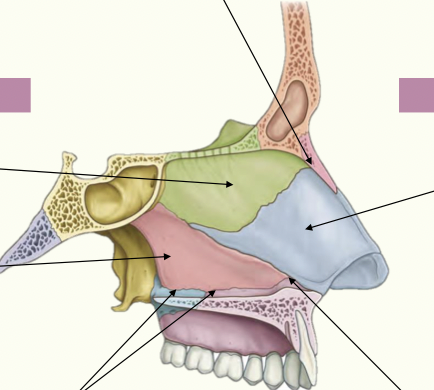
- ANasal Bones
- BPerpendicular Plate of Ethmoid Bone
- CVomer
- DNasal Crest of Maxillary & Palatine Bone
- EIncisor Crest of Maxillary
- FSeptal Cartilage
12Label the vascular supply of the diagram
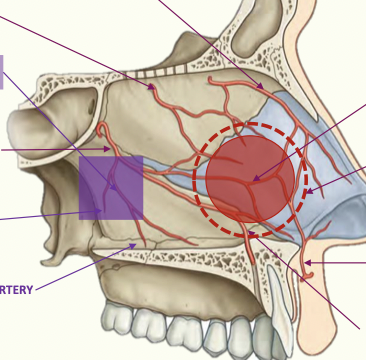
- AAnterior Ethmoidal Artery
- BPosterior Ethmoidal Artery
- CWoodruff Plexus
- DSphenopalatine Artery
- EPosterior Nasal Artery
- FAscending Pharyngeal Artery
- GGreater Palatine Artery
- HSuperior Labial Artery (septal branch)
- ILittle's Area
- JKiesselbach Plexus
13Label the innervation of the nasal cavity
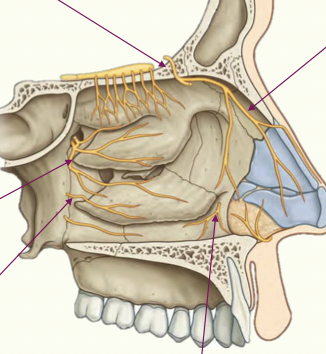
- AAnterior Ethmoidal Nerve
- BPosterior Superior Nasal Nerve
- CPosterior Inferior Nasal Nerve
- DSuperior Alveolar Nerve
- ENasal Branch Anterior Ethmoidal Nerve
14Piriform cortex, entorhinal area, amygdaloid cortex and corticomedial nuclear group of the amygdala are all involved in [blank_start]olfactory[blank_end] function
- Aolfactory
15Anosmia, hyposmia, hyperaemia are all [blank_start]quantitative[blank_end] olfactory dysfunction and parosmia, phantosmia and olfactory agnosia are all [blank_start]qualitative[blank_end] olfactory dysfunction
- Aquantitative
- Bqualitative
16There are [blank_start]four[blank_end] paranasal sinuses: [blank_start]Frontal[blank_end], [blank_start]Ethmoid[blank_end], [blank_start]Maxillary[blank_end], [blank_start]Sphenoid[blank_end]
- Afour
- BFrontal
- CEthmoid
- DMaxillary
- ESphenoid
17The following applies to which sinus:
'The floor of the sinus slopes toward the midline to reach the primary Ostia and connect the hour-glass shaped recess'- AMaxillary
- BEthmoid
- CFrontal
- DSphenoidal
18The largest of the paranasal sinuses is the [blank_start]maxillary[blank_end]
- Amaxillary
19Anterior ethmoid sinuses drain into the [blank_start]middle[blank_end] meatus, posterior ethmoid sinuses drain into the [blank_start]superior[blank_end] meatus
- Amiddle
- Bsuperior
20The basal lamella separates the anterior and posterior of the [blank_start]ethmoid[blank_end] sinuses
- Aethmoid
21[blank_start]Rhinosinusitis[blank_end] is symptomatic inflammation of the paranasal sinuses and nasal cavity
- ARhinosinusitis
22[blank_start]Piriform fossa[blank_end] is the most common site for hypopharygeal cancer
- APiriform fossa
23Salpingophayngeus, palatopharyngeus and stylopharyngeus are the [blank_start]longitudinal[blank_end] muscles of the [blank_start]pharynx[blank_end]
- Alongitudinal
- Bpharynx
24The voluntary phase of swallowing consists of which mechanisms?
- AClosing of nasopharynx and oral cavity
- BActivation of pressure receptors of oropharynx
- CPalatoglossus draws tongue toward soft palate
25The pharyngeal phase of swallowing consists of which mechanisms?
- ATensor palatini and levator palatini assist in closure of nasopharynx and oral cavity
- BReflexive phase as bolus reaches palatoglossal arch
- CAirway remains open
- DGravity moves food toward oesophagus
- ECN IX and X elevates larynx
- FTrue vocal folds remain open
- GFalse vocal cords contract
26The paired cartilage of the larynx are [blank_start]Cuniform[blank_end], [blank_start]Corniculate[blank_end] and [blank_start]Arytenoid[blank_end]
- AArytenoid
- BCorniculate
- CCuniform
27The unpaired cartilage of the larynx are the [blank_start]epiglottis[blank_end], [blank_start]thyroid[blank_end] and [blank_start]cricoid[blank_end]
- Aepiglottis
- Bthyroid
- Ccricoid
28Label the membranes and ligaments of the larynx
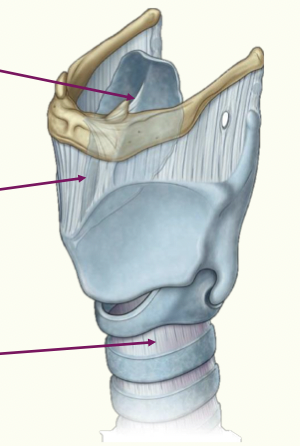
- AHyoepiglottic ligament
- BThyrohyoid membrane
- CCricotraheal ligament
29The median cricothyroid ligament can be incised to create an emergency airway during life-threatening situations
- ATrue
- BFalse
30Infrahyoid muscles of the larynx:
- AThyrohyoid
- BSternohyoid
- CSternothyroid
- DOmohyoid
- EMylohyoid
- FGeniohyoid
- GStylohyoid
- HDigastric
31Muscles of the larynx
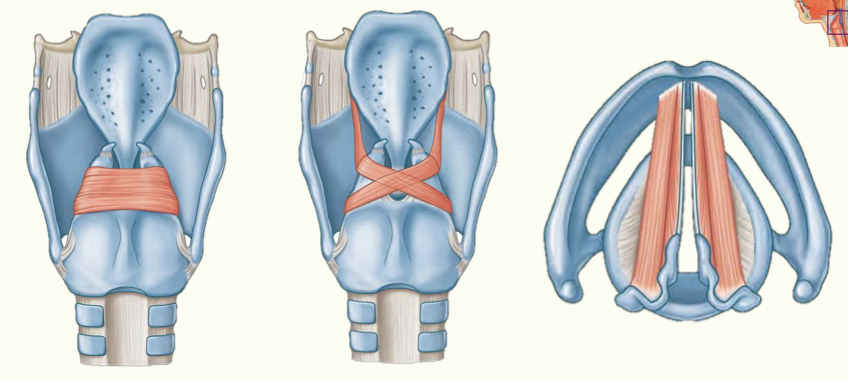
- ATransverse Arytenoid
- BOblique Arytenoid
- CThyroarythenoid and Vocalis
32Muscles of the larynx
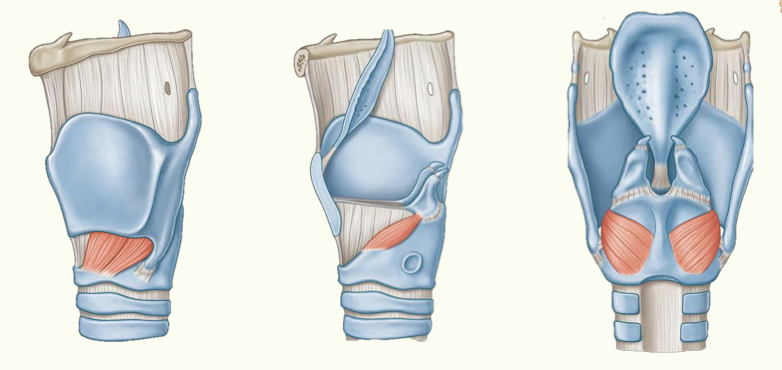
- ACricothyroid
- BLateral cricoarytenoid
- CPosterior cricoarytenoid
33Vasculature of the larynx
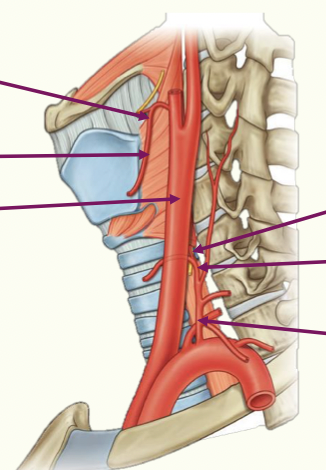
- ASuperior laryngeal artery
- BSuperior thyroid artery
- CExternal carotid
- DInferior thyroid artery
- EThyrocervical trunk
- FInferior laryngeal artery
34The [blank_start]superior[blank_end] laryngeal nerve innervates the cricothyroid muscle, the [blank_start]right[blank_end] recurrent laryngeal nerve innervates the intrinsic larynx muscles and the [blank_start]left[blank_end] recurrent laryngeal nerve loops under the aortic arch
- Asuperior
- Bleft
- Cinferior
- Dright
- Eright
- Fsuperior
- Gleft
- Hinferior
- Ileft
- Jinferior
- Ksuperior
- Lright
35The intrinsic larynx muscles adjust the tension of the vocal fold for high notes during singing, thus paresis or paralysis of the recurrent laryngeal nerve can result in pitch abnormalities and glissando
- ATrue
- BFalse
36This process involves movement of the arytenoid cartilages and vocal folds to allow intermittent release of expired air between the adducted vocal folds resulting in vibration and producing sound
- APhonation
- BArticulation
- CVocalisation
- DDictation
37Singing requires [blank_start]prolonged[blank_end] release of air between [blank_start]adducted[blank_end] folds.
[blank_start]Thyroarytenoid[blank_end] muscle [blank_start]relaxes[blank_end] vocal folds, making them [blank_start]shorter and thicker[blank_end], this [blank_start]slows[blank_end] down vibration for a [blank_start]lower[blank_end] pitch.
[blank_start]Cricothyroid[blank_end] muscle [blank_start]tenses[blank_end] vocal folds, making then [blank_start]longer and thinner[blank_end], this [blank_start]increases[blank_end] speed of vibration for a [blank_start]higher[blank_end] pitch.- Aprolonged
- Bminimal
- Cadducted
- Dabducted
- EThyroarytenoid
- Frelaxes
- Gshorter and thicker
- Hslows
- Ilower
- JCricothyroid
- Ktenses
- Llonger and thinner
- Mincreases
- Ndecreases
- Ohigher
38A 54yo male has impaired breathing and loss of speech following recent surgery to remove a malignancy in the deep cervical lymph nodes. What is the most likely cause?
- AVocal Cord Palsy: Bilateral complete section of the recurrent laryngeal nerves
- BVocal Cord Palsy: Unilateral complete section of a recurrent laryngeal nerves
- CEpiglottitis
- DThyroiditis
39There are [blank_start]four[blank_end] paranasal sinuses: f[blank_start]rontal[blank_end], e[blank_start]thmoid[blank_end], m[blank_start]axillary[blank_end], s[blank_start]phenoid[blank_end]
- Afour
- Brontal
- Cthmoid
- Daxillary
- Ephenoid
40Agger nasi cells can be found in the [blank_start]frontal[blank_end] recess of the [blank_start]inferior[blank_end] border within the [blank_start]frontal[blank_end] sinus
- Afrontal
- Bethmoid
- Cmaxillary
- Dsphenoid
- Einferior
- Fsuperior
- Ganterior
- Hposterior
- Ifrontal
- Jethmoid
- Kmaxillary
- Lsphenoid
Information
- Description
- Y2: Resp, HARC 1
- Author
- Stephanie Thomas
- Language
- English
- Views
- 187
- Tags
- Rating
- No ratings yet Rate this quiz