
Quiz
Practice Set (3) - Image Weighting and Contrast
Questions in this quiz (65)
1MRI images that are based on the differences in longitudinal relaxation
characteristics of tissues are known as- ATl weighted images
- BT2 weighted images
- CProton density weighted images
- DTransitional images
2MRI images that are based on the differences in the amount of hydrogen nuclei
in tissues are known as- ATI weighted images
- BT2 weighted images
- CProton density weighted images
- DTransitional images
3MRl images that are based on the differences in the transverse relaxation
characteristics of tissues are known as- ATI weighted images
- BT2 weighted images
- CProton density weighted images
- DSpin density weighted images
4The image parameter that primarily affects TI weighting is
- AEcho time
- BInversion time
- CRepetition time
- DNone of the above
5The image parameter that primarily affects T2 weighting is
- AEcho time
- BInversion time
- CRepetition time
- DNone of the above
6In a TI weighted image, a short TR is used to
- AMaximize T2 effects
- BMinimize T2 effects
- CMaximize T1 effects
- DMinimize T1 effects
7In a T2 weighted image, a long TR is used to
- AMaximize T2 effects
- BMinimize T2 effects
- CMaximize T1 effects
- DMinimize T1 effects
8In a T2 weighted image, a long TE is used to
- AMaximize T2 effects
- BMinimize T2 effects
- CMaximize T1 effects
- DMinimize T1 effects
9In a T1 weighted image, a short TE is used
- AMaximize T2 effects
- BMinimize T2 effects
- CMaximize T1 effects
- DMinimize T1 effects
10In a T1 weighted image, tissues with short T1 relaxation times produce
what type of signal- AHigh
- BLow
- CIntermediate
- DNone of the above
11In a Tl weighted image, tissues with long Tl relaxation times produce what
type of signal?- AHigh
- BLow
- CIntermediate
- DNone of the above
12In a T2 weighted image, tissues with short T2 relaxation times appear
- AHyperintense
- BHypointense
- CIsointense
- DNone of the above
13In a T2 weighted image, tissues with long T2 relaxation times appear
- AHyperintense
- BHypointense
- CIsointense
- DNone of the above
14In a proton density weighted image, tissues with a high number of hydrogen
nuclei appear- AHyperintense
- BHypointense
- CIsointense
- DNone of the above
15In a proton density weighted image, tissues with a low number of hydrogen
nuclei appear- AHyperintense
- BHypointense
- CIsointense
- DNone of the above
16In biological tissue, which type of relaxation occurs the quickest?
- AT2 relaxation
- BT2* relaxation
- CTl relaxation
- DNone of the above
17Longitudinal relaxation occurs more efficiently in which type of tissue?
- AWater
- BFat
- CMuscle
- DCortical bone
18In a Tl weighted image, fat has a _____ Tl relaxation time and therefore
appears _____- ALong, Bright
- BLong, Dark
- CShort, Dark
- DShort, Bright
19In a Tl weighted image, CSF has a ____ Tl relaxation time and therefore
appears _____- ALong, Bright
- BLong, Dark
- CShort, Dark
- DShort, Bright
20In a T2 weighted image, fat has a ____ T2 relaxation time and therefore
appears _____- ALong, Bright
- BLong, Dark
- CShort, Dark
- DShort, Bright
21In a T2 weighted image, CSF has a ____ T2 relaxation time and therefore
appears ____- ALong, Bright
- BLong, Dark
- CShort, Dark
- DShort, Bright
22A spin echo image with a long TR and a short TE is known as what type of
image?- AT1 weighted image
- BProton density weighted image
- CSpin density weighted image
- DProton density weighted image & Spin density weighted image
23A spin echo image with a long TR and a long TE is known as what type of
unage?- AT1 weighted image
- BProton density weighted image
- CT2 weighted image
- DSpin density weighted image
24A spin echo image with a short TR and a short TE is known as what type of
iInage?- ATl weighted image
- BT2 weighted image
- CProton density weighted image
- DNone of the above
25Another name for a proton density weighted image is
- ASpin density
- BIntermediate
- CInversion recovery
- DSpin density & Intermediate
26On a TI weighted image of the brain, fat appears ____ to white matter.
- AHyperintense
- BHypointense
- CIsointense
27On a TI weighted image of the brain, white matter appears ____ to grey
matter- AHyperintense
- BHypointense
- CIsointense
28On a TI weighted image of the brain, grey matter appears to CSF
- AHyperintense
- BHypointense
- CIsointense
29On a TI weighted image of the brain, CSF appears _____ to fat
- AHyperintense
- BHypointense
- Clsointense
30On a proton density weighted image of the brain, white matter appears ____
to grey matter- AHyperintense
- BHypointense
- CIsointense
31On a proton density weighted image of the brain, CSF appears ____ to
grey matter- AHyperintense
- BHypointense
- CIsointense
32On a T2 weighted image of the brain, CSF appears ____ to grey matter
- AHyperintense
- BHypointense
- CIsointense
33On a T2 weighted image of the brain, grey matter appears ____ to white
matter- AHyperintense
- BHypointense
- CIsointense
34On a TI weighted image of the knee, cortical bone appears ____ to all
other tissues- AHyperintense
- BHypointense
- CIsointense
35On a TI weighted image of the knee, bone marrow appears ____ to
meniscal tissues.- AHyperintense
- BHypointense
- CIsointense
36On a Tl weighted image of the spine, the intervertebral disk appears ____
to spinal cord.- AHyperintense
- BHypointense
- CIsointense
37On a T2 weighted image of the spine, the intervertebral disk appears ____
to the spinal cord- AHyperintense
- BHypointense
- Clsointense
38At a field strength of 1.0 tesla, the approximate Tl relaxation time of fat is
- A180 ms
- B270 ms
- C360 ms
- D390 ms
39At a field strength of 1.0 tesla, the approximate T2 relaxation time of fat is
- A40 ms
- B50 ms
- C80 ms
- D90 ms
40At a field strength of 1.0 tesla, the approximate T1 relaxation time of liver
tissue is- A180 ms
- B270 ms
- C360 ms
- D390 ms
41At a field strength of 1.0 tesla, the approximate T2 relaxation time of liver
tissue is- A40 ms
- B50 ms
- C60 ms
- D70 ms
42At a field strength of 1.0 tesla, the approximate T1 relaxation time for spleen
tissue is- A360 ms
- B380 ms
- C400 ms
- D480 ms
43At a field strength of 1.0 tesla, the approximate T2 relaxation time for spleen
tissue is- A60 ms
- B80 ms
- C90 ms
- D100 ms
44At a field strength of 1.0 tesla, the approximate T1 relaxation time for grey
matter is- A390 ms
- B450 ms
- C520 ms
- D620 ms
45At a field strength of l.0 tesla, the approximate T2 relaxation time for grey
matter is- A70 ms
- B80 ms
- C90 ms
- D100 ms
46At a field strength of 1.0 tesla, the approximate T1 relaxation time for white
matter is- A180 ms
- B270 ms
- C360 ms
- D390 ms
47At a field strength of 1.0 tesla, the approximate T2 relaxation time for white
matter is- A80 ms
- B90 ms
- C100 ms
- D140 ms
48At a field strength of 1.0 tesla, the approximate T1 relaxation time for renal
cortex tissue is- A180 ms
- B270 ms
- C360 ms
- D390 ms
49At a field strength of 1.0 tesla, the approximate T2 relaxation time for renal
cortex tissue is- A45 ms
- B50 ms
- C60 ms
- D70 ms
50At a field strength of 1.0 tesla, the approximate T1 relaxation time for muscle
tissue is- A270 ms
- B480 ms
- C600 ms
- D680 ms
51At a field strength of 1.0 tesla, the approximate T2 relaxation time for muscle
tissue is- A40 ms
- B70 ms
- C80 ms
- D100 ms
52At a field strength of 1.0 tesla, the approximate Tl relaxation time for renal
medulla tissue is- A520 ms
- B600 ms
- C680 ms
- D800 ms
53At a field strength of 1.0 tesla, the approximate T2 relaxation time for renal
medulla tissue is- A90 ms
- B100 ms
- C140 ms
- D300 ms
54At a field strength of 1.0 tesla, the approximate Tl relaxation time for blood
is- A540 ms
- B680 ms
- C800 ms
- D1000 ms
55At a field strength of 1.0 tesla, the approximate T2 relaxation time for blood
is- A140 ms
- B180 ms
- C240 ms
- D300 ms
56At a field strength of 1.0 tesla, the approximate Tl relaxation time for CSF
is- A800 ms
- B1000 ms
- C2000 ms
- D2500 ms
57At a field strength of 1.0 tesla, the approximate T2 relaxation time for CSF is
- A70 ms
- B100 ms
- C180 ms
- D300 ms
58At a field strength of 1.0 tesla, the approximate T1 relaxation time for water
is- A800 ms
- B1000 ms
- C2000 ms
- D2500 ms
59At a field strength of 1.0 tes1a, the approximate T2 relaxation time for water
is- A800 ms
- B1000 ms
- C2000 ms
- D2500ms
60Figure 3-1 displays which type of relaxation curve?
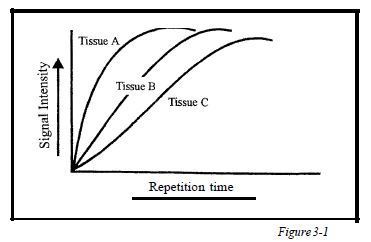
- AT1 Relaxation curve
- BT2 relaxation curve
- CInversion recovery curve
61Figure 3-2 displays which type of relaxation curve?
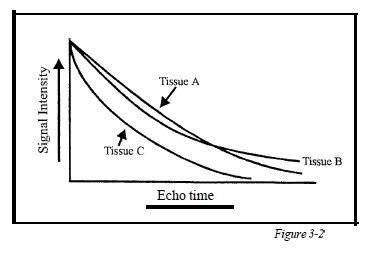
- ATI relaxation curve
- BT2 relaxation curve
- CInversion recovery curve
62Figure 3-3 displays which type of relaxation curve?
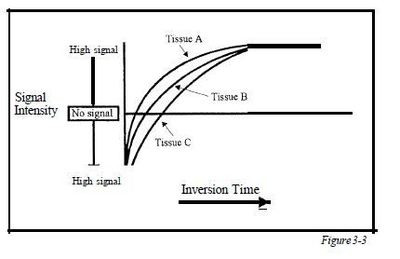
- AT1 relaxation curve
- BT2 relaxation curve
- CInversion recovery curve
63In Figure 3-4, at a TR of 200, which of the following tissues has the greatest
signal intensity?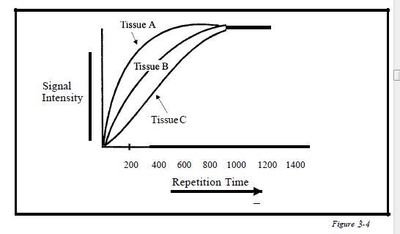
- ATissue A
- BTissue B
- CTissue C
64In figure 3-5, at a TE of 90, which of the following tissues has the greatest
signal intensity?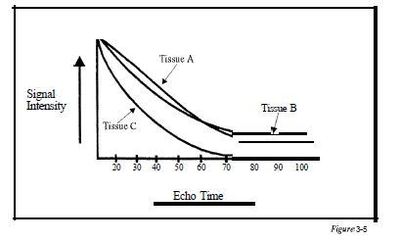
- ATissue A
- BTissue B
- CTissue C
65Figure 3-6 displays which type of relaxation curve?
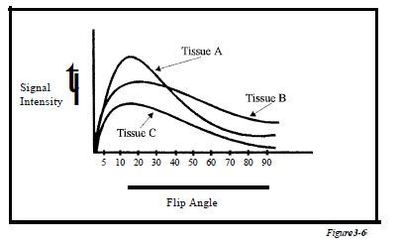
- AT1 relaxation curve
- BInversion recovery curve
- CT2 relaxation curve
- DT2* relaxation curve
Information
- Description
- Diploma Magnetic Resonance Quiz on Practice Set (3) - Image Weighting and Contrast, created by Thea Ampofo on 24/01/2016.
- Author
- Thea Ampofo
- Language
- English
- Views
- 511
- Tags
- Rating
- No ratings yet Rate this quiz