
Quiz
Revising transactional writing
This quiz has question types that open in the usual player.
Questions in this quiz (10)
1What is the transaction that takes place in transactional writing?

- AKnowledge of the subject gained from the 2 non-fiction texts is used to craft an original piece of writing for a specific purpose which requires the audience to act on the information in some way.
- BKnowledge gained from the 2 non-fiction texts is used to create a pastiche of one of these texts in which the purpose and audience is changed.
- CThe transaction is between the writer and reader as the purpose of the writing means the reader has to act on the information given.
- DThe 2 non-fiction texts from the reading section inform the way the writing task is completed.
2What are the 5 purposes of transactional writing?

- AArgue
- BPersuade
- CAdvise
- DInform
- EExplain
- FImagine
- GExplore
- HEntertain
- IDescribe
3You will only have to write for one of the 5 purposes in the task on the exam paper.

- ATrue
- BFalse
4What is the first thing you should do when reading the transactional writing task on the exam paper?

- AIdentify the SPAF.
- BWork out the thematic link to the non-fiction texts.
- CStart making a note of subject-specific vocabulary to use.
- DDecide on the structure of your response.
5Complete the definition of SPAF by choosing the correct annotation from the drop-down menus.
S stands for [blank_start]'subject' the topic[blank_end] you are being asked to write about. It will always be [blank_start]thematically[blank_end] linked to the 2 non-fiction texts from the reading section of the paper so you can use these as source material for your response.
P stands for [blank_start]purpose[blank_end]. There are [blank_start]5[blank_end] purposes in transactional writing: [blank_start]argue, persuade, advise, inform, explain[blank_end]. The task will require you to use conventions of [blank_start]one or more of these.[blank_end]
A stands for [blank_start]audience[blank_end]. This is the group of people the text is intended for. Audiences are [blank_start]broad[blank_end] e.g. cyclists but all have something in common which helps you to make choices of [blank_start]subject-specific vocabulary[blank_end], tone, register and the most appropriate conventions of the purpose(s) to use.
F stands for [blank_start]form.[blank_end] This is the specific [blank_start]type[blank_end] of text you will be asked to write. It will always be a [blank_start]non-fiction form[blank_end] of text and could be a web-based text such as a [blank_start]webpage or blog post.[blank_end]
- A'subject' the topic
- Bthe sentence variation
- Cthe symbolism
- Dthematically
- Estructurally
- Fpuposefully
- Gpurpose
- Hpeople
- Iparagraphs
- J5
- K3
- L6
- Margue, persuade, advise, inform, explain
- Nimagine, explore, entertain, describe
- Oinform, explain, describe, narrate
- Pone or more of these.
- Qjust one of these
- Rall 5 of these
- Saudience
- Tadjectives and adverbs
- Uattention to detail
- Vbroad
- Wgeneral
- Xspecific
- Ysubject-specific vocabulary
- Zpunctuation marks
- AAstructural devices
- ABform.
- ACfunction.
- ADfit for purpose.
- AEtype
- AFstyle
- AGgenre
- AHnon-fiction form
- AIcreative writing form
- AJfictional form
- AKwebpage or blog post.
- ALtwitter post
- AMformal email
6Annotate this transactional writing exam task by dragging and dropping the SPAF labels to the correct hotspots on the two tasks.
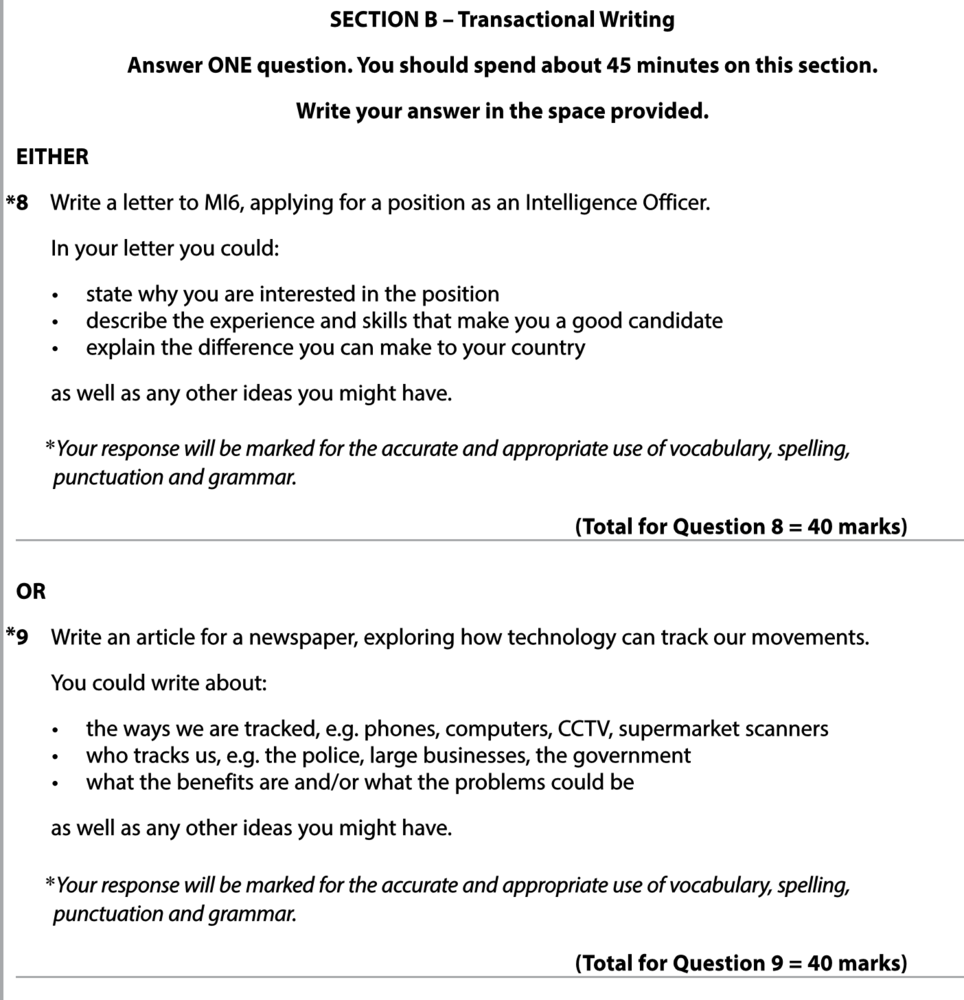
- AF= formal letter
- BF = informal letter
- CA = MI6
- DA = British Government
- ES = applying for a job as a spy
- FS = job application
- GP = to explain, also inform & persuade
- HP = explain
- IForm = article
- JForm = newspaper
- KS= use of technology to track us
- LS= tracking technology
- MP= inform, explain
- NP = explore, explain
- OA = choose specific newspaper readers
- PA= not specified so general public
7Here is a high-scorning response to the transactional writing task that asked for a letter of application to MI6.
Complete the response by making the appropriate choices of vocabulary from the options in the drop-down menus.
Throughout my [blank_start]post[blank_end] school experiences I have [blank_start]acquired[blank_end] several sets of skills that [blank_start]enable[blank_end] me to be the best in this field. I spent the three years post-university (between the age of twenty-one and twenty-four) training at Sandhurst where I have [blank_start]pushed[blank_end] myself not only physically but also mentally. This [blank_start]encouraged[blank_end] me to believe, achieve and succeed. I now have the self-determination and physical condition to [blank_start]attempt[blank_end] any mission necessary. My fitness levels are [blank_start]extremely[blank_end] high. I regularly take part in 5-a-side, which not only develops my fitness but also [blank_start]encourages[blank_end] team work and collaboration. Finally from the age of thirteen I trained in mixed martial arts and [blank_start]attained[blank_end] a black belt, showing that I am skilled in safe self-preservation and combat. These are [blank_start]essential[blank_end] skills in the times our country faces.
- Apost
- Bafter
- Cout of
- Dacquired
- Egained
- Fgot
- Genable
- Hallow
- Iempower
- Jpushed
- Ktrained
- Lexerted
- Mencouraged
- Nled
- Oallowed
- Pattempt
- Qcomplete
- Rundertake
- Sextremely
- Treally
- Uvery
- Vencourages
- Wpromotes
- Xsupports
- Yattained
- Zgot
- AAachieved
- ABessential
- ACimportant
- ADvital
8Structure simply means the order in which you present your ideas.

- ATrue
- BFalse
9Which of these devices can be used to give structure to your writing?

- ASubheadings
- BRepetition
- CBullet point or numbered lists
- DTopic sentences
- EText boxes
- FBold/coloured fonts
10Choose the elements that make an effective piece of transactional writing.

- AConscously crafted to have impact on the intended audience.
- BDeliberate choices made of vocabulary, structure, conventions to match the SPAF.
- CIncludes a variety of sentence forms and structures appropriate to SPAF.
- DIs developed and sustained.
- EDraws on different sources for ideas
- FUses punctuation deliberately to enhance meaning and create particular effects.
- GDemonstrates accurate spelling, punctuation and grammar.
- HIs written neatly and easy to read.
- IContains all three sentence structures and all four forms.
- JUses emotive language
Information
- Description
- A revision quiz to help learners recap the key concepts and skills they have learnt throughout the transactional writing unit. This resource relates to the Edexcel (9-1) GCSE English Language specification.
- Author
- Sarah Holmes
- Language
- English
- Views
- 1,180
- Tags
- Rating
- No ratings yet Rate this quiz