
Quiz
Neuropathology III - Raised ICP, SOL & Trauma
This quiz has question types that open in the usual player.
Questions in this quiz (17)
1The normal ICP range is between 5-10mmHg. Anything over [blank_start]15[blank_end]mmHg is considered to be a high ICP
- A15
2[blank_start]Hydrocephalus[blank_end] is an accumulation of excessive CSF within the ventricular system of the brain.
- AHydrocephalus
3The normal volume of CSF is ...
- A120-150ml
- B100-130ml
- C150-170ml
- D150-250ml
4As CSF travels from the 3rd to the 4th ventricle via the cerebral aqueduct, some can escape via two distinct foramen called ...
- AThe foramen of Magendie
- BThe foramen of Luschka
- CThe foramen of Roberts
- DThe foramen of Winslow
- EThe foramen of Panizza
5Types of Hydrocephalus:
[blank_start]Communicating[blank_end] = Obstruction to CSF flow originates outside the ventricular system (e.g. subarachnoid space)
[blank_start]Non-Communicating[blank_end] = Obstruction to CSF flow originates within the ventricular system- ACommunicating
- BNon-Communicating
- CObstructive
- DNon-Obstructive
6Raised ICP can cause coning of the brainstem, which leads to death due to ...
- ALack of ability to breathe normally
- BLack of ability to regulate heart rate (extreme bradycardia causes death)
- CImmunosuppression (death via infection)
- DLoss of downwards neurological controls
7Temporal lobe uncal herniation typically leads to compression of which cranial nerve?
- AOculomotor Nerve
- BTrigeminal Nerve
- CFacial Nerve
- DGlossopharyngeal Nerve
- EVagus Nerve
8In children, 70% of tumours arise below which structure?
In adults, approximately 70% of tumours arise above this structure.- ATentorium Cerebelli
- BDiaphragm Sellae
- CPons
- DCorpus Callosum
- E3rd Ventricle
9In both children and adults, the most common type of tumour is ...
- AAstrocytoma
- BOligodendroglioma
- CEpendymoma
- DMeningioma
- ESchwannoma
- FLymphoma
10If an astrocytoma shows neovascularization, it is most likely to be a ...
- APilocytic Astrocytoma
- BWell Differentiated Astrocytoma
- CAnaplastic Astrocytoma
- DGlioblastoma
11Which astrocytoma is the most common brain tumour in children?
- APilocytic astrocytoma
- BWell differentiated astrocytoma
- CAnaplastic astrocytoma
- DGlioblastoma Multiforme
12The second most common brain tumour in children after pilocytic astrocytoma is ...
- AMedulloblastoma
- BCraniopharyngioma
- CMeningioma
- DEpendymoma
13Is medulloblastoma more sensitive to chemo or radiotherapy?
- AChemotherapy
- BRadiotherapy
14This patient, who suffered from headaches and fever, is likely to have suffered which condition?
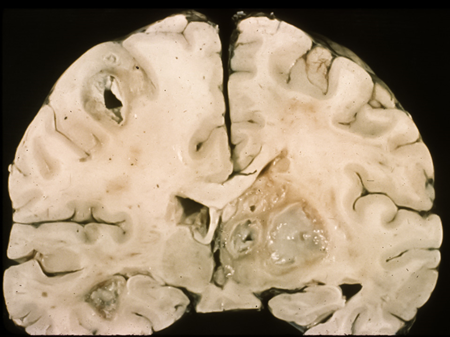
- AMultiple brain abscesses
- BMultiple brain metastases
15Common causes of bacterial meningitis:
[blank_start]E.coli[blank_end] = Neonates
[blank_start]H.Influenzae[blank_end] = Infants & Children
[blank_start]Neisseria Meningitidis[blank_end] = Adolescents & Young Adults
[blank_start]Listeria Monocytogenes[blank_end] = Older Adults- AE.coli
- BH.Influenzae
- CNeisseria Meningitidis
- DListeria Monocytogenes
16Coup & Contracoup Brain Injuries:
[blank_start]Coup[blank_end] = Occurs to the brain on the side of the impact
[blank_start]Contracoup[blank_end] = Occurs to the brain on the diametrically opposite point of impact
[blank_start]Contracoup[blank_end] injuries are typically the more severe injuries.- ACoup
- BContracoup
- CContracoup
- DCoup
- EContracoup
- FCoup
17Diffuse Axonal Injury is typically caused via [blank_start]blunt[blank_end] trauma to the head. This lesions typically affect the [blank_start]central[blank_end] structures of the brain and, if they don't cause immediate death, leads to multiple clusters of [blank_start]microglial[blank_end] cells throughout the white matter weeks after injury.
- Ablunt
- Bpenetrative
- Ccentral
- Dperipheral
- Emicroglial
- Foligodendritic
- Gastrocytic
- Hneutrophilic
Information
- Description
- Neuropathology III - Raised ICP, Space Occupying Lesions & Trauma lecture given in week 4
- Author
- Matthew Coulson
- Language
- English
- Views
- 67
- Tags
- Rating
- No ratings yet Rate this quiz