
Quiz
BIOL2022 L06 ANOVA in practice. Why do it? Analyses with more than two means; interactions
This quiz has question types that open in the usual player.
Questions in this quiz (5)
1ANOVA vs t-tests:
Fundamentally, what can ANOVA do that t-tests can’t?- AWork with more than 2 means
- BCook steak fuckin’ perfectly
- CCompare means directionally
2Homogeneity of variance:
Levene’s and Cochran’s are different tests for this homogeneity/heterogeneity of variance.
If they are found to be significant (P<0.05), this means:- ANeed to transform first
- BData is good, go ahead
3Homogeneity of variance:
Levene’s and Cochran’s are different tests for this homogeneity/heterogeneity of variance.
If they are found to be not significant (P>0.05), this means:- ANeed to transform data first
- BData is good, go ahead
4ANOVA is good an all that, but:
Data [blank_start]___________[blank_end];
Normality [blank_start]____________[blank_end];
Variance [blank_start]____________[blank_end].- Amust be independent
- Bisn’t important
- Cmust be homogeneous
- Dneed not be independent
- Eneed not be homogeneous
- Fis important
- Gmust be independent
- Hisn’t important
- Imust be homogeneous
- Jneed not be independent
- Kneed not be homogeneous
- Lis important
- Mmust be independent
- Nisn’t important
- Omust be homogeneous
- Pneed not be independent
- Qneed not be homogeneous
- Ris important
5What conclusion(s) can be drawn from this 2-way ANOVA?
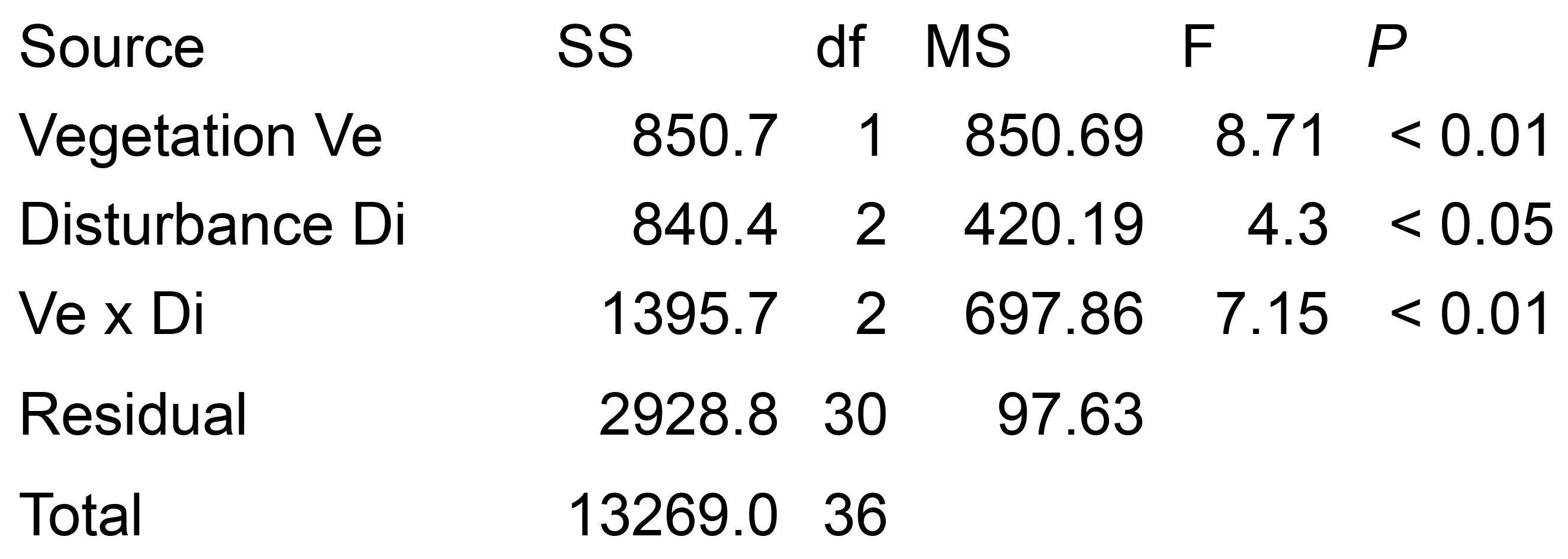
- AVegetation and Disturbance have a significant interaction
- BVegetation has a significant effect
- CDisturbance has a significant effect
- DNo significance can be drawn from this ANOVA
Information
- Description
- Module 1, Lecture 6 By the end of this lecture you should understand: - Why we need ANOVA - Entering data and running a 1-way ANOVA - Interpreting a 1-way ANOVA - Entering data and running a 2-way orthogonal ANOVA - Interpretation of one of those ^^
- Author
- Deleted user
- Language
- English
- Views
- 23
- Tags