
Quiz
Tides
This quiz has question types that open in the usual player.
Questions in this quiz (19)
1What are tides?
- APeriodic, short-term changes in the height of the ocean surface at a particular place
- BThe constant waves that lap up on a coast.
- CA laundry detergent
- DA yummy snack. (No. just no.)
2What causes tides?
- AThe gravitational force of the Moon, Sun, and Earth
- BWind
- CWater Displacement
- DDirty laundry
3Tide waves are the [blank_start]longest[blank_end] waves on earth: their wavelength is [blank_start]half[blank_end] of the Earth's circumference. These waves are known as [blank_start]forced[blank_end] waves.
- Alongest
- Bshortest
- Chalf
- D1/3
- E1/10
- F2/3
- Gforced
- Hnatural
- Irogue
4The moon's gravity [blank_start]attracts[blank_end] the ocean. Then the Motion of the Earth around the [blank_start]center of mass[blank_end] of the Earth-moon system causes a [blank_start]bulge[blank_end] on the side of the earth [blank_start]opposite[blank_end] the moon. Combined, this creates two [blank_start]bulges[blank_end].
- Aattracts
- Brepels
- Ccenter of mass
- Dmidpoint
- Eedge
- Fbulge
- Gdivot
- Hbulges
- Idivots
- Jopposite
- Kfacing
5[blank_start]High tides[blank_end]: the bulges are the crests of the planet-sized waves
[blank_start]Low tides[blank_end]: the troughs, the area between the bulges- AHigh tides
- BLow tides
6Label the image
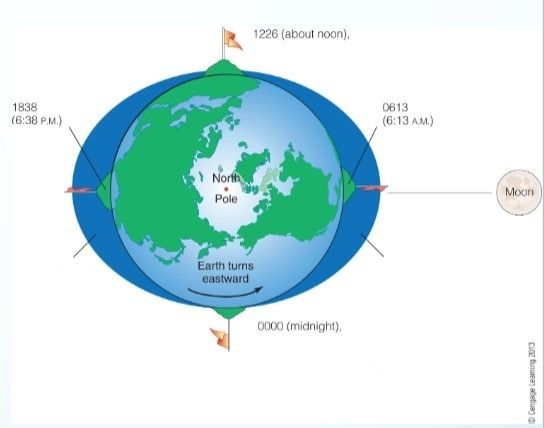
- AIsland exposed
- BIsland submerged (evening)
- CIsland high & dry
- DInertia bulge
- EGravity bulge
- FIsland submerged (morning)
7Lunar tides:
- Atides caused by gravitation & inertial interaction of the moon and Earth
- Btides caused by gravitation & inertial interaction of the sun and Earth
- Ctides caused by Luna Lovegood, because she's great
8In a 24h solar day, the moon moves [blank_start]12.2[blank_end] degrees eastward. The earth must rotate another [blank_start]50[blank_end] minutes to again place the moon at the highest position.
- A12.2
- B50
- C10.2
- D21.2
- E50
- F12.2
- G40
- H10
9The sun has a greater effect on Earth's tide than the moon.
- ATrue
- BFalse
10[blank_start]Spring tide[blank_end]: when earth, moon, and sun are all in a line. These are [blank_start]additive[blank_end], and correspond to the [blank_start]new and full[blank_end] moons.
[blank_start]Neap tide[blank_end]: When earth, sun, and moon form a right angle. Tide [blank_start]diminishes[blank_end] the lunar tide, and correspond with the [blank_start]quarter[blank_end] moons.- ASpring tide
- Badditive
- Cnew and full
- DNeap tide
- Ediminishes
- Fquarter
11Land masses obstruct tidal crests, diverting and [blank_start]slowing[blank_end] movement. This causes different patterns in the arrival of tidal crests and is influenced by [blank_start]basin shape[blank_end].
- Aslowing
- Bquickening
- Cbasin shape
- Dwater depth
- Ebasin depth
- Fsalinity
12[blank_start]Semidiurnal[blank_end] tides: two high tides and two low tides of nearly equal level each lunar day
[blank_start]Diurnal[blank_end] tides: on high and one low
[blank_start]Mixed semidiurnal[blank_end] tides: successive high tides or low tides are of significantly different heights in the lunar day- ASemidiurnal
- BDiurnal
- CMixed semidiurnal
13Amphidromic points:
- Anodes at the center of ocean basins, no-tide points
- Bnodes at the center of ocean basins, high-tide points
14Tidal ranges increase with increasing distance from amphidromic points
- ATrue
- BFalse
15Water flow into or out of bays and harbors is known as...
- Atidal current
- Btidal flow
- Cwaves
- Dtidal waves
16[blank_start]Flood current[blank_end]: water rushing into an enclosed area because of the rise in sea level as a tide crest approaches
[blank_start]Ebb current[blank_end]: water rushing out because of the fall in sea level as the tide trough approaches
[blank_start]Slack water[blank_end]: a time of no currents, occurs at high and low tides when the current changes direction- AFlood current
- BEbb current
- CSlack water
- DTide current
17Tidal friction is gradually slowing the Earth's rotation.
- ATrue
- BFalse
18What is the intertidal zone?
- AThe zone between the high tide and low tide
- BThe zone in the middle of the high tide where there is a high concentration of life
- CThe part of the beach where the water reaches during high tide, but not low tide
- DThe final frontier
19Check all that apply to organisms in the intertidal zone
- ASessile organisms are emerged and submerged
- BMigrate with the tide
- CTriggers spawning
- DTriggers mating
Information
- Description
- quiz covering tides from oceanography course at UWF
- Author
- Jo O'Bar
- Language
- English
- Views
- 117
- History
- Created on 13 Nov 2018 · updated on 11 Dec 2018
- Tags
- Rating
- No ratings yet Rate this quiz