
Quiz
Passive Design- Passive solar heating
This quiz has question types that open in the usual player.
Questions in this quiz (38)
1Fossil fuel resources are not [blank_start]endless[blank_end], so the price of it will rise in the future. [blank_start]Renewable[blank_end] energy [blank_start]technology[blank_end] will be developed further and might get [blank_start]cheaper[blank_end], however they still need an initial [blank_start]investment[blank_end].
- Aendless
- BRenewable
- Ctechnology
- Dcheaper
- Einvestment
2Sustainable Design: The [blank_start]tier[blank_end] [blank_start]approach[blank_end]
[blank_start]Renewable[blank_end] energy
Mechanical [blank_start]heating[blank_end] and [blank_start]cooling[blank_end]
[blank_start]passive[blank_end] systems
[blank_start]basic[blank_end] building design
Renewable energy- Mechanical heating and cooling
However the [blank_start]mechanical[blank_end] system won't be [blank_start]small[blank_end] enough to be powered by [blank_start]renewable[blank_end] energy or passive systems won't work. Basic building design must be [blank_start]climate[blank_end] responsive.- Atier
- Bapproach
- CRenewable
- Dheating
- Ecooling
- Fpassive
- Gbasic
- Hsmall
- Iclimate
- Jrenewable
- Kmechanical
3Passive Design
-Passive design is a key element of [blank_start]sustainable[blank_end] construction
-Maximise [blank_start]comfort[blank_end] + minimise [blank_start]energy[blank_end] use
-only use the energy available locally (nothing new: similar to vernacular architecture)
-uses the [blank_start]natural[blank_end] flow of energy prevailing on site and works with it
1. to [blank_start]heat[blank_end]
2. to [blank_start]cool[blank_end]
3. to ill[blank_start]uminate[blank_end]
4. to ven[blank_start]tilate[blank_end] a place- Asustainable
- Bcomfort
- Cenergy
- Dnatural
- Eheat
- Fcool
- Guminate
- Htilate
4Passive Design.
has been [blank_start]adapted[blank_end] by a design which generally uses little [blank_start]energy[blank_end], and is highly energy efficient.
with this new interpretation of passive design small mechanical "[blank_start]active[blank_end]" [blank_start]appliances[blank_end] can be used to achieve user [blank_start]comfort[blank_end].- Aadapted
- Benergy
- Cactive
- Dcomfort
- Eappliances
5Passive Design
-low [blank_start]energy[blank_end] and energy [blank_start]efficent[blank_end] buildings means careful considerations of [blank_start]heating[blank_end], [blank_start]cooling[blank_end], [blank_start]lighting[blank_end] and [blank_start]ventilation[blank_end] systems
-[blank_start]solar[blank_end] [blank_start]control[blank_end] means of heating, cooling and ventilating needs to be [blank_start]available[blank_end] when it would be beneficial but has to be eliminated if detrimental to a comfortable [blank_start]indoor[blank_end] [blank_start]climate[blank_end].- Aenergy
- Befficent
- Cheating
- Dcooling
- Elighting
- Fventilation
- Gcontrol
- Hsolar
- Iavailable
- Jindoor
- Kclimate
6Passive Design
-uses the following principles to improve on the [blank_start]thermal[blank_end] [blank_start]comfort[blank_end] and [blank_start]energy[blank_end] performance of a building
1. [blank_start]orientation[blank_end]
2. [blank_start]glazing/solar control[blank_end]
3. [blank_start]insulation[blank_end]
4. [blank_start]ventilation[blank_end]
5. [blank_start]zoning[blank_end]
6. [blank_start]thermal mass[blank_end]- Athermal
- Bcomfort
- Cenergy
- Dorientation
- Eglazing/solar control
- Finsulation
- Gventilation
- Hzoning
- Ithermal mass
7The building [blank_start]bioclimatic[blank_end] chart
-used as a tool to decide what [blank_start]systems[blank_end] are valid for the [blank_start]climate[blank_end]
Procedure
-plot 2 points
1. monthly average [blank_start]min[blank_end] temp with the [blank_start]max[blank_end] rh
2. monthly average max [blank_start]temp[blank_end] with the min [blank_start]rh[blank_end]
- then link both points for each month
- each [blank_start]line[blank_end] will represent the hange in temp and rh over and averge [blank_start]day[blank_end]
- one "pair" of data = 1 point
- one line = 1 month- Abioclimatic
- Bsystems
- Cclimate
- Dmin
- Emax
- Ftemp
- Grh
- Hline
- Iday
8Passive [blank_start]solar[blank_end] heating
- technique that uses [blank_start]heat[blank_end] of the [blank_start]sun[blank_end] to [blank_start]regulate[blank_end] a buildings [blank_start]temp[blank_end] without using other [blank_start]energy[blank_end] [blank_start]sources[blank_end]
- successful use of passive design depends upon
1. the [blank_start]correct[blank_end] understanding of [blank_start]sun's[blank_end] [blank_start]movements[blank_end]
2. the best use of [blank_start]mterials[blank_end] and their [blank_start]placement[blank_end] in order to capitalise on the solar energy- Asolar
- Bheat
- Csun
- Dregulate
- Etemp
- Fenergy
- Gsources
- Hsun's
- Icorrect
- Jmovements
- Kmterials
- Lplacement
9Main objectives of solar [blank_start]heating[blank_end]
1. to [blank_start]minimise[blank_end] all [blank_start]areas[blank_end] of heat [blank_start]loss[blank_end] from the building
2. [blank_start]maximise[blank_end] heat [blank_start]gains[blank_end] within each [blank_start]space[blank_end]- Aheating
- Bminimise
- Closs
- Dareas
- Emaximise
- Fgains
- Gspace
10Passive Solar heating
- to [blank_start]minimise[blank_end] [blank_start]heat[blank_end] [blank_start]loss[blank_end] by
1. [blank_start]infiltration[blank_end]
2. [blank_start]conduction[blank_end]- Aminimise
- Bloss
- Cinfiltration
- Dconduction
- Eheat
11[blank_start]Infilitration[blank_end]
- [blank_start]air[blank_end] moving [blank_start]through[blank_end]
1. [blank_start]cracks[blank_end]
2. [blank_start]apertures[blank_end] (openings)
3. [blank_start]porous[blank_end] [blank_start]elements[blank_end] of the [blank_start]building[blank_end] [blank_start]fabrics[blank_end]
this can be [blank_start]minimised[blank_end] by making sure that the building [blank_start]envelop[blank_end] is [blank_start]airtight[blank_end] and not [blank_start]leaking[blank_end]- AInfilitration
- Bair
- Cthrough
- Dcracks
- Eapertures
- Fporous
- Gelements
- Hbuilding
- Ifabrics
- Jminimised
- Kenvelop
- Lairtight
- Mleaking
12[blank_start]Conduction[blank_end]
can be [blank_start]minimised[blank_end] by
1. usuing sufficient [blank_start]insulation[blank_end] for the building [blank_start]envelope[blank_end]
2. using [blank_start]double[blank_end] / [blank_start]triple[blank_end] glazed [blank_start]windows[blank_end]
3. [blank_start]avoiding[blank_end] [blank_start]thermal bridges[blank_end]- AConduction
- Bminimised
- Cinsulation
- Denvelope
- Edouble
- Ftriple
- Gwindows
- Havoiding
- Ithermal bridges
13Passive solar heating
- [blank_start]maximise[blank_end] [blank_start]solar[blank_end] [blank_start]gain[blank_end]
- there are several types of [blank_start]solar systems[blank_end] that can exploit solar gain
1. [blank_start]direct[blank_end] gain system
2. [blank_start]indirect[blank_end] gain system
3. [blank_start]isolated[blank_end] gain system- Amaximise
- Bsolar
- Cgain
- Dsolar systems
- Edirect
- Findirect
- Gisolated
14Passive solar heating system involves
- a [blank_start]collection[blank_end] of [blank_start]solar radiation[blank_end] (typically through [blank_start]equator-facing windows[blank_end])
- [blank_start]storage[blank_end]
1. takes place in [blank_start]thermal mass[blank_end] which [blank_start]absorbs[blank_end] a large amount of [blank_start]solar energy[blank_end]. thermal mass is characterised by its ability to [blank_start]absorb[blank_end] and [blank_start]store[blank_end] [blank_start]heat[blank_end] to then [blank_start]re-radiate[blank_end] it at a [blank_start]later[blank_end] time
- [blank_start]distribution of solar energy[blank_end]
1. through [blank_start]radiation[blank_end], [blank_start]convection[blank_end] and [blank_start]conduction[blank_end]. (small [blank_start]pumps[blank_end] and [blank_start]fans[blank_end] might assist in this process)
- [blank_start]control of solar radiation admittance[blank_end]- Acollection
- Bsolar radiation
- Cequator-facing windows
- Dstorage
- Ethermal mass
- Fabsorbs
- Gsolar energy
- Habsorb
- Istore
- Jheat
- Kre-radiate
- Llater
- Mdistribution of solar energy
- Nradiation
- Oconvection
- Pconduction
- Qpumps
- Rfans
- Scontrol of solar radiation admittance
15[blank_start]Thermal Mass[blank_end]
-[blank_start]materials[blank_end] which have the [blank_start]capacity[blank_end] to [blank_start]store thermal energy[blank_end] for [blank_start]extended[blank_end] periods
-[blank_start]applications[blank_end]
1.passivve [blank_start]solar heating[blank_end]
2. [blank_start]passive cooling[blank_end]
-[blank_start]functions[blank_end]
1. [blank_start]moderates indoor temperature[blank_end] fluctutations
2. [blank_start]reduces heat flow[blank_end] through [blank_start]envelope[blank_end]
3. [blank_start]stores energy[blank_end]
- [blank_start]dampens[blank_end] & [blank_start]shifts[blank_end] [blank_start]peak loads[blank_end]- AThermal Mass
- Bmaterials
- Cstore thermal energy
- Dcapacity
- Eextended
- Fapplications
- Gsolar heating
- Hpassive cooling
- Ifunctions
- Jmoderates indoor temperature
- Kreduces heat flow
- Lenvelope
- Mstores energy
- Ndampens
- Oshifts
- Ppeak loads
16[blank_start]Inside[blank_end] and [blank_start]outside[blank_end] [blank_start]temperatures[blank_end] also known as [blank_start]time lag[blank_end] and [blank_start]decrement factor[blank_end].
[blank_start]Time lag[blank_end]
1. the [blank_start]time delay[blank_end] due to the [blank_start]thermal mass[blank_end] known as a time lag
2. the [blank_start]thicker[blank_end] and more [blank_start]resistive[blank_end] the [blank_start]material[blank_end], the [blank_start]longer[blank_end] it will take for [blank_start]heat waves[blank_end] to [blank_start]pass through[blank_end]
[blank_start]Decrement factor[blank_end]
1. the [blank_start]reduction[blank_end] in [blank_start]cyclical temperature[blank_end] on the [blank_start]inside surface[blank_end] compared to the [blank_start]outside surface[blank_end] is known as [blank_start]decrement[blank_end]
2. a material with a [blank_start]decrement value[blank_end] of [blank_start]0.5[blank_end] which experiences a [blank_start]20[blank_end] degree celcius [blank_start]diurnal variation[blank_end] in the [blank_start]external surface temperature[blank_end] would experience on a [blank_start]10[blank_end] degree celcius [blank_start]variation[blank_end] in the [blank_start]internal surface temperature[blank_end]- AInside
- Boutside
- Ctemperatures
- Dtime lag
- Edecrement factor
- FTime lag
- GDecrement factor
- Htime delay
- Ithermal mass
- Jthicker
- Kresistive
- Lmaterial
- Mlonger
- Nheat waves
- Opass through
- Preduction
- Qcyclical temperature
- Rinside surface
- Soutside surface
- Tdecrement
- U0.5
- Vdecrement value
- W20
- Xdiurnal variation
- Yexternal surface temperature
- Z10
- AAvariation
- ABinternal surface temperature
17[blank_start]Thermal mass[blank_end] for buildings
- for a [blank_start]material[blank_end] to provide a [blank_start]useful level[blank_end] of [blank_start]thermal mass[blank_end], a combination of three basic [blank_start]properties[blank_end] is required
1. [blank_start]high specific heat capacity[blank_end]
-to [blank_start]maximise[blank_end] the [blank_start]heat[blank_end] that can be [blank_start]stored[blank_end] [blank_start]per kg[blank_end] of material
2. [blank_start]high density[blank_end]
- to [blank_start]maximise the overall weight[blank_end] of the [blank_start]material used[blank_end]
3. [blank_start]moderate thermal conductivity[blank_end]
- so that [blank_start]heat conduction[blank_end] is roughly in [blank_start]synchronisation[blank_end] with the [blank_start]diurnal heat flow in and out[blank_end] of the [blank_start]building[blank_end]- AThermal mass
- Bmaterial
- Cuseful level
- Dthermal mass
- Eproperties
- Fhigh specific heat capacity
- Gmaximise
- Hheat
- Istored
- Jper kg
- Khigh density
- Lmaximise the overall weight
- Mmaterial used
- Nmoderate thermal conductivity
- Oheat conduction
- Psynchronisation
- Qdiurnal heat flow in and out
- Rbuilding
18What is the thermal conductivity of brick? [blank_start]0.77[blank_end]
what is the density of lightweight aggregate block? [blank_start]1400[blank_end]
what is the specific heat capacity of sandstone? [blank_start]1000[blank_end]
what is the effective thermal mass of timber? [blank_start]low[blank_end]
what is the effective thermal mass of concrete? [blank_start]high[blank_end]
what is the formula for desnity [blank_start](kg/m3)[blank_end]
what is the formula for thermal conductivity [blank_start](W/ mK)[blank_end]
what is the formula for heat capacity? [blank_start](J/ kg K)[blank_end]
what does TC stand for? [blank_start]thermal conductivity[blank_end]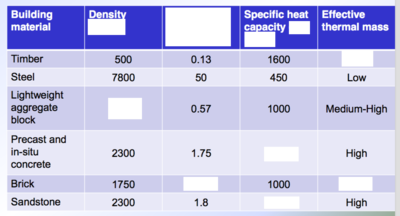
- A0.77
- B1400
- C1000
- Dlow
- Ehigh
- F(kg/m3)
- G(W/ mK)
- H(J/ kg K)
- Ithermal conductivity
19Thermal mass in [blank_start]summer[blank_end]
[blank_start]Day[blank_end]
- during [blank_start]hot[blank_end] weather, [blank_start]windows[blank_end] kept [blank_start]shut[blank_end] to keep [blank_start]warm air out[blank_end]
-[blank_start]overhangs[blank_end] on the [blank_start]south elevations[blank_end] to keep out [blank_start]high angle sun[blank_end] during the hottest part of the day
-[blank_start]cooling[blank_end] is provided by [blank_start]thermal mass[blank_end] in [blank_start]floors[blank_end] and [blank_start]walls[blank_end]
[blank_start]Night[blank_end]
- [blank_start]windows opened[blank_end] at night to [blank_start]ventilate[blank_end] the building iand [blank_start]cool[blank_end] the [blank_start]fabric[blank_end]
-if [blank_start]another hot day[blank_end] is expected, windows are closed again in the morning and [blank_start]cycle is repeated[blank_end]- Asummer
- BDay
- Chot
- Dwindows
- Eshut
- Fwarm air out
- Goverhangs
- Hsouth elevations
- Ihigh angle sun
- Jcooling
- Kthermal mass
- Lfloors
- Mwalls
- NNight
- Owindows opened
- Pventilate
- Qcool
- Rfabric
- Sanother hot day
- Tcycle is repeated
20Thermal mass in [blank_start]winter[blank_end]
[blank_start]Day[blank_end]
- during [blank_start]heating season[blank_end], [blank_start]low angle sun[blank_end] can enter through [blank_start]south-facing windows[blank_end], and the [blank_start]heat is absorbed[blank_end] by the [blank_start]thermal mass[blank_end] in the [blank_start]floor[blank_end] and [blank_start]walls[blank_end]
- in the [blank_start]evening[blank_end] when the sun goes down and the [blank_start]temperature drops[blank_end], the [blank_start]heat flow[blank_end] is [blank_start]reserved[blank_end] and [blank_start]passes[blank_end] back into the [blank_start]room[blank_end]
[blank_start]Night[blank_end]
- curtains are drawn and [blank_start]windows kept closed[blank_end] to [blank_start]minimise heat loss[blank_end]
- [blank_start]heat continues[blank_end] to be [blank_start]released[blank_end] by the thermal mass and [blank_start]supplementary heating[blank_end] is [blank_start]adjusted[blank_end] so only [blank_start]minimal[blank_end] amount is used
- [blank_start]morning[blank_end], the thermal mass will have given up most of its heat and the [blank_start]occupants[blank_end] will typically need to [blank_start]rely[blank_end] on s[blank_start]upplementary heating until later[blank_end] in the [blank_start]day[blank_end]- Awinter
- BDay
- Cheating season
- Dlow angle sun
- Esouth-facing windows
- Fheat is absorbed
- Gthermal mass
- Hfloor
- Iwalls
- Jevening
- Ktemperature drops
- Lheat flow
- Mreserved
- Npasses
- Oroom
- PNight
- Qwindows kept closed
- Rminimise heat loss
- Sheat continues
- Treleased
- Usupplementary heating
- Vadjusted
- Wminimal
- Xmorning
- Yoccupants
- Zrely
- AAupplementary heating until later
- ABday
21What 4 is type of passive heating system is shown in the image order them in terms of the image?
1. [blank_start]Direct[blank_end] system
2. [blank_start]Roof pond[blank_end] system
3. [blank_start]Thermal wall[blank_end] system
4. [blank_start]Sunspace[blank_end]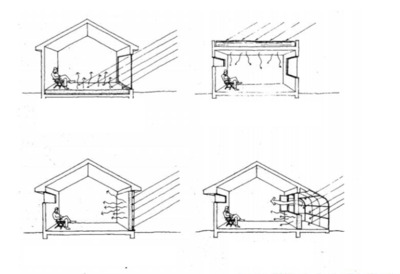
- ADirect
- BRoof pond
- CThermal wall
- DSunspace
22[blank_start]Direct gain[blank_end] system
-passive heating technique generally used in [blank_start]cold[blank_end] or [blank_start]temperate climates[blank_end]
-sunlight enters theough [blank_start]windows[blank_end], [blank_start]clerestories[blank_end] or [blank_start]skylights[blank_end] and is [blank_start]absorbed[blank_end] by the [blank_start]inside surfaces[blank_end] [blank_start](thermal mass)[blank_end]
- if the room is [blank_start]warm[blank_end] [blank_start]thermal mass[blank_end] will [blank_start]conduct heat[blank_end] into the [blank_start]core[blank_end]
- when [blank_start]temmperatures drop[blank_end] the [blank_start]heat[blank_end] is [blank_start]released slowly[blank_end]- ADirect gain
- Bcold
- Ctemperate climates
- Dwindows
- Eclerestories
- Fskylights
- Gabsorbed
- Hinside surfaces
- I(thermal mass)
- Jwarm
- Kthermal mass
- Lconduct heat
- Mcore
- Ntemmperatures drop
- Oheat
- Preleased slowly
23[blank_start]Direct gain[blank_end] system
thermal mass deisgn considerations
1. large areas of the [blank_start]equator-facing glazing[blank_end]
2. large areas of [blank_start]thermal mass[blank_end]
-[blank_start]solar exposure[blank_end]
-[blank_start]size/ thickness[blank_end]
-to [blank_start]absorb[blank_end] and [blank_start]store[blank_end] the required amount of [blank_start]energy[blank_end]
3. [blank_start]located in walls and floors[blank_end], in areas that experience [blank_start]direct solar gain[blank_end]
4. thermal mass should not [blank_start]lose the absorbed heat[blank_end] to the [blank_start]outside air[blank_end] [blank_start](insulation require)[blank_end]
5. needs to be [blank_start]exposed internally[blank_end] to work properly
-bare functionally and asthetically as possible, [blank_start]no carpet[blank_end] or other [blank_start]thermal mass material[blank_end] to cover, if need cover use [blank_start]ceramic tiles[blank_end].
- in [blank_start]summer[blank_end], [blank_start]shading[blank_end] of the [blank_start]collector surface is necessary[blank_end] in order to [blank_start]avoid overheating[blank_end]- ADirect gain
- Bequator-facing glazing
- Cthermal mass
- Dsolar exposure
- Esize/ thickness
- Fabsorb
- Gstore
- Henergy
- Ilocated in walls and floors
- Jdirect solar gain
- Klose the absorbed heat
- Loutside air
- M(insulation require)
- Nexposed internally
- Ono carpet
- Pthermal mass material
- Qceramic tiles
- Rsummer
- Sshading
- Tcollector surface is necessary
- Uavoid overheating
24Case study: [blank_start]Johnson Residence ArkinTilt Architects[blank_end] [blank_start]Gardnerville, Nevada[blank_end]
- winner of the AIA COTE top 10 green projects 2005
-[blank_start]direct gain passive solar[blank_end]
-[blank_start]straw bale[blank_end] with earthen finish, and [blank_start]concrete floors for thermal mass[blank_end]
- [blank_start]solar hot-water[blank_end] and [blank_start]deep sand bed hydronic heating system[blank_end]
-[blank_start]photovoltaic panels[blank_end] PV- AJohnson Residence ArkinTilt Architects
- BGardnerville, Nevada
- Cdirect gain passive solar
- Dstraw bale
- Econcrete floors for thermal mass
- Fsolar hot-water
- Gdeep sand bed hydronic heating system
- Hphotovoltaic panels
25Case study: [blank_start]Hidden Villa Youth Hostel[blank_end] [blank_start]ArkinTilt Architects[blank_end] [blank_start]Los Altos Hills, California[blank_end]
-winner of AIA COTE top 10 green projects [blank_start]2003[blank_end]
- [blank_start]direct gain passive solar[blank_end]
- [blank_start]rammed earth walls[blank_end] and [blank_start]concrete floors[blank_end] for [blank_start]thermal mass[blank_end]
-[blank_start]ground-source geothermal heat pump[blank_end] for [blank_start]hydronic heating system.[blank_end]- AHidden Villa Youth Hostel
- BArkinTilt Architects
- CLos Altos Hills, California
- D2003
- Edirect gain passive solar
- Frammed earth walls
- Gconcrete floors
- Hthermal mass
- Iground-source geothermal heat pump
- Jhydronic heating system.
26[blank_start]Indirect solar gain[blank_end]
-[blank_start]thermal mass located[blank_end] between the [blank_start]sun[blank_end] and the [blank_start]room[blank_end] (usually living room)
-thermal mass [blank_start]acting[blank_end] as [blank_start]insulation[blank_end], [blank_start]absorbs[blank_end] the [blank_start]direct sunlight[blank_end] and [blank_start]transfers[blank_end] it to the [blank_start]living space by radiation/ conduction[blank_end]- AIndirect solar gain
- Bsun
- Croom
- Dthermal mass located
- Einsulation
- Facting
- Gabsorbs
- Hdirect sunlight
- Itransfers
- Jliving space by radiation/ conduction
27Indirect solar gain types
1. [blank_start]solar or mass[blank_end] wall
2. [blank_start]trombe[blank_end] wall
3. [blank_start]translucent insulation[blank_end]
4. [blank_start]roof pond systems[blank_end]- Asolar or mass
- Btrombe
- Ctranslucent insulation
- Droof pond systems
28[blank_start]Mass wall[blank_end] - [blank_start]Indirect solar gain[blank_end]
- [blank_start]thermal mass[blank_end] located immediatley behind (south-facing) [blank_start]glass[blank_end]- AIndirect solar gain
- BMass wall
- Ctrombe wall
- Dthermal mass
- Eglass
29[blank_start]Trombe wall[blank_end]- [blank_start]indirect solar gain[blank_end]
-same principle as [blank_start]mass wal[blank_end]l but it as [blank_start]openings[blank_end] at the [blank_start]top[blank_end] and [blank_start]bottom[blank_end]
-[blank_start]sunlight passes through the glass[blank_end] and is [blank_start]absorbed[blank_end] and [blank_start]stored[blank_end] by the [blank_start]wall[blank_end]
-the [blank_start]vents[blank_end] at both [blank_start]upper and lower[blank_end] parts provide for [blank_start]air circulation[blank_end] and [blank_start]heat transfer[blank_end] in the space behind [blank_start]during the day[blank_end]
- the [blank_start]glass airspace[blank_end] keep the [blank_start]heat[blank_end] [blank_start]from radiating back to the outside[blank_end]
- heat is [blank_start]transferred[blank_end] by [blank_start]conduction/ radiation[blank_end] as the [blank_start]thermal mass[blank_end] [blank_start]surface warms up[blank_end], and is [blank_start]slowly delivered[blank_end] to the [blank_start]building[blank_end] some [blank_start]hours later[blank_end]- ATrombe wall
- Bindirect solar gain
- Cmass wal
- Dopenings
- Etop
- Fbottom
- Gsunlight passes through the glass
- Habsorbed
- Istored
- Jwall
- Kvents
- Lupper and lower
- Mair circulation
- Nheat transfer
- Oduring the day
- Pglass airspace
- Qheat
- Rfrom radiating back to the outside
- Stransferred
- Tconduction/ radiation
- Uthermal mass
- Vsurface warms up
- Wslowly delivered
- Xbuilding
- Yhours later
30[blank_start]Indirect gain system[blank_end]- design considerations
-wall facing the [blank_start]sun[blank_end] should be a [blank_start]dark colour[blank_end]
-[blank_start]vents closed at night[blank_end]
-varying [blank_start]thicknesses for thermal storage wall[blank_end], depending on [blank_start]material[blank_end] (brick, concrete, abode, rammed earth etc.)- AIndirect gain system
- Bsun
- Cdark colour
- Dvents closed at night
- Ethicknesses for thermal storage wall
- Fmaterial
31[blank_start]Transparent insulation[blank_end]- Indirect solar gain
-2 useful attributes
1. small [blank_start]u-value[blank_end]
2. high [blank_start]sunlight transmission[blank_end]
-[blank_start]compared[blank_end] to [blank_start]traditional insulation[blank_end] it aims to [blank_start]reduce heat loss[blank_end] and [blank_start]compensate[blank_end] with [blank_start]solar gains[blank_end] plus [blank_start]contributing to heating the interior.[blank_end]
How does it work?
1. [blank_start]solar rays cross[blank_end] the light [blank_start]permeable transparent insulation[blank_end] module and hit [blank_start]dark massive wall[blank_end]
2. [blank_start]solar radiation[blank_end] is [blank_start]converted[blank_end] into [blank_start]heat[blank_end] and [blank_start]stored[blank_end] in the [blank_start]wall[blank_end], which [blank_start]conducts the heat[blank_end] with [blank_start]time delay[blank_end] of several hours into the [blank_start]interior[blank_end]
3. carful cause could [blank_start]overheat during summer[blank_end], [blank_start]shading devices[blank_end] maybe [blank_start]required[blank_end]- ATransparent insulation
- Bu-value
- Csunlight transmission
- Dreduce heat loss
- Ecompared
- Ftraditional insulation
- Gcompensate
- Hsolar gains
- Isolar rays cross
- Jpermeable transparent insulation
- Kdark massive wall
- Lsolar radiation
- Mconverted
- Nheat
- Ostored
- Pwall
- Qcontributing to heating the interior.
- Rconducts the heat
- Stime delay
- Tinterior
- Uoverheat during summer
- Vshading devices
- Wrequired
32[blank_start]Trombe wall[blank_end] case study - [blank_start]Hostel for youth education institute[blank_end] [blank_start]Thomas Herzog, Windberg[blank_end], [blank_start]Germany[blank_end]
- south facade
1. [blank_start]recessed 1st floor[blank_end]
2. [blank_start]thermal storage wall[blank_end] behind [blank_start]glass[blank_end]
3. [blank_start]shading provided[blank_end] by large [blank_start]roof overhang + roll-down blinds[blank_end] [blank_start]between glass and TI[blank_end]
what does TI stand for ? [blank_start]Translucent insulation[blank_end]- ATrombe wall
- BHostel for youth education institute
- CThomas Herzog, Windberg
- DGermany
- Erecessed 1st floor
- Fthermal storage wall
- Gglass
- Hshading provided
- Iroof overhang + roll-down blinds
- Jbetween glass and TI
- KTranslucent insulation
33[blank_start]Isolated solar gain[blank_end]
-[blank_start]solar radiation collection[blank_end] and [blank_start]storage[blank_end] are [blank_start]thermally isolated[blank_end] from the [blank_start]living spaces[blank_end] of the building
1. [blank_start]sunspace[blank_end]
2. [blank_start]conservatories[blank_end]
-[blank_start]sunspace glazed room[blank_end] that is [blank_start]part[blank_end] of or [blank_start]attached[blank_end] to a [blank_start]building[blank_end] but which can be completely [blank_start]closed[blank_end] [blank_start]off[blank_end] from the main [blank_start]occupied areas[blank_end]- AIsolated solar gain
- Bsolar radiation collection
- Cstorage
- Dthermally isolated
- Eliving spaces
- Fsunspace
- Gconservatories
- Hsunspace glazed room
- Ipart
- Jattached
- Kbuilding
- Lclosed
- Moff
- Noccupied areas
34Case study: [blank_start]Overmeyer Residence Phil Tabb[blank_end], [blank_start]Architect Golden[blank_end], [blank_start]Colorado[blank_end]
-[blank_start]off-grid[blank_end] (no utility bills)
-[blank_start]attached sunspace[blank_end]
-operable [blank_start]clerestory windows for ventilation[blank_end]
-[blank_start]stone[blank_end] and [blank_start]concrete block for thermal mass[blank_end]
-[blank_start]photovoltaic panels[blank_end]
-[blank_start]wood stove[blank_end]- AOvermeyer Residence Phil Tabb
- BArchitect Golden
- CColorado
- Doff-grid
- Eattached sunspace
- Fclerestory windows for ventilation
- Gstone
- Hconcrete block for thermal mass
- Iphotovoltaic panels
- Jwood stove
35[blank_start]Isolated solar gain[blank_end]-functions of space
1. [blank_start]buffer space[blank_end]
-intermediate [blank_start]space[blank_end] between [blank_start]inside[blank_end] and [blank_start]outside[blank_end]
-[blank_start]adding another layer[blank_end] to buildings [blank_start]envelope[blank_end], [blank_start]thermal buffer[blank_end]
-[blank_start]shelter building envelope[blank_end] from wind chill, rain. more important in northern wind exposed locations
2. [blank_start]pre-heated ventilation[blank_end]
- [blank_start]openable vents[blank_end] in [blank_start]walls[blank_end] at [blank_start]top of sunspace[blank_end] to allow [blank_start]warm air flow[blank_end] in [blank_start]adjoining spaces[blank_end]
-[blank_start]cool air returned[blank_end] from [blank_start]living spaces via lower vents[blank_end] and [blank_start]heated[blank_end] as part of [blank_start]convective loop[blank_end], called [blank_start]thermosyphonic system[blank_end]
-[blank_start]mechanical ventilation[blank_end] [blank_start]increase penetration of pre-heated air[blank_end] deeper into [blank_start]adjoining rooms[blank_end]
3. [blank_start]thermal mass/ storage wall[blank_end]
- [blank_start]day warm air[blank_end] comes through [blank_start]vents[blank_end] to [blank_start]heat up space[blank_end]
-[blank_start]night[blank_end] when the air gets cold [blank_start]vents are closed[blank_end] and [blank_start]heat is transferred[blank_end] to [blank_start]living spaces[blank_end] through [blank_start]thermal storage wall[blank_end] separating the sunsapce from living space.- AIsolated solar gain
- Bbuffer space
- Cpre-heated ventilation
- Dthermal mass/ storage wall
- Espace
- Finside
- Goutside
- Hadding another layer
- Ienvelope
- Jthermal buffer
- Kshelter building envelope
- Lopenable vents
- Mwalls
- Ntop of sunspace
- Owarm air flow
- Padjoining spaces
- Qcool air returned
- Rliving spaces via lower vents
- Sheated
- Tthermosyphonic system
- Uconvective loop
- Vmechanical ventilation
- Wincrease penetration of pre-heated air
- Xadjoining rooms
- Yday warm air
- Zvents
- AAheat up space
- ABnight
- ACvents are closed
- ADheat is transferred
- AEliving spaces
- AFthermal storage wall
36[blank_start]Isolated solar gain[blank_end]- design considerations
1. [blank_start]double glazing[blank_end] should be considered ([blank_start]reduce conductive losses[blank_end])
2. the [blank_start]darker the internal surfaces[blank_end] of the sunspace, the [blank_start]more effective[blank_end] the ability of [blank_start]thermal mass[blank_end] to [blank_start]store heat during the day[blank_end]
3. [blank_start]consideration[blank_end] need when choosing sunspace with [blank_start]vegetation and pot-plants[blank_end] ([blank_start]foliage[blank_end] can [blank_start]obscure and shade main floor and wall)[blank_end]
4. [blank_start]easily overheat in summer[blank_end]
- can be [blank_start]resolved by shading[blank_end] via external shading from [blank_start]roof overhang[blank_end] or [blank_start]adjacent louvers[blank_end]
-[blank_start]deciduous trees[blank_end] (leafless trees will continue to shade to an extent)
-[blank_start]ventilating[blank_end] the sunspace by placing [blank_start]vents[blank_end] to the [blank_start]exterior through the roof[blank_end]- AIsolated solar gain
- Bdouble glazing
- Creduce conductive losses
- Ddarker the internal surfaces
- Emore effective
- Fthermal mass
- Gstore heat during the day
- Hconsideration
- Ivegetation and pot-plants
- Jfoliage
- Kobscure and shade main floor and wall)
- Leasily overheat in summer
- Mresolved by shading
- Nroof overhang
- Oadjacent louvers
- Pdeciduous trees
- Qventilating
- Rvents
- Sexterior through the roof
37Isolated gain system: Case study
1.[blank_start]ECOS homes[blank_end], [blank_start]Great Bow yard[blank_end], UK
2. Office and housing project, [blank_start]Gleisdorf, Austria, Reinberg Architects[blank_end]- AECOS homes
- BGleisdorf, Austria, Reinberg Architects
- CGreat Bow yard
38Thermal mass in commercial buildings
[blank_start]cost transfer[blank_end]
-[blank_start]integrated system approach[blank_end]
-[blank_start]enevelope/ architectural[blank_end]
-features vs infrastructure
[blank_start]Capital cost savings[blank_end]
-[blank_start]smaller equipments sizes[blank_end]
-[blank_start]less mechnical equipment[blank_end]
-[blank_start]smaller mechanical rooms[blank_end]
[blank_start]Operating cost savings[blank_end]
-[blank_start]reduced energy use[blank_end]
[blank_start]peak load shifting[blank_end]- Acost transfer
- BCapital cost savings
- COperating cost savings
- Dintegrated system approach
- Eenevelope/ architectural
- Fsmaller equipments sizes
- Gless mechnical equipment
- Hsmaller mechanical rooms
- Ireduced energy use
- Jpeak load shifting
Information
- Description
- minimise heat loss- infiltration and convection maximise solar gain- direct, indirect and isolated solar gain
- Author
- Raelle Barnard
- Language
- English
- Views
- 19
- Tags
- Rating
- No ratings yet Rate this quiz