
Quiz
Weather and Climate Exam 2 Review
This quiz has question types that open in the usual player.
Questions in this quiz (21)
1A thermometer is an example of a _______ method of observation because it must be in contact with the environment it's measuring.
- Adirect
- Bactive sensor
- Cindirect
- Dpassive sensor
2A Doppler Radar is considered a(n) _______ because it emits and receives radiation.
- Aactive sensor
- Bpassive sensor
- Cindirect method
- Ddirect method
3The ________ relates to the increase or decrease of frequency of a wavelength that changes as the source and observer move towards or away from each other. This is the theory that allows radars to work.
- ADoppler Effect
- BRadar Shift
- CShift Effect
- DPolarization Effect
4A satellite is an example of a(n) __________ method of observation because it can gather information about an environment without being in contact with it.
- Adirect
- Bindirect
- Cpassive sensor
- Dactive sensor
5This radar image shows an example of a(n) ________ which can indicate rotation possibly leading to tornado formation.
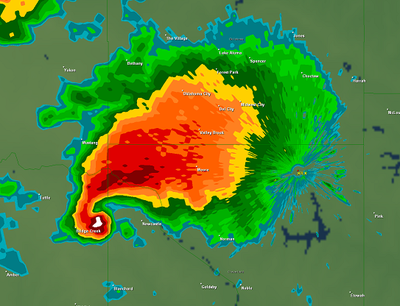
- Adebris ball
- Bhook echo
- Cvelocity couplet
- Dthunderstorm anvil
6A Lapse Rate is:
- Athe rate at which air temperature increases with increasing altitude
- Bthe rate at which air pressure increases with increasing altitude
- Cthe rate at which air pressure decreases with decreasing altitude
- Dthe rate at which air temperature decreases with increasing altitude
7The Windward side of a mountain will have drier and hotter conditions than the Leeward side.
- ATrue
- BFalse
8The circled area of this radar image shows a(n) ____________, which can be used to determine tornado activity.
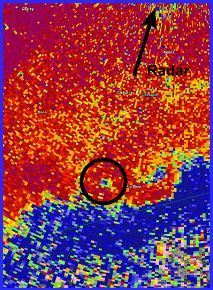
- Adebris ball
- Bhook echo
- Chail mass
- Dvelocity couplet
9a.) After a warm front passes through an area we can expect [blank_start]higher[blank_end] temperatures, winds from the [blank_start]south[blank_end], and higher dewpoints.
b.) After a [blank_start]cold front[blank_end] passes through an area we can expect lower temperatures, winds from the [blank_start]northwest[blank_end], and lower dewpoints.
c.) After a dryline passes through we can expect similar temperatures, but [blank_start]lower[blank_end] dewpoints.
d.) If we have cool, dry conditions both before and after a front passes, it must be an [blank_start]occluded front[blank_end].- Ahigher
- Bsouth
- Cnorth
- Dwest
- Eeast
- Fsoutheast
- Gsouthwest
- Hnortheast
- Icold front
- Jwarm front
- Kdryline
- Lnorthwest
- Mlower
- Noccluded front
10Match the air mass with the description:
a.) During the night, temperatures plummet into the negatives, in fact its so bitterly cold that President Mazey cancels classes. This describes an [blank_start]Artic (A)[blank_end] air mass.
b.) It's so hot and humid that it is unbearable to go outside. This describes a [blank_start]Maritime Tropical (mT)[blank_end] air mass.
c.) It's a cool, dry fall day, perfect for going on a walk and crunching leaves while drinking pumpkin spice lattes. This describes a [blank_start]Continental Polar (cP)[blank_end] air mass.
d.) It is a hot, dry day. It's like living in a desert. This describes a [blank_start]Continental Tropical (cT)[blank_end] air mass.
e.) It is a cool, rainy day, the kind that needs a jacket and umbrella. This describes a [blank_start]Maritime Polar (mP)[blank_end] air mass.- AArtic (A)
- BMaritime Tropical (mT)
- CContinental Polar (cP)
- DContinental Tropical (cT)
- EMaritime Polar (mP)
- FMoist Polar (mP)
- GCold Polar (cP)
- HMoist Tropical (mT)
11Lake effect snow occurs when ________ air passes over a ________ lake.
- Acold, cold
- Bwarm, cold
- Ccold, warm
- Dwarm, warm
12a.) At the height of [blank_start]2km[blank_end] we can find the LCL.
b.) It is possible to expect clouds from [blank_start]2km-4km[blank_end].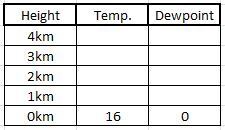
- A2km
- B3km
- C1km
- D0km
- E4km
- FNone of these options
- G2km-4km
- H1km-3km
- I0km-4km
- J2km-3km
- Knone of these options
13Where is the LCL located?
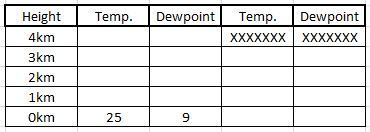
- A3km
- B2km
- C1km
- D4km
- E0km
14_________ occurs when air temperature decreases with a decrease in the pressure.
- AAdiabatic cooling
- BAdiabatic warming
- CConditional instability
- DAbsolute stability
15[blank_start]Visual Imagery[blank_end] is satellite based on reflectivity. Dark regions in an image are associated with a [blank_start]lower[blank_end] albedo, whereas bright regions are associated with a [blank_start]higher[blank_end] albedo. The [blank_start]bright[blank_end] regions often coincide with clouds. This form of imagery is not very effective during the [blank_start]nighttime[blank_end].
- AVisual Imagery
- Blower
- Chigher
- Dbright
- Enighttime
- Fdaytime
- GInfrared Imagery
- HWater Vapor
- Idark
16[blank_start]Infrared Imagery[blank_end] detects radiation at the infrared wavelengths. Colder clouds appear [blank_start]bright[blank_end] while [blank_start]darker[blank_end] objects are warm. This imagery can be used during the [blank_start]day or night[blank_end].
- AInfrared Imagery
- Bbright
- Cdarker
- Dday or night
- Enight only
- Fday only
- GVisible Imagery
- HWater Vapor Imagery
17This radar image shows an example of a(n) ____________ which can indicate roation possibly leading to tornadoes.
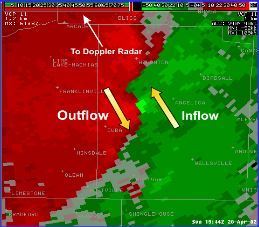
- Avelocity couplets
- Bdebris ball
- Chook echo
- Doutflowing
18What type of stability does this table demonstrate?
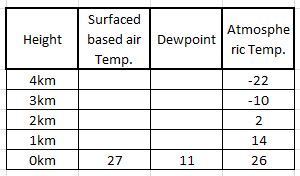
- AAbsolute instability
- BAbsolute stability
- CConditional stability
- DConditional instability
19What type of stability does this temperature demonstrate?
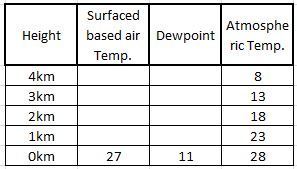
- AAbsolute stability
- BAbsolute instability
- CConditional stability
- DConditional instability
20What type of stability does this temperature demonstrate?
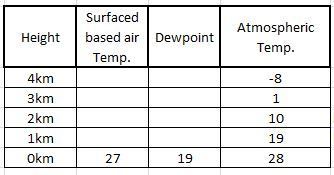
- AAbsolute stability
- BAbsolute instability
- CConditional stability
- DConditional instability
21At what height is the LFC and the EL?
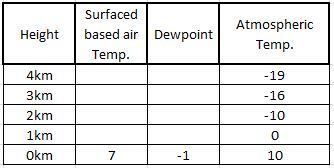
- A2km, 4km
- B2km, 3km
- C1km, 4km
- D1km, 3km
Information
- Description
- This is quiz filled with practice questions related to topics 6, 7, and 8. It does not count for any points and is only meant to be a reference to prepare for the Unit 2 Exam.
- Author
- Rebekkah Gresh
- Language
- English
- Views
- 123
- Tags
- Rating
- No ratings yet Rate this quiz