
Quiz
Chapter 4
This quiz has question types that open in the usual player.
Questions in this quiz (25)
1Why do astronomers build radio telescopes?
- ARadio waves give a different view of the universe
- BRadio waves from space reach the Earth’s surface
- CRadio telescopes can detect signals from aliens
- DRadio telescopes can be much larger than optical telescopes
2What type of telescope is most likely to suffer from chromatic aberration and have a low light-gathering power?
- Aa small diameter reflecting telescope
- Ba large diameter reflecting telescope
- Ca small diameter refracting telescope
- Da large diameter refracting telescope
3When does chromatic aberration occur in a telescope?
- Awhen different colours of light do not focus at the same point in a reflecting telescope
- Bwhen different colours of light do not focus at the same point in a refracting telescope
- Cwhen light of different wavelengths gets absorbed by the mirror in a reflecting telescope
- Dwhen light of different wavelengths gets absorbed by the lens in a refracting telescope
4What type of telescope is a radio telescope?
- Areflecting
- Brefracting
- Cdeflecting
- Dretracting
5What type of telescope has a lens as its objective and contains no mirrors?
- Adeflecting
- Breflecting
- Crefracting
- Dcompound
6How is the objective of most radio telescopes similar to the objective of a reflecting optical telescope?
- AThey are both bowl-shaped (concave)
- BThey are both hill-shaped (convex)
- CThey are typically the same size
- DThey are both made of metal
7What type of primary is found in a reflecting telescope?
- Aprism
- Bmirror
- Clens
- Ddiffraction grating
8You point your backyard reflecting telescope at the star Vega. Where does Vega’s light go?
- Afrom the primary mirror, to the secondary mirror, to the eyepiece
- Bfrom the primary mirror to the eyepiece
- Cthrough the primary lens, to the secondary mirror, to the eyepiece
- Dthrough the primary lens, through the secondary lens, to the eyepiece
9Which of the following best explains the concept of atmospheric windows?
- AHoles in the Earth’s atmosphere allow ultraviolet radiation to reach the North and South poles
- BX-ray radiation from space can see through the atmosphere to observe activities on the ground
- COnly certain wavelengths of electromagnetic radiation from space reach the Earth’s surface
- DThe Earth’s atmosphere can be “closed” or “open” to electromagnetic radiation, depending on the weather
10What is the main reason for building large optical telescopes?
- AIt’s the best way to see through clouds and other light-absorbers in the atmosphere
- BIt’s the best way to collect as much light as possible from faint objects
- CIt’s the best way to nullify the blurring effects of the Earth’s atmosphere and thus produce higher resolution images
- DIt’s the best way to magnify objects and make them brighter
11An astronomer takes two pictures of the same object using the Hubble Space Telescope. One picture is taken with red light and one with blue light. Which one would you expect to show finer details?
- ABlue light will show finer details
- BRed light will show finer details
- CBoth should be the same
- DThe amount of detail depends on the distance to the object
12Which property of a telescope determines its light-gathering power?
- Athe focal length of the objective
- Bthe focal length of the eyepiece
- Cthe diameter of the objective
- Dthe length of the telescope tube
13What is the light-gathering power of a telescope directly proportional to?
- Athe diameter of the primary mirror or lens
- Bthe focal length of the primary mirror or lens
- Cthe length of the telescope tube
- Dthe diameter of the eyepiece
14Why can’t a telescope image be magnified to show any level of detail?
- ADiffraction limits the amount of detail that is visible
- BTelescopes only view a small region of the sky
- CMagnification depends on focal length
- DResolving power depends on wavelength
15Which of the following has the most light-gathering power?
- Aa telescope of 5 centimeters diameter and focal length of 50 centimeters
- Ba telescope of 6 centimeters diameter and focal length of 100 centimeters
- Ca telescope of 2 centimeters diameter and focal length of 100 centimeters
- Da telescope of 3 centimeters diameter and focal length of 75 centimeters
16How is the resolving power of a telescope defined?
- AIt is a measure of the minimum angular separation that can be seen with the telescope
- BIt is a measure of the amount of light that the telescope can gather in one second
- CIt is the separation between the objective and the image
- DIt is a measure of how blurry objects appear in the telescope
17What happens to a telescope’s light-gathering power and resolving power when you increase its diameter?
- AIts light-gathering power and resolving power both increase
- BIts light-gathering power increases and its resolving power decreases
- CIts light-gathering power decreases and its resolving power increases
- DIts light-gathering power and resolving power both decrease
18What can be done to improve the resolving power of ground-based optical telescopes?
- AUse them at longer wavelengths
- BEquip them with an adaptive optics system
- CChange them from reflectors to refractors
- DIncrease their focal length
19The pupil of the human eye is approximately 0.8 centimeters in diameter when adapted to the dark. What is the ratio of the light-gathering power of a 1.6 meter telescope to that of the human eye?
- A2 : 1
- B20 : 1
- C400 : 1
- D40,000 : 1
20What is the ratio of the light-gathering power of a 10-metre telescope to that of a 1-metre telescope?
- A10 to 1
- B1 to 10
- C100 to 1
- D1 to 100
21The diagram below illustrates the layout and light path of a reflecting telescope of the __________design
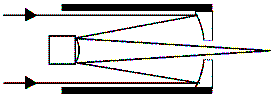
- ACassegrain
22A(n)___________is used to measure the brightness and colour of stars
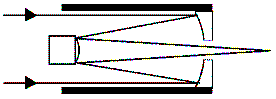
- Aphotometer
23300 nanometer light has a lower frequency than 500 nanometer light
- ATrue
- BFalse
24X-rays easily penetrate the Earth’s atmosphere and reach the ground from space
- ATrue
- BFalse
25What is the purpose of interferometry?
- AIt is used to improve the resolving power of telescopes
- BIt is used to decrease the chromatic aberration of a telescope
- CIt is used to make large X-ray and ultraviolet telescopes
- DIt allows radio telescopes to be within a few hundred feet of each other
Information
- Description
- Astronomy
- Author
- Ryan Tram
- Language
- English
- Views
- 1,102
- Tags
- Rating
- 5.0 out of 5 · 1 rating Rate this quiz