
Quiz
Catalysts And Addition Reactions For Alkenes
This quiz has question types that open in the usual player.
Questions in this quiz (19)
1What catalyst is needed for the addition reaction of hydrogen to an alkene in a lab?
- APlatinum catalyst
- BNickel catalyst
- CPhosphoric acid catalyst.
2The product of this addition reaction is- 2,3-dibromobutane. Thus meaning the addition reaction is [blank_start]bromination[blank_end], This requires [blank_start]room[blank_end] temperature and pressure. A colour change can be seen when this reaction occurs. The solution changes from [blank_start]browny red[blank_end] to [blank_start]colourless[blank_end]. This is commonly known as the test for [blank_start]unsaturation[blank_end].
- Abromination
- Broom
- Cbrowny red
- Dcolourless
- Eunsaturation
3Tick the answers which are addition reactions for alkenes.
- ABromination
- BHydrobromination
- CHydration
- DOxidation
- EHydrogenation
4The hydration process in a lab is as follows...
The alkene is [blank_start]heated under reflux[blank_end] then [blank_start]concentrated sulfuric acid[blank_end] is added. Finally [blank_start]water[blank_end] is added, which attaches to the alkene.- Aheated under reflux
- Bheated under high temperature
- Cheated under low pressure
- Dconcentrated sulfuric acid
- Econcentrated nitric acid
- Fconcentrated hydrochloric acid
- Gwater
- Hhydroxide ions
- Ihydrated salt, such as NaCl.XH2O
5Hydrobromination's colour change is browny red to colourless.
- ATrue
- BFalse
6The hydration addition reaction in an alkene in the industry is completed under high temperature and pressure.
- ATrue
- BFalse
7This specific addition reaction involves a nickel catalyst and high temperature and pressure. Which addition reaction is it?
- AHydrogenation (Industry)
- BHydrogenation (Lab)
- CHydration (Lab)
- DHydration (Industry)
8A heterogenous catalyst (step by step)-
Reactants get [blank_start]adsorbed[blank_end] to surface. Bonds [blank_start]weaken[blank_end] and [blank_start]break[blank_end]. [blank_start]New bonds form[blank_end] between products. Products [blank_start]deadsorb[blank_end] from surfac ([blank_start]diffuse away[blank_end]).- Aadsorbed
- Bweaken
- Cbreak
- DNew bonds form
- EOld bonds reform
- Fdeadsorb
- GDeabsorb
- Hdiffuse away
9Catalyst poisons are what to the heterogeneous catalyst surface.
- AIrreversibly adsorbed.
- BEngulfed by surface.
- CAdsorbed and stain surface before deadsorbtion.
10Catalyst poisons increase the surface area for reactants to attach to.
- ATrue
- BFalse
11Which of the following definitions for heterogenous catalyst is correct?
- AA catalyst is a substance which speed up the rate of the reaction by lowering the activation energy. The catalyst itself is not used up in the reaction. Heterogenous means the catalyst is at a different state to the reactants. For example in a catalytic converter the catalyst is solid whereas the reactants are gases.
- BA catalyst is a substance which speed up the rate of the reaction by lowering the activation energy. The catalyst itself is not used up in the reaction. Heterogenous means the catalyst is at the same state to the reactants. For example in a catalytic converter the catalyst is solid whereas the reactants are gases.
- CA catalyst is a substance which speed up the rate of the reaction by highering the activation energy. The catalyst itself is used up in the reaction. Heterogenous means the catalyst is at a different state to the reactants. For example in a catalytic converter the catalyst is solid whereas the reactants are gases.
- DA catalyst is a substance which slows down the rate of the reaction by lowering the activation energy. The catalyst itself is not used up in the reaction. Heterogenous means the catalyst is at a different state to the reactants. For example in a catalytic converter the catalyst is solid and the reactants are also solids.
12What is set up in a Br2 molecule when it comes into close proximity with an alkene?
- AInduced dipole
- BDeduced dipole
- CSimple induced dipole
13Why is a dipole set up in in a Br2 molecule when it comes into close proximity with an alkene?
- ADue to the high electron density in the C=C of the alkene.
- BDue to the high electron density in the C-H of the alkene.
- CDue to the trend in reactivity between a halogen and a carbon atom
14What does the dipole mean in a Br2 molecule
- AThe electrons shared between the Br2 move closer to the furthest Br from the alkene. Forming two areas of charge.
- BThe covalent bond in the C=C and donates an electron pair to the Br2.
- CLone pairs in the Br2 molecule closest to the alkene are forced towards the covalent bond causing the molecule to split into two Br- ions.
15Which of the following are electrophiles?
- AC+
- BBr-
- CH+
16An electrophile is a species, which is either a [blank_start]positive[blank_end] ion or has a [blank_start]partially[blank_end] charged element. An electrophile is attracted to an area of [blank_start]high electron density[blank_end]. For example, the C=[blank_start]C[blank_end] double bond.
- Apositive
- Bpartially
- Chigh electron density
- DC
17Label the electrophillic addition mechanism diagram below.
~The label in the corner, is there for you to name which addition reaction the mechanism is showing~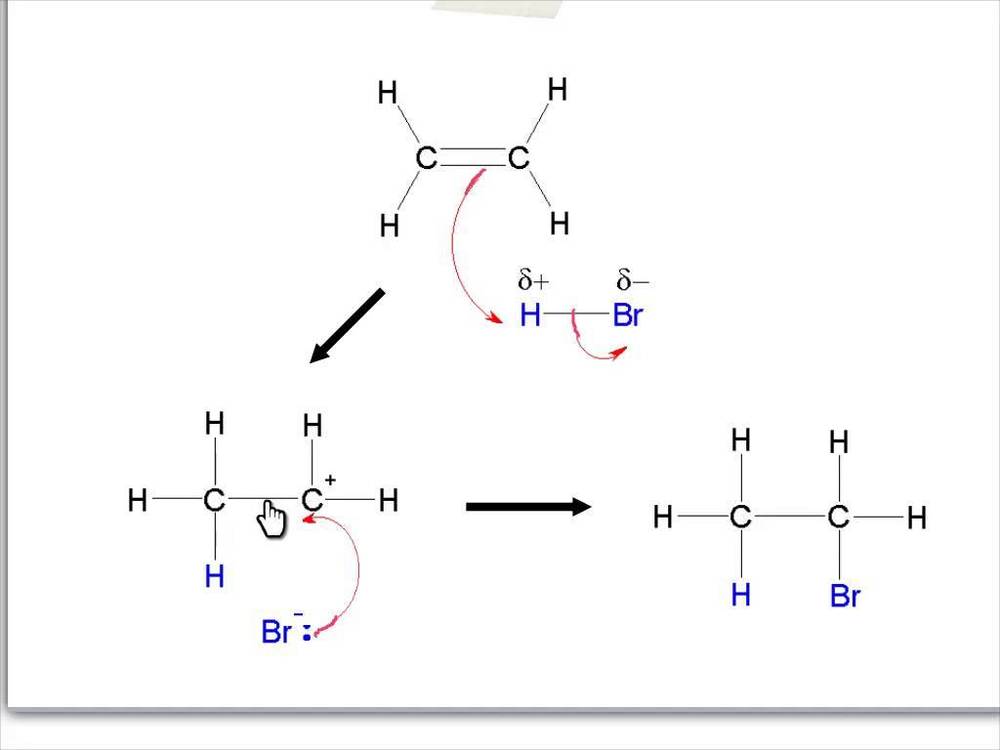
- AAlkene
- BInduced dipole
- CCarbocation
- DElectrophile
- EAlkane
- FBromination
- GHydrogenation
- HHydration
- IHydrobromination
18A full headed curly arrow, in the annotation of an electrophillic addition mechanism, means what?
- AThe movement of a pair of electrons
- BThe movement of an electron
- CSpecifically the movement of charge
19What ions are formed after the addition of Br? (Hint only one Br out of the Br2 has bonded to the organic molecule).
- ABr- and C+
- BBr+ and C-
- CBr+ and C+
- DBr- and C-
Information
- Description
- Quiz on Untitled, created by Nathan Butler on 22/02/2017.
- Author
- Nathan Butler
- Language
- English
- Views
- 88
- Tags
- Rating
- 3.0 out of 5 · 1 rating Rate this quiz