
Untitled
Slides in this set (12)
-
- OPERATIONS MANAGEMENT FOR SOCIAL, ECOLOGICAL & ECONOMIC SUSTAINABILITY
-
- Operations management describes the activities, decisions and responsibilities of designing, executing and controling the purchase, production and distribution of products and services.
- Sustainability is 'the ability to be sustained, supported, upheld, or confirmed; the quality of not being harmful to the environment or depleting natural resources, and thereby supporting long-term ecological balance'
-
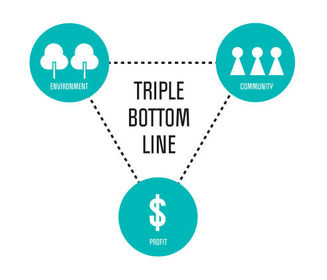
- The Triple Bottom Line (TBL) is an accounting framework that considers three aspects of business' performance: social, environmental and financial. Companies should be preparing three separate bottom lines- first one is the bottom line of corporate profit (profit and loss account). The second one considers 'people account' (social responsibility of business' operations). The third one is the line of 'planet account' and it measures the environmental responsibility of the firm. Together they are known as 3 Ps; profit, people and planet.
- Every business should be assessed not only in terms of its profits, but also by considering its impact on the society and natural world.
-
-
- Economic sustainability refers to maintaining high efficiency of the company by the application of effective operations management. It is an important part of sustainability as it helps to meet needs and demands of the customers over a sustained period of time with the usage of sustained methods. Increasing economic sustainability is tied up with improving efficiency in order to reduce costs, utilize maximum capacity and achieve business objectives. Efficient and effective utilization of resources means that the business is getting as much positive return as possible.
-
ACHIEVING ECONOMIC SUSTAINABILITY
- Managing operational assets and infrastructure in the effective way. This can include equipment, machinery and permises that are owned by the business. Proper management and maintenance increase their usefulness and capabilities and extends the lifespan. It also ensures that assets do not have to be replaced through damage or unneccessary wear. In a shorter period maintenance can be expensive, however it will pay over longer life of the asset.
- Increasing the efficiency of the production process. It involves increasing labour and capital productivity in order to imrove the competitiveness of the business
- Utilizing skills,knowledge and experience of the labour to their maximum potential. Proper and accurate recruitment process, trainigs and support from the management are essential to achieve long term sustainability of the business
- Creating customers' interest and value. It is done by researching and developing products and processes that will catch attention, meet customers' demands and satisfy their needs
-
- Ecological (or environmental) sustainability defines a capacity of an ecosystems to maintain functions and processes and keep biodiversity in the total extent over long period. In business that kind of sustainability involves making decisions and actions that aim to protect natural world and preserve its resources in order to support future generations of all living organisms.
-
ACHIEVING ECOLOGICAL SUSTAINABILITY
- Reducing waste at all levels of the business. It can be achieved by implementing more sustained production methods like lean manufacturing or quality management
- Reducing the use of energy and water. Recycling water and using renewable sources of the energy decrease the wastes and is less harmful to the environment, therefore the use of non-renewable sources in the production should be limited. Business can also choose less harmful sources of the energy for its operations, for example electric cars
- Designing products that use recycled materials or allow materials to be recycled at the end of their life
- Working with realiable and environmetally friendly suppliers. Raw materials and their transport are important part of production and they should be chosen wisely and with consideration of the environment
- Promoting eco-friendly approach among stakeholders. Nowadays more and more people are aware of environmetal issues and that kind of project can be both a positive form of education and promotion.
-
- Social sustainability is 'the ability of communities to develop processes and structures which not only meet the needs of its current members but also support the ability of future generations to maintain a healthy community.' It includes aspects such as community development, social responibility, human rights, equality. In a business term it means that the company takes the responsibility for the fact that its action have an impact on other people- both local communities and the world at large. Social sustainability takes into consideration the entire world in relation to globalization, communities and culture.
- http://www.businessdictionary.com/definition/social-sustainability.html#ixzz3tqjC4oEG
-
ACHIEVING SOCIAL SUSTAINABILITY
- Reducing the negative impact of business' activity on society. It includes pollution, negative influence of production or noise. Limiting those factors is important aspect of being socialy sustained
- Designing workplaces and create jobs in order to develop social interactions. It is especially important in low-income or deprived areas, where unemployment level is high and can be achieved by relocating factories or operations facilities
- Ensuring safe and healthy production systems. Safe and inspected conditions are vital not only for the emlpoyees, but for the whole community of the given area. Thus high quality and secure workplaces must be provided in order to achieve sustainability
Information
- Description
- Slide Set on Untitled, created by truskawka2008 on 09/12/2015.
- Created by
- truskawka2008 · Dec 2015
- Updated
- Feb 19, 2016
- Views
- 2
- Rating