
Additional science revision
Slides in this set (6)
-
- terminal velocity
- An object falling will initially accelerate because of the force due to gravity.
- Eventually the resultant force will be zero as the weight and resistive forces balance.
- The object will then travel at a steady speed which is called its terminal velocity.
-
- Ionic compounds
- Giant structures of ions.
- They are held together by strong forces of attraction that act in all directions between oppositely charged ions. this is called ionic bonding.
- Ionic compounds:
- have a high melting an boiling point
- conduct electricity when molten or in solution as the ions are able to move freely.
- Ionic bonds
- An ionic bond occurs between a metal and a non metal. It involves a transfer of electrons from one atom to another.
- This forms electrically charged ions, which all have a completed outer energy level.
-
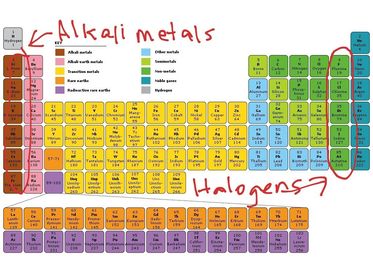
- Alkali metals and halogens
- Alkali metals:
- 1 electron in their outer shell
- react with non metal elements to form ionic compounds where the metal ion has a single positive charge.
- Halogens:
- seven electrons in their outer shell
- react with alkali metals to form an ionic compound where the ions have a single negative charge.
-
- Mixtures and compounds
- A mixture is two or more elements of compounds that aren't chemically combined.
- A compound is a substance where two or more elements are chemically combined.
- Atoms can form chemical bonds by sharing electrons or gaining or losing electrons.
- Simple molecular compounds
- Substances that consist of simple molecular compounds are gases, liquids or solids that have a relatively low melting or boiling point.
- The molecules have no overall electrical charge, so they cant conduct electricity. They have weak intermolecular forces.