
Flashcards
Immunity and Vaccinations
Cards in this deck (26)
- 1What are the two types of immunity?Active
Passive - 2What is active immunity?When your immune system makes its own antibodies after being stimulated by an antigen
- 3What are the two types of active immunity?Natural - when you become immune after catching a disease (e.g. measles)
Artificial - when you become immune after being inoculated (given a vaccination) with a harmless dose of antigen - 4What is passive immunity?The type of immunity you get from being given antibodies made by a different organism - your immune system does NOT produce any antibodies of its own
- 5What are the two types of passive immunity?Natural - when a baby becomes immune due to the antibodies it receives from its mother (through placenta or breast milk)
Artificial - when you become immune after being injected with antibodies from someone else (e.g. collected from blood donations) - 6Compare the levels of exposure to antigens in active immunity and passive immunityACTIVE
Requires exposure to antigen
PASSIVE
No exposure to antigen - 7Compare the speed of protection in active immunity and passive immunityACTIVE
Takes a while for protection to develop
PASSIVE
Immediate protection - 8Compare the longevity of protection in active immunity and passive immunityACTIVE
Protection is long-term
PASSIVE
Protection is short-term - 9Compare the production of memory cells in active immunity and passive immunityACTIVE
Memory cells are produced
PASSIVE
Memory cells are NOT produced - 10What is an autoimmune disease?An autoimmune disease is a disease resulting from the immune system treating self-antigens as foreign antigens and launching an immune response against the organism's own tissues.
- 11TRUE OR FALSE: Autoimmune diseases are usually chronic and cannot be curedTRUE AND FALSE
Autoimmune diseases are usually chronic
BUT! Although they can often be treated, they are currently incurable - 12Name two autoimmune diseasesLupus
Rheumatoid arthritis - 13Describe the cause and symptoms of lupusCAUSE
Caused by the immune system attacking cells in the connective tissues
SYMPTOMS
Damages the tissues and causes painful inflammation
Can affect the skin and joints, as well as organs such as the heart and lungs - 14Describe the cause and symptoms of rheumatoid arthritisCAUSE
Caused by the immune system attacking cells in the joints
SYMPTOMS
Causes pain and inflammation - 15Define vaccinationThe administration of antigens (in a vaccine) into the body
- 16Define immunisationThe process by which you develop immunity (vaccination causes immunisation)
- 17How do vaccines work?Vaccines contain antigens that cause the body to produce memory cells against a particular pathogen, without the pathogen causing disease. The antigens may be free or attached to a dead or attenuated (weakened) pathogen.
Vaccines may be injected or taken orally. - 18What are the disadvantages of taking vaccines orally?It could be broken down by enzymes in the gut
The molecules of the vaccine may be too large to be absorbed into the blood - 19TRUE OR FALSE A vaccine only needs to be administered once for a person to remain immune for the rest of their lifeFALSE
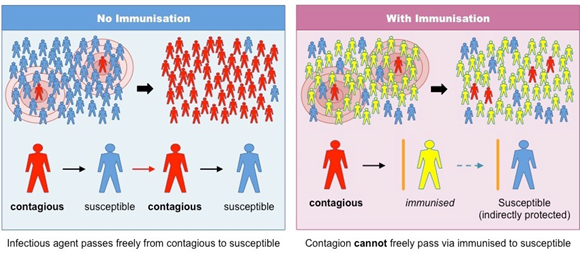
Sometimes booster vaccines are given later on to make sure that more memory cells are produced - 20Why are people being vaccinated?If most people in a community are vaccinated, the disease becomes extremely rare. This means that even people who have not been vaccinated are unlikely to get the disease, as there is no one to catch it from. This is known as herd immunity
- 21Complete the sentence: Herd immunity helps to prevent ___________.Herd immunity helps to prevent EPIDEMICS.
- 22Name two routine vaccines that are offered to everybodyMMR vaccine
Meningitis C vaccine - 23What does the MMR vaccine do?Protects against measles, mumps and rubella. The MMR is usually given to children as an injection at around a year old, and again before they start school.
It contains attenuated measles, mumps and rubella viruses - 24What does the meningitis C vaccine do?Protects against the bacteria that causes meningitis C. It is first given as an injection to babies at 3 months.
Boosters are then given to 1-year olds and teenagers - 25Some vaccines may need to be changed frequently. Why?Some pathogens can change their surface antigens (e.g. influenza virus), forming new strains. Memory cells produced from vaccination one with strain will not recognise other strains with different antigens
- 26Labs collect samples of different ________ and organisations (e.g. WHO and Centre for Disease Control (CDC)) test the _____________ of different vaccines. This is an example of using science to inform ________ _________.Labs collect samples of different STRAINS and organisations (e.g. WHO and Centre for Disease Control (CDC)) test the EFFECTIVENESS of different vaccines. This is an example of using science to inform DECISION MAKING.
Information
- Description
- User has deleted their subject information Flashcards on Immunity and Vaccinations, created by Deleted user on 05/03/2018.
- Created by
- Deleted user
- Views
- 16
- History
-
- Created by Yinka F · Feb 5, 2018
- Copied by Yinka F · Mar 5, 2018
- Rating