
Flashcards
Unit 5 - thermodynamics
Cards in this deck (43)
- 1standard enthalpy of an element is...zero
- 2H2(g) + 0.5O2(g)--> H20(l) what is this an example of?standard molar enthalpy of formation
- 3the standard enthalpy of atomisation is...the enthalpy change which accompanies the formation of one mole of gaseous atoms from the element in its standard state under standard conditions
- 4Mg(s) -->Mg(g) is an example of...the standard enthalpy of atomisation
- 5definition of first ionisation energy...is the standard enthalpy change when one mole of gaseous atoms is converted into a mole of gaseous ions each with a single positive charge.
- 6Na(g) --> Na+(g) + e- is an example of...first ionisation energy
- 7definition of second ionisation energyrefers to the loss of a mole of electrons from a mole of singly positively charged ions
- 8Na+(g) --> Na2+(g) + e- is an example of..second ionisation energy
- 9O(g) + e- ---> O-(g) is an example offirst electron affinity
note it refers to single atoms, not oxygen molecules, O2 - 10definition of lattice formation enthalpy is...is the standard enthalpy change when one mole of solid ionic compound is formed from it's gaseous ions
- 11O-(g) + e- --> O2- (g) is an example ofthe second electron affinity
- 12Na+(g) + Cl-(g) --> NaCl(s) is a definition oflattice formation enthalpy
- 13(Na+) + aq --> Na+ (aq) is an example ofenthalpy of hydration
- 14definition on the enthalpy of solution is...is the standard enthalpy change when one mole of solute dissolves completely in sufficient solvent to form a solution in which the molecules or ions are far enough apart not to interact with each other.
- 15NaCl(s) + aq --> Na+(aq) + Cl-(aq) is an example ofenthalpy of solution
- 16definition of mean bond enthalpyis the enthalpy change when one mole of gaseous molecules each breaks a covalent bond to form two free radicals, averaged over a range of compounds
- 17standards conditions =100kPa and 298k
- 18ionic bonding is betweenmetal and non metal ions
- 19the metal ions in ionic compounds are...positively charged ions that have a stable outer shell of electrons
- 20the non-metal ions in an ionic compound are..negatively charged ions with a stable outer shell of electrons
- 21Hess's law statesthe total enthalpy change for a chemical reaction is the same whatever route is take
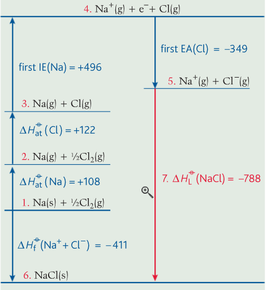
- 22Born - Haber cycle isa thermochemical cycle that includes all the enthalpy changes involved in the formation of an ionic compound
- 23A born-haber cycle starts withthe elements in there standard states, so starts from zero
- 24draw the born haber cycle for NaCl
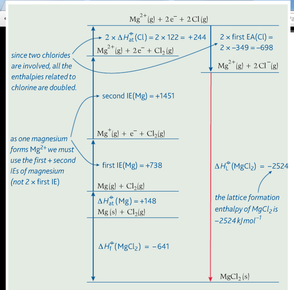
- 25draw the born haber cycle for MgCl when we know 1. delta Hf = -641kJmol-1 2. delta H at (Mg) = +148 kJmol-1 3. first IE (Mg) = +738Kjmol-1 4. second IE (Mg) = +1451 Kjmol-1 5. atomisation of Cl = +122Kjmol-1 6. first EA of Cl = -349kJmol-1 7. lattice formation = -2524kJmol-1
- 26all first electron affinities of all element are negative because...the added electron is attracted by the nuclear charge.
- 27looking at the trends in lattice energy, a larger ion means...a smaller lattice enthalpy
- 28why does a larger ion lead to a smaller lattice enthalpy...because the opposite charges do not approach each other as closely when the ions are larger.
- 29the lattice enthalpy increases with the size of the charge, why?because ions with double the charge give out roughly twice as much energy when they come together
- 30negative delta H is a clue as to whether a reaction isspontaneous or not
- 31gases are more ..... than liquidsrandom
because of the arrangement of their particles - 32the randomness of a system is calledentropy
- 33is the particles of the products is more disordered than the reactants then the entropy change is...positive
- 34what has a larger entropy, liquids, gases, or solids?gases>liquids>solids
- 35units of entropy areJK-1mol-1
or
kJK-1mol-1 - 36the entropy change for a reaction can be calculated byadding all the entropies of the products and subtracting the sum of the entropies of the reactants.
- 37what are the two factors that dictate whether a reaction is feasible?enthalpy change and entropy change
- 38is delta G = negative this means?the reaction is feasible
- 39if delta G = positive this means?the reaction is not feasible
- 40gibbs depends on temperature thereforesome reactions may be feasible at one temperature and not at another
- 41when delta G = 0 what does this mean?this is the point at which the reaction is feasible.
- 42enthalpy and entropy tell us nothing about the rate of the reaction.. why?because there may be a high activation energy barrier
- 43delta S isthe sum of the entropies of the products - the sum of the entropies of the reactants
Information
- Description
- Flashcards on Unit 5 - thermodynamics, created by jasmin.sahota on 14/06/2013.
- Created by
- jasmin.sahota
- Views
- 99
- Rating