
Flashcards
Structural Macromolecules / Cell Walls
Cards in this deck (41)
- 1What is closest in relation to the archaea - bacteria or eukarya?Eukarya
- 2What features of a prokaryotic cell are in ALL prokaryotic cells?Plasma membrane, circular chromosome, nucleoid, cytoplasm containing ribosomes.
- 3What features aren't in all prokaryotes but are important in some?Outer membrane, plasmids, flagellum, cell wall
- 4Primary roles of the cytoplasmic membrane?-separating the cytoplasm from the cell's environment
-permeability barrier
-contains a range of diverse membrane proteins
-site of the generation and use of proton motive force - 5What is phosphotidylethanolamine?A primary lipid in bacterial cytoplasmic membrane. It has a hydrophilic polar head as phosphate and ethanolamine are charged and has fatty acid chains that corm a hydrophobic interior
- 6What is the bacterial cell wall?It is composed of peptidoglycan and forms a sac around the cell. It gives shape to the bacteria and resists turgor pressure. It is gram positive in thick areas and gram negative in thinner areas.
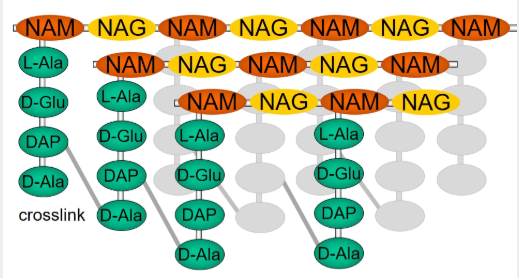
- 7What is peptidoglycan made up of?Glycan chains and peptides. N-acetylglucosamine (NAG) and N-acetylmuramic acid (NAM) make up the glycan bit. They are repeated NAG, NAM, NAG, NAM, etc. Chain of 4 amino acids in cell walls too. Some are D forms not L forms of amino acids.
- 8Summary of peptidoglycan chain?NAG (N-acetylglucosamine) and NAM (N-acetylmuramic acid) are sugars linked by beta 1-4 bonds.
Tetrapeptide chain attached to NAM which contains D forms of a.a's.
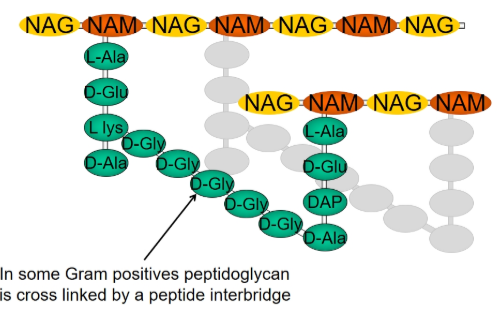
Crosslinks formed by transpeptidases. Gram posotives may have peptide interbridges. - 9What gives peptide chains their strength?Crosslinks
- 10Where are the crosslinks in the bacterial cell wall in gram negatives?Between the terminal D-alanine on one chain and the di-amino acid on another chain (like DAP and D-Glu).
- 11Structure sometimes found in gram positives?Peptidoglycan is cross linked by a peptide interbridge. Third amino acid in one chain links to terminal D-alanine in another but is connected by a chain of amino acids (D-Gly in given example)
- 12Diagram of gram negative peptides in bacterial cell wall?
- 13Diagram of crosslinks in gram positive bacterial cell wall?
- 14Why is the peptidoglycan a target for antibacterials?Cells cannot do without their peptidoglycan - they burst without it. Some of the first antibacterials like penicillin targeted peptidoglycan.
- 15How is lysosome (found in tears) an antibiotic?It will cleave the beta 1-4 linkage in the peptidoglycan polysaccharide backbone
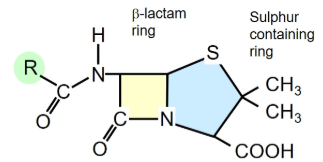
- 16Structure of penicillin?
- 17What are transpeptidases?They form peptide cross links between adjacent glycan chains. They are essential for the structure of peptidoglycan. Cell wall is weakened with fewer cross links.
- 18What is the gram positive cell envelope?There is a PM plasma membrane, a IWZ inner wall (soluble low density components) zone and a OWZ outer wall zone (peptidoglycan network). There is the PM, then the IWZ, then the OWZ
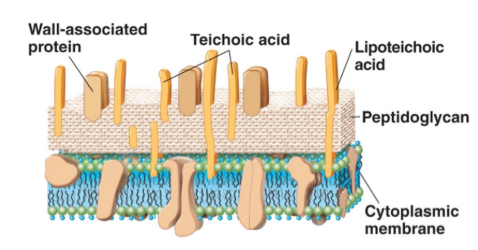
- 19What else is found in gram positives?Wall teiochic acids which are covalently linked to peptidoglycan. Lipoteichoic acids are anchored into the plasma membrane via glycolipids.
- 20What is the function of teiochic and lipoteichoic acids?They protect the gram positive envelope, are important in the bacteria-host cell interactions and often are recognised by the immune system of the host
- 21What are teichoic acids and what are they made of?Up to 60% of the mass of the cell waqll is teichoic acids and they are made of polymers of sugars or sugar derivatives such as glycerol and ribitol. They are negatively charged.
- 22Diagram of gram positive cell wall?
- 23Gram negative cell envelope?They have two membranes. There is the PG which is a thin layer of peptidoglycan and an outer membrane (OM) which is an asymmetric lipid bilayer. The inner leaflet is composed mainly of phosopholipids and the outermost layer made of lipopolysaccharide or LPS. They are impermeable. There is also the cytoplasmic membrane.
- 24Structure of lipopolysaccharide?There is Lipid A has fatty acid side chains and is found in all LPS and chains vary in length.
Core polysaccharide is highly conserved and contains KDO and other unusual sugars
O-specific polysaccharide is highly variable and antigenic - 25As there are two membranes in gram negative walls, there is a space between the two walls. What is this space called?The periplasm. It is a subcellular compartment between the cytoplasmic and outer membranes. 10-20% of cell volume. High protein content with proteins for cell wall synthesis and uptake and transport of nutrients. Environment is oxidising (disulfide bonds in proteins) and contains chaperones to fold proteins
- 26Diagram of gram negative cell wall?
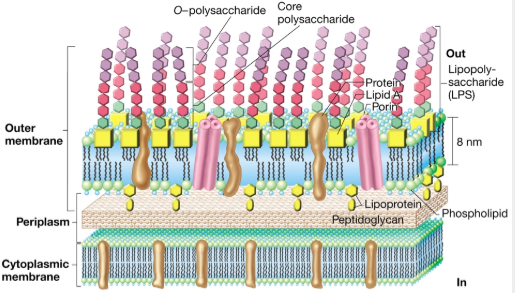
- 27How do things like proteins get in and out of the outer membrane?Through proteins like porins which span the outer membrane and are a beta-barrel shape. Solutes diffuse through the water filled channel and many antibiotics diffuse through these to work
- 28Diagram of porins?
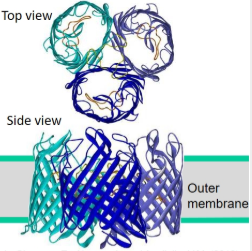
- 29Do gram positives have a periplasmic space?It is in research. There are soluble low density components which may be a periplasmic space that could be the site of enzyme activity in gram positives but we don't know if it is a periplasm.
- 30A few things found in gram negative organisms...Lipopolysaccharide, cytoplasmic membrane, outer membrane, periplasm, peptidoglycan
- 31Things found in gram positive organisms?Cytoplasmic membrane, teichoic acids, lipoteichoic acids, peptidoglycan, peptide interbridges
- 32The S layer is found in some bacteria but not all. What is it?A regularly spaced array of protein subunits. They self assemble into a structure which coats the entire cell creating a porous lattice. Covalently attached to the peptidoglycan in gram positives and to the O-polysaccharide in chains of LPS in gram negatives
- 33Capsules and slime are found in some bacteria but not all. What are they?Extracellular polymeric substances (EPS) and are often polysaccharides (like the O side chains of LPS). The capsule is a discrete layer covalently attached to OM lipids of PG. Slime isn't covalently attached and isn't discrete.
- 34The archaeal cytoplasmic membrane?Ether linkages not ester linkages. Different to bacteria and mammalian membranes. Have unique lipids. Membrane lipids in aechaea are glycerol diethers, diglycerol tetraethers and crenarchaol (which contains rings) .
- 35Summary of archaeal cytoplasmic membrane lipids?Lipid tails are attached to glycerol via an ether linkage.
Lipids are branched with methyl groups - isoprenes
Phytanyl or byphytanyl
Crenarchaeol - hydrocarbon moiety containing 5 and 6 carbon rings - 36Architecture of archaeal cytoplasmic membrane?
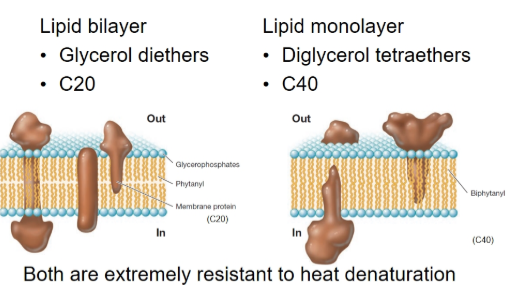
- 37Other features or archaea cell walls?S-layers are common, have other polysaccharide walls and no peptidoglycan but some have pseudomurein. Pseudomeurin is like peptidoglycan but instead of 1-4 linkages it has 1-3 linkages.
- 38Summary of things found in Archaea membranes?Pseudomeurin, lipid monolayer membranes, lipid bilayer membranes, diglycerol tetraethers, s-later proteins
- 39cell walls of fungi?Ergosterol replaces cholesterol to make it fluid. Outer layer glycoproteins - cell wall proteins, mannose polymers covalently linked to CWP. Inner layer of skeletal polysaccharides like chitin to form microfibrils. Beta a1-6 glucan links CWP to skeletal polysaccharides
- 40Structure of Candid albicans (thrush)?
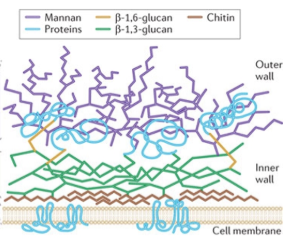
- 41Antifungal agents target cytoplasmic membrane - how?Polyenes target the CM of fungi. Target to ergosterol and disrupt membrane function.
Echinocandins used for systemic fungal infections in immunocompromised patients. Inhibit synthesis of glucan in the cell wall by inhibiting 1,3 beta glucan synthase
Information
- Description
- Introduction to Microbiology Flashcards on Structural Macromolecules / Cell Walls, created by Emma Lloyd on 20/05/2018.
- Created by
- Emma Lloyd
- Views
- 5
- Rating