
Flashcards
Cisco CCENT R&S Exam Flashcards
Cards in this deck (40)
- 1What are the three principles of Cisco?Understand, Configure, Troubleshoot
(If you don't understand it, you can't configure it. If you can't configure it, you can't troubleshoot it). - 2What is a Host?Hosts are anything that creates and deletes data and has a NIC (wired or wireless). These have a range of networking applications (Chrome, Firefox, Netflix).
- 3What are the primary components of network infrastructure, and which are access and which are networking?Access Points (A)
Hubs (A)
Switches (A)
Routers (N)
Firewalls (N) - 4What are the two primary types of Cables?Copper and Fibre
- 5What are the advantages and disadvantages of copper cables?- Transmission occurs by electricity (Types: Rolled, Crossover, ST)
- Heavily affected by interference
- Cheap
- Easy to create - 6What are the advantages and disadvantages of fibre cables?- Transmission via Light
(Types: MM or SM)
- No interference
- Distance (far)
- More secure - 7What types of copper cables are there, and what do they do?CoAxial: - RG-6 → TV/High Speed Internet
- RG-59 → Patch Panels---Used in 10Base5 (ThickNet) / 10Base2 (ThinNet).
- RJ-11 → Telephone (GP2C)
- Twisted Pair (Shielded/Unshielded) are “ethernet” cables. - 8What types of fibre cables are there?Cable Types - Fibre:
- ST (Straight-Tip)
- FC (Field Assembly Connector / Ferrule Connector)
- SC (Square Connector / Subscriber Connector)
- LC (Little Connector / Lucent Connector)
- SFFP (Small Form Factor Pluggable) - 9What are network topologies?1) Physical
2) Logical
The connections and hardware units that make up a topology in the real world are the physical elements of that topology.
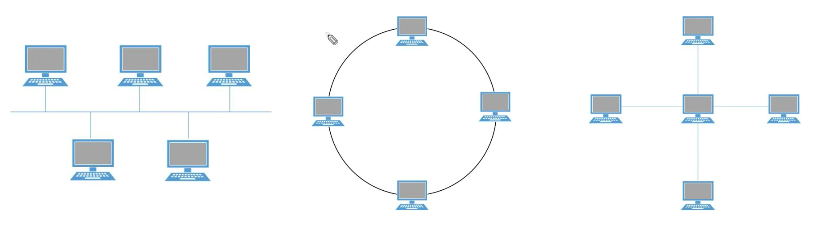
The flow of the topology and the structure is the logical side. - 10What are the three primary types of topologies?Star
Bus
Ring - 11What are some defining features of topologies (logic)?Collision, Carrier-sense multiple access with collision detection (CSMACD), Centralization, Decentralization (P2P)
- 12What is Hub and Spoke, Full Mesh and Partial Mesh?The spoke-hub distribution paradigm is a form of transport topology optimization in which traffic routes are organized as a series of 'spokes' that connect outlying points to a central 'hub.'
Full mesh occurs when all spokes can communicate with each other. Partial Mesh is some can communicate with each other, but not all. - 13What is peer to peer and peer to multipoint and why does it differ from other topological models?Peer to peer rejects a centralization topology, which assumes an independent hub. All hosts are hubs in peer to peer. Peer to multi-point occurs when you have "leeching", where one hub has the file the other hubs are trying to acquire. There is not mutuality between all hosts.
- 14What are the application behaviors of Peer to Peer and Application to Server?Peer to peer platforms are cheap and easy to setup, but lack any security protocols. They are also heavily dependent on the peers in the network. Network collapse is a problem. Application to server is substantively more expensive than P2P, but allows for robust administration and security protocols.
- 15What is the OSI model? (Layer 7 - 5)Layer 7: Application Layer (DATA)
Network process to Application
Layer 6: Presentation Layer (DATA)
Data representation and encryption
Layer 5: Session Layer (DATA)
Interhost communication - 16What is the OSI model? (Layer 4-1)Layer 4: Transport Layer (Segment)
End-to-end connections and reliability
Layer 3: Network Layer (Packets)
Path determination and IP (Logical Addressing)
Layer 2: Data-Link Layer (Frames)
MAC and LLC (Physical Addressing)
Layer 1: Physical Layer (Bits)
(Physical transmission) - 17What is the TCP model?Level 5: Application
Level 4: Transport
Level 3: Network
Level 2: Data-Link
Level 1: Physical - 18What are the differences between the TCP and UDP models found at Layer 4?UDP - User Datagram Protocol
- Connectionless, fast, unreliable (Skype is an example).
- It has low overhead because it is much faster.
- Does not check for server existence, does not send acknowledgement that data sent has been received, sends packets that can get lost because server can be at 99% capacity.
Common uses and ports: DNS(53), DHCP(67/68), RIP(520), TFTP(69)
TCP - Transmission Control Protocol
- Connection oriented
- Reliable / Flow Control
- Higher overhead due to ACK and SYN process.
- TCP issues 3-way handshake (SYN, SYN/ACK, ACK) back and forth so that the data reaches the right destination, and the data can be sent in a multitude of structured ways, so no data is lost. - 19What is the difference between LAN and WAN and why are these terms relative?LAN is Local Area Network and is confined to a small geographic area while WAN is a Wide Area Network and is based on a wide geographic area. These terms are relative because they depend on the scale of your operations.
- 20What are the two different types of design of WAN and LAN networks, and what are the advantages and disadvantages?A “collapsed core” is when the distribution layer and core layer functions are implemented by a single device. This reduces network cost but makes the system slower and more vulnerable. A "three tier" model has a separate distribution to core layer, and is safer, but is more expensive and doesn't require meshing.
- 21What layer is IPv4 at?Layer Three (Network) (Packet)
- 22Describe some elements of the IPv4 Protocol?IPv4 uses a 32 bit addressing system which is displayed within four octets.
(192.133.0.1) = Binary
01010101 _ 01010101 _ 01010101 _ 0101010101 = Bit
Each byte is an octet (from 0-255). - 23What are some defining elements of IP?IP is best effort, connectionless and unreliable. IP addresses represent hosts and networks.
- 24Before classless networks were replaced, what did they consist of?CLASS IDBITS RANGE
A 0 1-126
B 10 128-191
C 110 192-223
D 1110 224-239
E 1111 240-255 - 25What are binaries and how do you calculate them from decimals?Binary:
0’s and 1’s, considered low or high or off and on.
Decimal to Binary:
128,64,32,16,8,4,2,1 → 192.168.0.1
Does 192 fit into the above?
192-128 = 64
64-64 = 0
128,64,32,16,8,4,2,1
1 1 0 0 0 0 0 0
Translation: 11000000 - 26What are some classes of IPv4?There are three classes of IPv4 addresses, and each reveal where the host and the network are:
A: 0.0.0.0 (First is the network, last three are the host)
B: 128.0.0.0 (First and second are the network, other two are the host)
C: 192.0.0.0 (First and second and third are the network, the last is the host)
Smaller networks can use the 254 C Class model (254 addresses). - 27What is classless IPv4, how did we get it, and why do we have it?Classless IPv4 is the IPv4 protocol without the initial binary numbers indicating class. The reason we went classless was because different companies required different IP's, but were on the same network, and this became costly at scale. This became popular post-1990's. Subnetting fixed the class problem.
- 28What is subnetting?If 195.0.1.0 is the broadcast address → 195.0.1.128 / 195.0.1.136 (these two IP’s are on different networks, but have the same IP). Subnet masks were introduced to help identify the dividing line between network and host bits.
- 29What ranges exist in subnetting?Classful Subnet Ranges:
A: 255.0.0.0/8
B: 255.255.0.0/16
C: 255.255.255.0/24 (the slash + number is often referred to as a CIDR or Network Prefix notation). In this example, 255 is the network and 0 is the host.
A would represent:
11111111.00000000.00000000.00000000 - 30What is the purpose of the subnet mask?Inform the host/networking device how to calculate it’s network address.
- 31Give me an example of the following decimal subnet IP in binary: 255.255.255.192/2411111111.11111111.11111111.11000000
(255).(255).(255).(128+64, because the first two, when turned on, add up to 192, and the rest are off). Two bits are turned on, which means there are four other networks available, and 62 available ports. (64-2n = 62). - 32What are the subnet mask formulas?Number of Subnets =
2n = if N equals the number of 1’s in the Subnet ID
Number of available host addresses = 2n-2 if N = number of 0’s in the Host ID
Host ID cannot be all 0’s or all 1’s. - 33Tell me the difference between network and broadcast addresses and then show me the way to get 9 networks from a subnet maskNetwork addresses are internal, broadcast addresses ping all of the network addresses. (SEE WRITTEN EXAMPLE HERE).
- 34Where are host and network bits located?82.100.90.0/24
11111111.11111111.11111111.00000000
N N N H
2,4,8,16,32,64,128,256
2n - 2
256-2 = 254
254 usable IP addresses - 35How do you calculate host and network bits?11111111.11111111.11111111.11110000
Subnet left to right for network bits, right to left for host bits
2/4/8/16 - 2
2n - 2 = 14 hosts (IP addresses)
This solves the 9 network problem established above.
Decimal translation = 255.255.255.240 (because you have to add all the turned on bits together - IIII = 128+64+32+16 = 240)
Remember to calculate both left to right and right to left! - 36What are Public IPs?These are globally unique and can be static or dynamic. IP addresses that can overlap are private addresses. Each UniCast class (A,B,C) has a private IP range. IANA - Internet Assigned Numbers Authority manages the global IP address market (ARIN is the North America authorizer).
- 37What are Private IPs?RFC 1918 (IETF) = ranges
10.0.0.0 → 10.255.255.255 = 10/8 prefix)
Class A
172.16.0.0 → 172.31.255.255 = 172.16/12 prefix) Class B
192.168.0.0 → 192.168.255.255 = 192.168/16 prefix) Class C - 38What are reserved IP addresses and what is overloading?Reserved IP Addresses: APIPA, 169.254.x.x, loopback 127.0.0.0/8 (call ping on this to see packet loss).
Putting all of these private IP’s and converting them into one public IP is called overloading, and you see it with the PAT protocol. Many houses have multiple devices on the same network. They are all different, and are thus assigned a different private IP; when they connect with www.google.com, they are meshed and are under one, public IP. - 39What are FLSM, VLSM, CIDR?Fixed Length Subnet Masks are subnet masks that encompass an organization on one length. i.e. every department gets the maximum number of IP's on the subnet.
Variable Length Subnet Masks allow for different organizations to have more tailored numbers of IP's, so they are not wasteful.
CIDR is a notation for describing blocks of IP addresses and is used heavily in various networking configurations. IP addresses contain 4 octets, each consisting of 8 bits giving values between 0 and 255. The decimal value that comes after the slash is the number of bits consisting of the routing prefix. This in turn can be translated into a netmask, and also designates how many available addresses are in the block. - 40FLSM, SLSM, VLSM, CIDR points to remember?A lot of people think CIDR and VLSM are the same thing. They’re not.
CIDR = let the world go classless, in terms of network and host bits.
VLSM = was really just an upgrade of FLSM.
FLSM can still be useful, however, because of the ease of implementation.
Engineers still use terminology such as Class C, instead of /24. It is important to know what the engineers mean when they discuss this, because it is the equivalent of industry short-hand.
Information
- Description
- These are flashcards for a CCENT R&S exam. These are based on the work I've done so far, and will continue to do.
- Created by
- Alexander Coffman
- Views
- 59
- Tags
- Rating