
Flashcards
B2B Marketing - part 2
Cards in this deck (35)
- 1Just-in-time manufacturing Originally JIT referred to the production of goods or services to meet the customer’s
requirements, on time ant to the standard required.
Over the years, it has come to mean continues improvement and the elimination of
waste - 2Quick response manufacturingmeans responding to customers’ needs by rapidly designing and manufacturing
products tailored to those needs - 3Lead timeA lead time is the latency between the
initiation and execution of a process - 4lean thinkingAims at reduce non valueadding types of waste
(through continuous
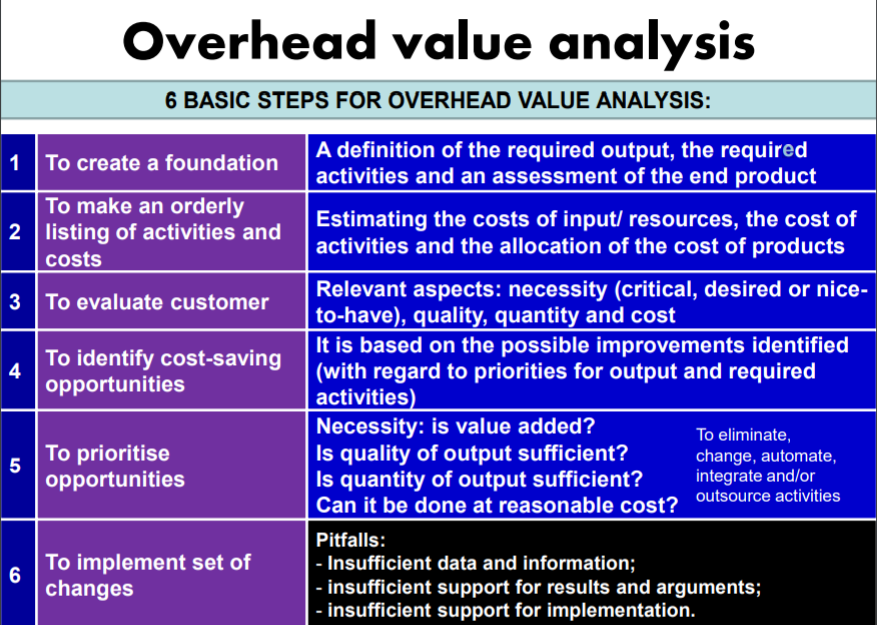
improvement programmes) - 5Overhead value analysis
- 6Kay's distinctive capabilitiesJohn Kay’s distinctive capabilities model (1993) is a strategy theory that adds to
the understanding of the nature of (sustained) competitive advantage
1. Architecture, 2. Reputation, 3. Innovation - 7Distinctive capabilitiesCompanies with distinctive capabilities have attributes that cannot be replaced by
other companies, and therefore allow the company to generate above-average
economic profits - 8OutsourcingOutsoursing is the delegation of non-core operations to an external source that is specialised in the management
of that operation - 9OffshoringOff-shoring is comparable to outsourcing, but he business process – production, manufacturing
or services – is moved to another country - 10Market researchThe process of gathering, interpreting and reporting
information to help marketers solve specific marketing problems or take
advantage of marketing opportunities. - 11ExpertsExperts are people who have extensive knowledge of the market in which you
are interested. - 12TechnostructureTechnostructure is the group of
technicians, analysts within
an organisation (enterprise,
administrative body) with considerable
influence and control on its economy. - 13Delphi techniqueThe Delphi technique is a method of collecting opinion on a particular research question.
It is based on the premise that pooled intelligence enhances individual judgment and
captures the collective opinion of a group of experts without being physically
assembled. - 14The scenariothe technique itself consists broadly of constructing hypothetical futures
and testing the likelihood of these futures by identifying avenues by which they can
be achieved. - 15Transparencyrefers to process of making explicit assumptions about the relationship
between key driving forces. - 16Diversity– implies that there is no single ‘best’ scenario or ‘high’ or ‘low’ market
projection; it recognises that the future is uncertain and considers a number of
different strategic routes. - 17Morphological techniques- these techniques are mainly concerned with identifying the
implications of certain courses of action and assisting in the comprehensive
consideration of alternatives by the use of forms. - 18Road mappinga process, by which experts forecast future developments in technology
and in the marketplace, and identify the consequence of those developments for
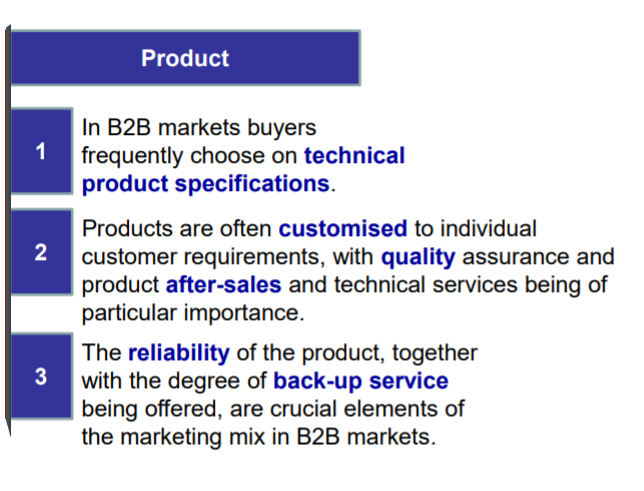
companies - 19The marketing mix - product
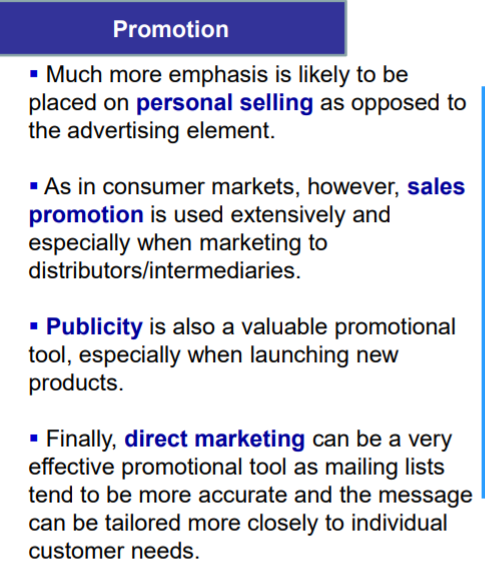
- 20The marketing mix - promotion
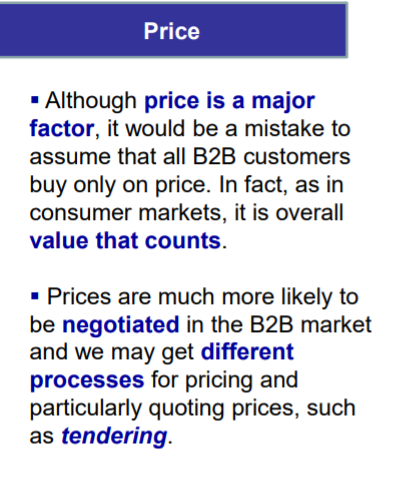
- 21The marketing mix - price
- 22The marketing mix - placeThe logistics aspects of distribution are particularly important in B2B markets as speed and, above all, reliability of delivery are vital. This emphasis on reliability of delivery has increased in recent years with the introduction of just-in-time (JIT) and flexible manufacturing systems in purchasing and production.
- 23Mintzberg's configurations - purposeThe framework describes 6 organisational configurations
These configurations help with understanding what drives
decisions and activities in an organisation - 24Mintberg's configuration - advantageADVANTAGE:
It helps to understand the relationship
between the nature of an organisation and
its co-ordination mechanism - 25Mintberg's configurations - disadvantageDISADVANTAGE:
Due to robust nature of the framework, it is difficult for organisations to match or
compare to these configurations (limited
number of criteria, there are many hybrids or combinations in practice); for example, it is irrelevant whether an organisation can be exactly classified as innovative or
entrepreneurial - 26Mintberg's configurations - most important parameterthe way in which power is distributed
throughout the organisation (it refers
to the type of decentralisation) - 27Mintberg's configurations - elements and main dtrategic guidelines
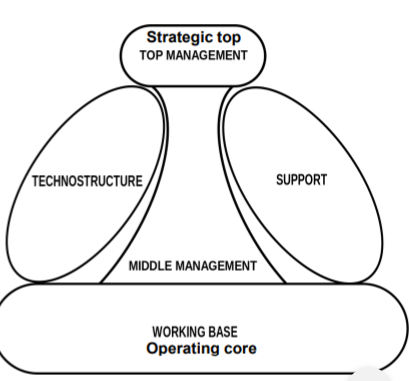
- 28Boston Consulting Group Matrix - disadvantagesAnalysis is based on two factors;
There are no clear criteria in what type of
market is appropriate to use;
Does not indicate where to assign new
products;
Matrix is focused on rapid growth rates;
Does not take into account competitors'
actions. - 29Boston consulting group production portofolio matrix - general guidelineTo use the profit of “Cash Cow” for “Star” investments or new product
development. These funds can be used for “Problem child”, to make
them “Star”. Usually, “Dogs” makes the biggest part in portfolio.
There is an advice to stop “Dogs” production, if in the future
significant investments are required. - 30Boston consulting group product portofolio matrix
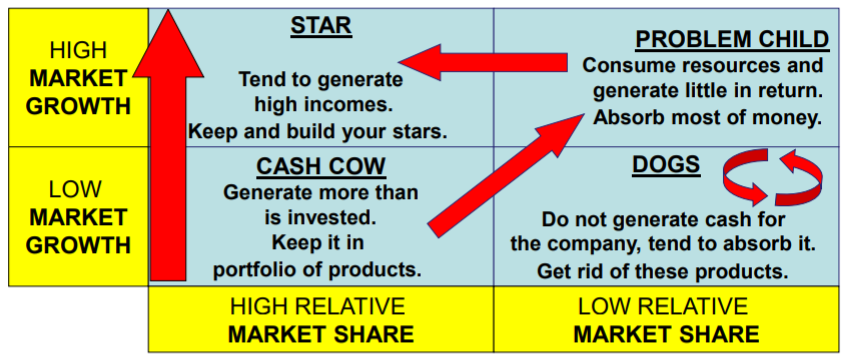
- 31Porter's five-forces model - main purposeFive Forces Analysis helps the marketer to contrast a competitive
environment. It has similarities with other tools for environmental audit,
such as PEST analysis, but tends to focus on the single business or unit
rather than a single product or range of products. - 32Porter's five forces model
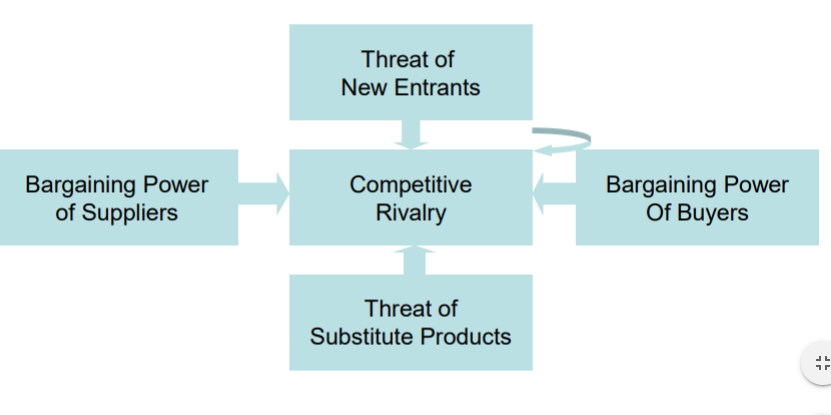
- 33Scenario - objectivesA specific goal (one-off, problem-solving projects) versus a more
general objective (longer-term projects that enable the survival of the
organisation).
2. Projects undertaken to open up an organisation that is closed to new
ways of thinking, versus projects to achieve closure on decisions and
action in an organisation that is drifting. - 34Scenario - categorization of scenario objectives
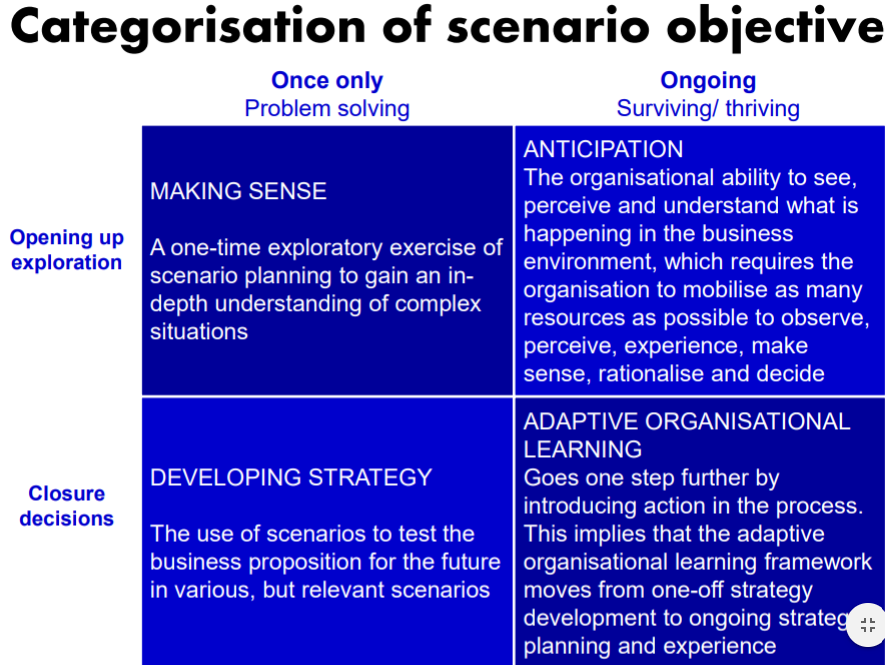
- 35Morphological Techinques - Main methodsThe most common forms used are the matrix and the relevance tree.
These forms are particularly useful as a first stage forecast where a
new product is involved or where opportunities are being sought for
existing products in new markets.
The matrix is used to show in tabular form the interaction of at least
two sets of parameters.
The relevance tree is used schematically to represent possible product
needs arising from particular trends in the business environment.
Morphological forecasting techniques have already been used in such
diverse areas as the market for industrial materials, and the
implications of pollution control for an oil company.