
Flashcards
Topic 4 - Guideline solutions
Cards in this deck (34)
- 14.1.1 Describe examples of oscillationsPendulum, mass on a spring, a tube floating in water when pushed down and released etc.
- 24.1.2 Define displacementThe instantaneous distance of a moving object from its mean position (in a specified direction) (m)
- 34.1.2 Define amplitudeMaximum displacement from the equilibrium position
- 44.1.2 Define frequencyNumber of oscillations completed per unit time (Hz) (#cycles/second)
- 54.1.2 Define PeriodThe time taken for one complete oscillation (s) (seconds/cycle)
- 64.1.2 Define phase differenceMeasure of how "in step" different particles are. If moving together, they are IN PHASE (2π). If not, they are OUT OF PHASE by half a cycle (π), quarter of a cycle (π/2)
- 74.1.3 Define Simple Harmonic motionIt is the motion that takes place when the acceleration of the object is always directed towards, and is proportional to, its displacement from a fixed point. (a=-\(ω^2\)x)
- 84.2.1 Describe the interchange between kinetic energy and potential energy during SHMKE is max when the object travels fastest; this is at the bottom of the swing. At the top of the swing, the bob is stationary so KE = 0. PE is max at the top of the swing, whereas it is minimum when the bob is at its lowest point. PE = 0. If no energy is lost, total energy is a constant value. Energy continually changes between KE and PE.
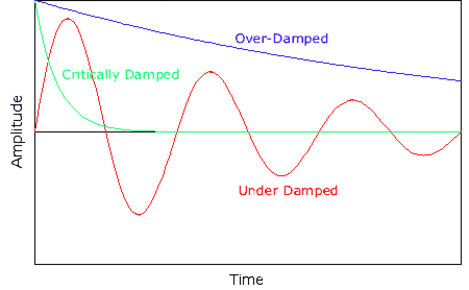
- 94.2.2 State what is meant by dampingDamping involves a force that is always in the opposite direction to the direction of the motion of the oscillating particle. As the particle oscillates, it does work against this dissipative force and so the particle losses energy. Total energy \(\propto\) \(A^2\) so amplitude decreases
- 104.3.2. Describe examples of damped oscillationsLightly damped (in air), Heavy damping/overdamped, Critically damped (shock absorbers in car, electric meters with moving pointers, door closing mechanisms)
- 114.3.2 Describe examples of damped oscillations (graph of the types of damping)
- 124.3.3 State what is meant by natural frequency of vibration and forced oscillationsNatural frequency of vibration - when the system is temporarily displaced from its equilibrium position, the system will oscillate. Forced oscillations - a system is forced to oscillate at a frequency other than the natural frequency.
- 134.3.5 State what is meant by resonanceResonance is an increase in amplitude that occurs when a system is subject to an oscillating force at exactly the same frequency as the natural frequency of oscillation of the system.
- 144.3.6 Describe examples of resonance where the effect is useful and where it should be avoided.Bad effects: Vibrations in machinery, Greenhouse effect. Good effects: Quartz oscillators, microwave generator, radio receivers, musical instruments.
- 154.4.1 Describe a wave pulse and a continuous progressive (travelling) wave.A wave pulse involves just one oscillation whilst a continuous wave involves a succession of individual oscillations.
- 164.4.2 State that progressive (travelling) waves transfer energyWaves transfer energy from one place to another, WITHOUT a net motion of the medium through which the wave travels.
- 174.4.3 Describe and give examples of transverse and longitudinal waves (TRANSVERSE)Transverse waves - the direction of the oscillation of the particles in the wave is perpendicular to the direction of transfer of energy by the wave. These waves can not be propagated in gases. Examples include: water ripples, light, waves along a stretched rope, earthquake waves.
- 184.4.3 Describe and give examples of transverse and longitudinal waves (LONGITUDINAL)Longitudinal waves - the direction of the oscillations of the particles is parallel to the direction of the transfer of energy by the wave. Examples include: sound waves, earthquake waves (both T & L), compression waves down a spring.
- 194.4.4 Describe waves in two dimensions, including the concepts of wavefronts and of rays.Wave fronts - line joining points that are in phase.
Circular wave front - produced by a point disturbance. The rays are radial.
Rays - show the direction of the waves (always at right angles to wave fronts) - 204.4.5 Describe the terms crest, tough, compression and rarefaction.
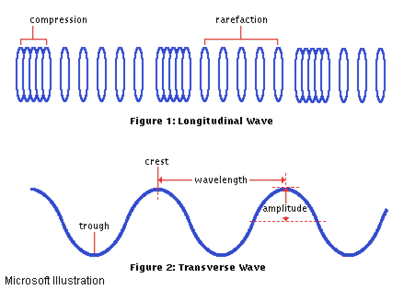
- 214.4.5 Describe the terms crest, tough, compression and rarefaction.Compression - everything is "bunched together" (high pressure)
Rarefaction - everything is "far apart" (low pressure) - 22Image of compressions and rarefactions.
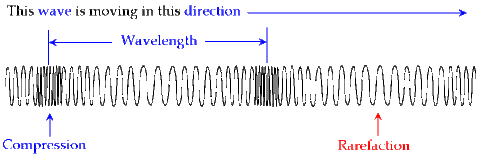
- 234.4.6 Define the terms displacement, amplitude, frequency, period, wavelength, wave speed and intensity. (WAVELENGTH)Wavelength - The distance between two consecutive crests, or any two consecutive points that are in phase
- 244.4.6 Define the terms displacement, amplitude, frequency, period, wavelength, wave speed and intensity. (WAVE SPEED)Wave speed - The distance travelled by the wave profile per unit time (m\(s^{-2}\))
- 254.4.6 Define the terms displacement, amplitude, frequency, period, wavelength, wave speed and intensity. (INTENSITY)The power per unit area that is received by the observer (I=P/A) I \(\propto\) \(A^2\)
- 264.4.7 Draw and explain displacement-time graphs and displacement-position graphs for transverse and for longitudinal wavesDisplacement - time graph: represents the oscillations for one point on the wave. The other points oscillate in a similar manner but do not start at the same time.
Displacement - position graph: "snapshot" of all the points along the wave at one instant of time. - 274.4.8 Derive and apply the relationship between wave speed, wavelength and frequency1) speed = distance/time
v = \(\frac{\(\lambda\)}{T}\)
\(\frac{1}{T}\) = f
v = f \(\lambda\) - 284.4.9 State that all electromagnetic waves travel with the same speed in free space, and recall the orders of magnitude of the wavelengths of the principal radiations in the electromagnetic spectrumAll EM waves travel at the speed of: 3.0 x \(10^8\) m\(s^{-1}\).
Gamma rays: < \(10^{-11}\)
X rays: \(10^{-9}\) - \(10^{-11}\)
UV: 4 x \(10^-7\) - \(10^{-9}\)
Blue: 4 x \(10^{-7}\)
Red: 7 x \(10^{-7}\)
Infrared: \(10^{-4}\) - 7 x \(10^{-7}\)
Microwave:\(10^
{-1}\) - \(10^{-4}\)
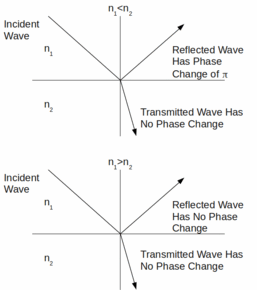
Radio: >\(10^{-1}\) - 294.5.1 Describe the reflection and transmission of waves at a boundary between two media.
- 304.5.2 State and apply Snell's Law\(\frac{sin i}{sin r}\)=\(\frac{V1}{V2}\) = n
n1 sin\(\theta\)1 = n2 sin\(\theta\)2 - 314.5.3 Explain and discuss qualitatively the diffraction of waves at apertures and obstaclesWhen waves pass through apertures they spread out. They also spread around obstacles. Smaller the aperture (relative to wavelength), bigger the diffraction effect.
- 324.5.4 Describe examples of diffractionSound: reason why we hear things without seeing them. Others...
- 334.5.5 State the principle of superposition and explain what is meant by constructive and destructive interference.The overall disturbance at any point and at any times where the waves meet is the vector sum of the disturbances that would have been produced by each of the individual waves. If waves have the same amplitude and same frequency, then the interference at a particular point can be constructive or destructive
- 344.5.6 State and apply the conditions for constructive and for destructive interference in terms of path difference and phase difference.Constructive interference takes place when the waves are "in step"; they are in phase. There is a ZERO phase difference between them. Path difference = n \(\lambda\) where n is an integer.
Destructive interference takes place when the waves are out of phase. There is phase difference = \(pi\) or alike. Path difference = (n+\(\frac{1}{2}\))\(\lambda\)
Information
- Description
- Physics (Topic 4 - Oscillations and Waves) Flashcards on Topic 4 - Guideline solutions, created by jessicapointing on 05/10/2013.
- Created by
- jessicapointing
- Views
- 119
- Tags
- Rating