
Flashcards
GCSE AQA Physics Unit 2 Flashcards

Cards in this deck (63)
- 1What does the gradient of a distance-time graph represent?speed
- 2What is velocity?Speed in a given direction
- 3What does the gradient of a velocity-time graph represent?Acceleration
- 4How do you work out the distance travelled?The area underneath a velocity-time graph
- 5What is newtons third law?Every action has an equal and opposite reaction
- 6What is the resultant force?The combined effect of all forces acting on an object
- 7What does the resultant force acting on an object make it do?Changes its state of rest or motion
- 8What happens if the resultant force acting on an object is zero?It is stationary
- 9If the resultant force is not zero what will happen to the object?The object will accelerate in the direction of the resultant force
- 10If the resultant force acting on a moving object is zero what happens to the object?The object will continue to move at the same speed in the same direction
- 11If the resultant force acting on a moving object is not zero what will happen to ?The object will accelerate in the direction of the resultant force
- 12What is the acceleration of an object determined by?The resultant force acting on the object and the mass of the object
- 13When a vehicle travels at a steady speed the what balances the driving force?The resistive forces
- 14The greater the speed of a vehicle the ______ the braking force needed to stopGreater/Higher
- 15What is the stopping distance?Thinking distance + braking distance
- 16What is thinking distance?The distance the vehicle travels during the driver's reaction time
- 17What are three things that effect a drivers reaction time?tiredness, alcohols and drugs
- 18What happens when the brakes of a vehicle are applied?Work done by the friction force between the brakes and the wheel reduces kinetic energy of the vehicle and the temperature of the brakes increase
- 19How is the braking distance of a vehicle effected?weather conditions, brake condition and road condition
- 20The faster an object moves through a lfluid the________ the _________ that acts on itgreater, frictional force
- 21Why will an object accelerating through a liquid initially accelerate?Due to the force of gravity,
- 22What is terminal velocity?When the resultant force is zero, drag force is equal to force making it move
- 23What may cause an object to change its shape?a force acting on the object
- 24What will happen when a force is applied to an elastic object?the object will stretch and store elastic potential energy e.g. spring
- 25What is Hooke's law?The extension of a spring is directly proportional to the force applied provided the limit of proportionality is not exceeded
- 26What is transferred when work is done?Energy
- 27What is the conservation of momentum?In a closed system the total momentum before an event is equal to the total momentum after the event
- 28What happens when certain insulating materials are rubbed together?They become electrically charged
- 29What are rubbed off from on material to another?Negatively charged electrons
- 30What happens when two electrically charged objects are brought together?They exert a force on each other (repel or attract)
- 31—Diode
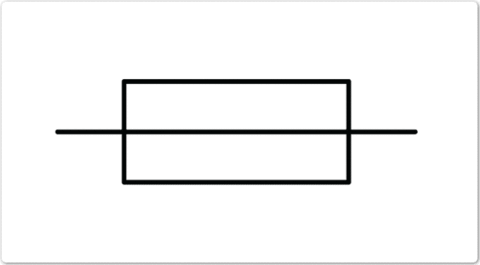
- 32—Fuse
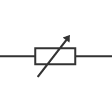
- 33—Variable resistor
- 34—Thermistor

- 35What is this graph for?For a resistor at a constant temperature

- 36What are current-potential difference graphs used to show?How the current through a component varies with the potential difference across it
- 37The current through a resistor is directly proportional to what?The potential difference across the resistor
- 38The greater the resistance the _______ the currentSmaller
- 39What is the same across each component in series?The current
- 40What is the same in each component of a parallel circuit?Potential difference
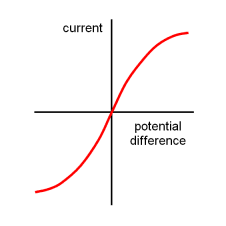
- 41What does this graph show?The resistance of a filament bulb increases as the temperature of the filament bulb increases
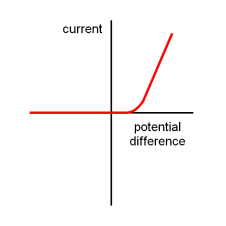
- 42What does this graph show?The current through a diode goes in one direction and has a very high resistance in the reverse direction
- 43When does an LED emit light?When current flows through it in the forward direction
- 44When does the resistance of an LDR decrease?As light intensity increases
- 45When does the resistance of a thermistor decrease?As the temperature increases
- 46What is an alternating current?A current that is repeatedly changing direction
- 47What is direct current?Current that passes in only one direction
- 48In the UK what is the frequency of mains electricity?50Hz and is about 230V
- 49What are the three wires in a three pin plug and what colour are they?Live wire (brown), neutral wire (blue) ant the Earth wire (yellow and green stripes)
- 50What is an RCCB?Residual Current Circuit Breaker
- 51What does the fuse do in a plug when the current exceeds the rating?It melts which breaks the circuit
- 52Which appliances usually have an earth wire?Ones with metal casing
- 53What happens when an electric charge flows through a resistor?It gets hot
- 54What is the basic structure of an atom?Protons, neutrons (nucleus) and electrons
- 55What is the relative mass of an electron?0.0005
- 56What is the relative mass of a proton or a neutron?1
- 57What is the relative charge of an electron?-1
- 58Does an atom have an overall charge?No
- 59How do atoms become ions?By losing or gaining electrons?
- 60What is an isotope?The atom of an element with the same number of protons but different numbers of neutrons
- 61Why is a substance said to be radioactive?substances that give out radiation from their nuclei of the atoms all the time
- 62What do alpha particles have in their nucleus?2 neutrons and 2 protons
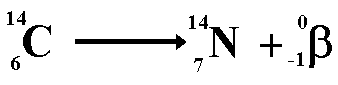
- 63What does this represent?Beta decay
Information
- Description
- Flashcards on the specification of Physics unit 2
- Created by
- Gabi Germain
- Views
- 629
- Tags
- Rating