Flashcards
Applying Psychological Science: Performance Psychology
Cards in this deck (22)
- 1What is procrastinationA decision to delay or not complete a task or goal that you’re committed to without a valid reason, and instead spending that time doing something of lesser importance despite the negative consequences that occur from not completing the original goal or task.
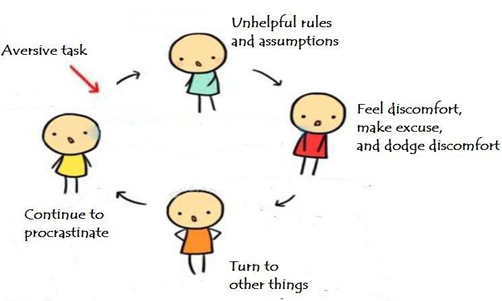
- 2What is the procrastination cycle
- 3Difference between procrastination and delay1. Gap between intention and action
2 voluntarily doing something else is procrastination - 4Prevalence of procrastination- 20% of adults engage in general procrastination
- up to 70% procrastination among college students - 5Reasons for procrastinationFear/Anxiety about
Doing poorly
Doing too well
Losing control
Looking stupid Sense of self or Self concept challenged
Raised by authoritarian parents - 6What is Affective forecastingis people’s predictions about their affect (emotional state) in the future (Gilbert & Wilson,2003)
- 7Affective forecasts four components1.predictions about future emotional valence
2.the specific emotions experienced 3.duration of the emotions
4.intensity of the emotions (impact bias) - 8Affective forecast exampleLottery winner vs paraplegics
What explains these findings: 1.Focalism (what changes not remains) 2.Presenteeism (valuing something now more then the future) (Pychl, 2013)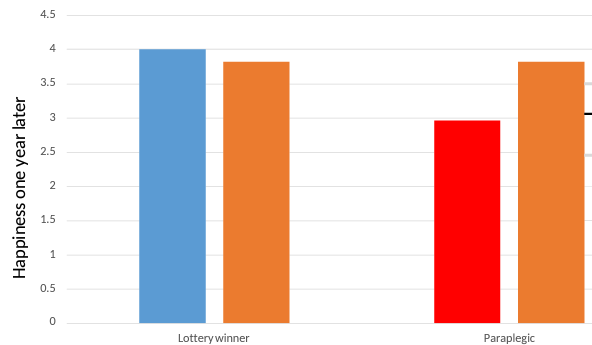
- 9relationship between affective forecasting and procrastinationExample: Going to the gym tomorrow
•Setting the intention •7pm –I set the intention I am going for a run tomorrow morning at 5am •When I set the intention at 7pm how do you think I will feel? •I am likely to focus on my current affective state when I make this
intention •Likely to be positive •I am planning to do something good for myself (e.g. future health behaviour) •Reality at 5am the next morning
•Result: I have badly forecasted my mood. Behaviour: Hit Snooze button - 10FocalismThe tendency to underestimate the extent to which other events will influence our thoughts and feelings in the future. • E.g., Unable to account for unknown future events like a headache affecting our mood
- 11PresenteeismThe fact that we put too much emphasis on the present in our prediction of the future. • E.g., Thinking that just because you woke up at 8am in good mood that makes you motivated then you’ll also be in this same motivated mood when it’s 5pm (assuming that no major mood altering event occurs)
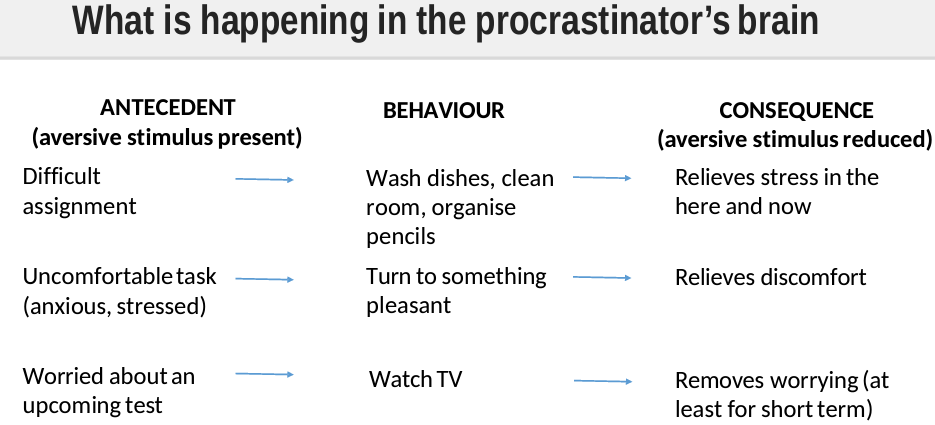
- 12Procrastination theory: Learned behavioureg Operant conditioning
- 13Cognitive Dissonanceunpleasant mental experience of tension from tow conflicting thoughts or beliefs
Four possible overall outcomes can occur: 1. Change behaviour
2. Change attitude
3. Change the perception of the inconsistent information
4. Ignore the information - 14Procrastination theory: Psychodynamic approachThe ID - instincts or pleasure
Ego - realistic balance
Super ego - moral or perfectionist - 15Procrastination theory: Biological perspectiveThe effect of the brain or neurological approach .
- 16—cognitive control system, mainly the prefrontal cortex, top-down signals to facilitate goal-directed behaviours
affective processing system responding to emotional stimuli limbic system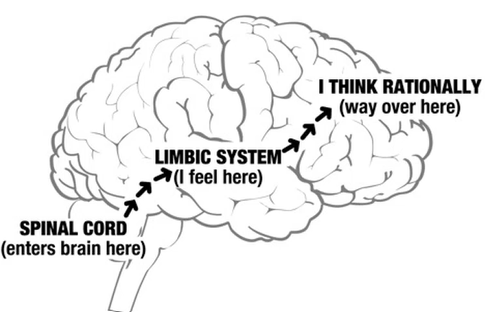
- 17Costs of procrastination1 Performance
2 Wellbeing
3 Relationships (often negatively perceived by others) - 18Why do we procrastinate?Unhelpful rules:
1. need to be in charge
2. pleasure seeking
3. fear of failure/disapproval
4. fear of uncertain / catastrophe
5. low self confidence
6. depleted energy - 19Why we believe Procrastination excuses?cognitive dissonance: unpleasant mental experience of tension from tow conflicting thoughts or beliefs
eg. fox stops trying to get grapes on the high branch because "he doesn't really want them anyway' - 20Cognitive Dissonance outcomes1 Distraction (dark playground)
2 forgetting
3. trivialization (not important)
4. Deny responsibility
5 add consonant cognitions (need more info before I can start)
6 make downward counterfactuals (explain in a different way eg Just get a penalty)
7 change behaviour - 21Procrastination interventions- the abc model (challenging the conclusions) Active event, Beliefs, Consequences
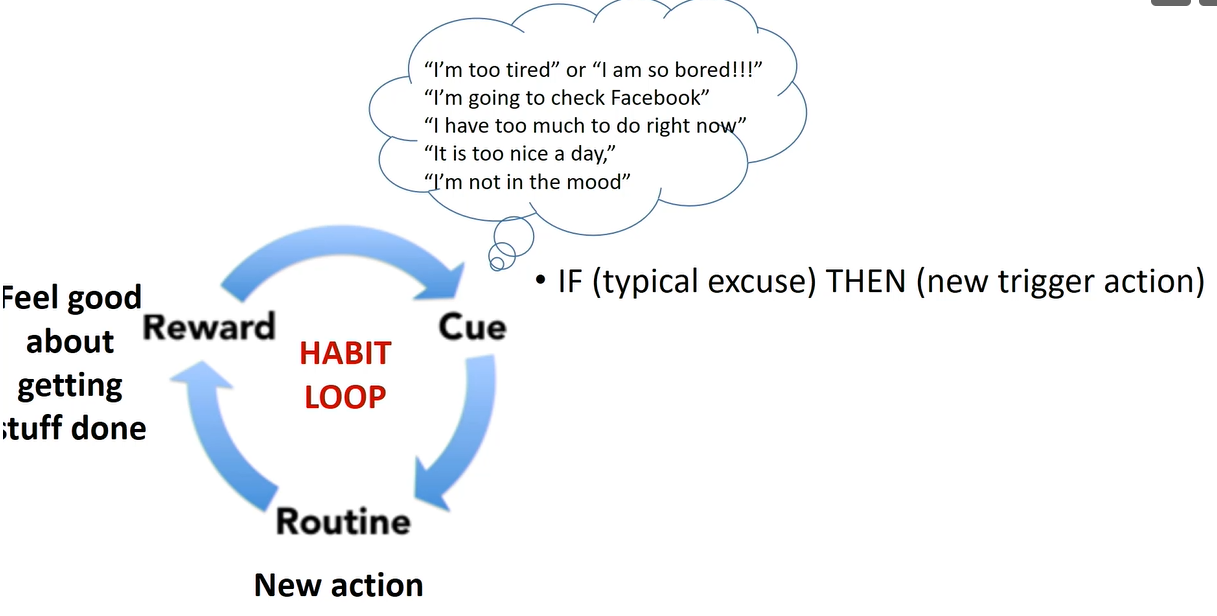
- implementation plan "IF situation x arises, THEN I will perform response y" - choose specific day time place and this replaces behaviour - 22Implementation Plan