
Flashcards
Artificial Intelligence - Informed Search
Cards in this deck (17)
- 1Uninformed search vs Informed searchUninformed search methods have access only to the problem definition.
Informed search methods may have access to a heuristic function h(n) that estimates
the cost of a solution from n. - 2Best-first searchThe generic best-first search algorithm selects a node for expansion according to
an evaluation function. - 3Greedy best-first searchGreedy best-first search expands nodes with minimal h(n). It is not optimal but
is often efficient. - 4A∗ search(Combine greedy and uniform-cost)
A∗ search expands nodes with minimal
f(n) = g(n) + h(n). A∗ is complete and
optimal, provided that h(n) is admissible (for TREE-SEARCH) or consistent (for
GRAPH-SEARCH). The space complexity of A∗ is still prohibitive. - 5Admissible heuristic?h(n) is admissible if h(n) never overestimates cost to reach a goal. Consequences:
-h(n) is always optimistic
- f(n) never overestimates cost of a solution through node n
-h(n) = 0 if n is a goal - 6Consistent heuristicThe estimation from a node n to the goal, is lesser than the cost from
n to a new node n' with the estimation from the node n' to the goal
h(n) ≤ c(n, a, n') + h(n')
Consistent heuristic is admissible. - 7Triangle inequality?Each side of a triangle cannot be longer than the sum of the other two
sides.
• h(n) : estimated cost between n and G
• C(n, a n’) : cost to go in n’ from n with
action a
• h(n’) : estimated cost between n’ and G - 8A* is Optimal : ProofA* (using Tree Search) is optimal if h(n) is admissible
Proof :
• A solution is a path from the initial state to a goal state
• Let C* be the lowest path cost among all solutions
• We must show that A* will not return a suboptimal path to a goal
Part (1)
• Let G be a goal node in the fringe, but in a suboptimal path
• Its path cost g(G)=C is not the lowest one (C > C*)
• f(G) = g(G) + h(G)
• h(G) = 0 because G is a goal node and h is admissible
• f(G) = g(G) = C > C*
• f(G) > C*
Part (2)
• Let n be a node in the fringe,
with n in the path to the optimal solution (cost C* )
• f(n) = g(n) + h(n)
• f(n) ≤ C* because h is admissible
Part (3)
• f(n) ≤ C* < f(G)
• Node G will never be selected
(end of proof)
Consequence
• A* expands no nodes with f(n) > C* - 9Properties of consistency?• If a heuristic is consistent, then it is also
admissible
• A* (using Graph Search) is optimal
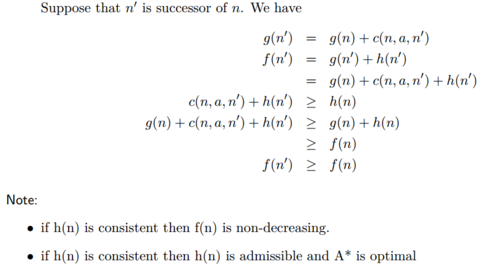
if h(n) is consistent - 10Monotonicity of f(n)If h(n) is consistent (Let a be an action and n,n’ two nodes we have
h(n) ≤ c(n, a, n') + h(n')) then f(n) along any path is non decreasing. - 11Properties of A*• With h(n) consistent, the sequence of
nodes expanded by A* using GraphSearch is in
non decreasing order of f(n)
• A* (using Graph-Search ) is optimal
if h(n) is consistent
• A* expands all nodes with f(n) < C*
• A* expands some (at least one)
of the nodes
on the C* contour before finding the goal
• A* expands no nodes with f(n) > C* - 12A* is optimally efficient?A* is optimally efficient because he don’t expand node with f(n) > C∗.
We can’t be more
efficient because if we don’t expand all node with f(n) < C∗ we take the risk of missing the optimal solution! - 13Iterative Deepening A*We combined the algorithm A* with the Iterative deepening. Let l be a limit.
IDA* use f-cost(g+h) as a cutoff rather than the depth.
At each iteration, the cutoff-value
is the smallest f-cost of any node the exceeded the cutoff on the previous iteration. - 14Recursive Best-First SearchIt’s a simple recursive algorithm trying to run in a linear space.
The structure is the same than the DFS except it does not keep going down indefinitely.
It us a f_limit value variable to keep track of the f-value of the best alternative path from the ancestor of the current node.
IDA* and RBFS use to little memory - 15Simple Memory-Bounded A*SMA* does run as A* until the memory is
full. When the memory is full,
it need to discard a node if it wants to add a new one.
It will discard the worst one
(one with highest f-value).
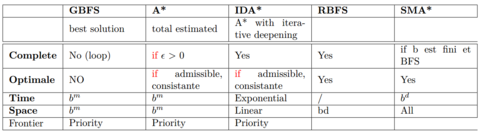
SMA* backups the value of the its parent so that the ancestor knows the quality of the best path in that sub tree. - 16Informed search comparaison
- 17Designing heurisiticYou must choose an admissible and consistent heuristic. You must choose the most dominant heuristics (The most dominant is the one with the most informations)
Information
- Description
- A-Level Artificial intelligence Flashcards on Artificial Intelligence - Informed Search, created by Wojciech Gryncze on 10/01/2016.
- Created by
- Wojciech Gryncze
- Views
- 34
- Tags
- Rating