
Flashcards
P2 Radioactivity and Stars
Cards in this deck (30)
- 1What is an atom made up of?The basic structure of an atom is a small central nucleus composed of protons and neutrons surrounded by electrons. Candidates should appreciate the relative size of the nucleus compared to the size of the atom.
- 2Numbers of particles in a neutral atom?In an atom the number of electrons is equal to the number of protons in the nucleus. The atom has no overall electrical charge.
- 3What is an ion?Atoms may lose or gain electrons to form charged particles called ions.
- 4What is the same for ALL atoms of an element?Number of protons
- 5What is atomic number?The total number of protons in an atom
- 6What is mass number?The total number of protons and neutrons in an atom
- 7What is an isotope?Same number of protons, different number of neutrons
- 8Origins of background radiation?Knowledge and understanding should include both natural sources, such as rocks and cosmic rays from space, and man-made sources such as the fallout from nuclear weapons tests and nuclear accidents.
- 9What can affect the radiation gives out by a radioactive substance?NOTHING!
- 10What is an alpha particle?two neutrons and two protons
- 11What is a beta particle?an electron from the nucleus
- 12What is a gamma ray?electromagnetic radiation
- 13Nuclear equations? (H)Candidates will be required to balance such equations, limited to the completion of atomic number and mass number. The identification of daughter elements from such decays is not required.
- 14Properties of alphaStrongly ionising (2+)
Penetrate thin paper
Short range in air - 15Properties of betaMedium ionising (1-)
Penetrate thin Al
Tens of cm in air - 16Properties of gammaWeakly ionising
Penetrates lead!
Very long range in air - 17Deflection of radiation by electric and magnetic fieldsAll candidates should know that alpha particles are deflected less than beta particles and in an opposite direction.
Higher Tier candidates should be able to explain this in terms of the relative mass and charge of each particle. - 18What is half-life?The half-life of a radioactive isotope is the average time it takes for the number of nuclei of the isotope in a sample to halve, or the time it takes for the count rate from a sample containing the isotope to fall to half its initial level.
- 19The uses of and the dangers associated with alphaSmoke detector.
Short-range means very dangerous inside the body, but limited danger outside. - 20The uses of and the dangers associated with betaThickness monitoring (paper, Al sheet).
Longer-range means more dangerous from outside the body, less dangerous from inside. - 21The uses of and the dangers associated with gammaMedical tracers (short half-life)
Radio-therapy
Sterilising surgical instruments.
Cancer risk from over-exposure to lower-energy gamma. - 22Name two nuclear fuels?There are two fissionable substances in common use in nuclear reactors: uranium-235 and plutonium-239.
- 23What is nuclear fission?Nuclear fission is the splitting of an atomic nucleus.
- 24What does the fuel nucleus have to do before it can fissh?For fission to occur the uranium-235 or plutonium-239 nucleus must first absorb a neutron.
- 25What happens when a nucleus undergoes fission?The nucleus undergoing fission splits into two smaller nuclei and two or three neutrons and energy is released.
The neutrons may go on to start a chain reaction.
Candidates should be able to sketch or complete a labelled diagram to illustrate how a chain reaction may occur. - 26What is nuclear fusion?Nuclear fusion is the joining of two atomic nuclei to form a larger one.
- 27How do stars form?Stars form when enough dust and gas from space is pulled together by gravitational attraction. Smaller masses may also form and be attracted by a larger mass to become planets.
- 28What is true for a 'main sequence' starDuring the ‘main sequence’ period of its life cycle a star is stable because the forces within it are balanced.
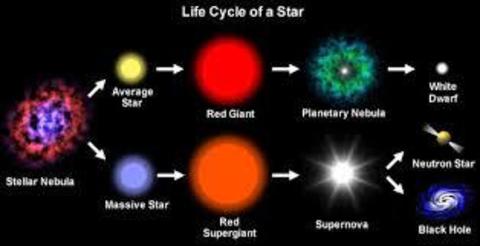
- 29Can you describe the life cycle of a star?
- 30Where do the elements come from?Fusion processes in stars produce all of the naturally occurring elements. These elements may be distributed throughout the Universe by the explosion of a massive star (supernova) at the end of its life.
Candidates should be able to explain how stars are able to maintain their energy output for millions of years.
Candidates should know that elements up to iron are formed during the stable period of a star. Elements heavier than iron are formed in a supernova.
Information
- Description
- GCSE Physics Flashcards on P2 Radioactivity and Stars, created by dfreeman on 16/05/2014.
- Created by
- dfreeman
- Views
- 1,053
- Tags
- Rating