
Documentary mind maps
38 mind maps by 34 users
This GoConqr page gathers over 30 documentary mind maps, covering styles, genres, realism and spectatorship. School students, university students and professional candidates can practise analysing documentary forms and representation, while teachers can find material for lessons. The collection spans school and university study as well as professional preparation. Pick a map to explore.
Mind maps
-
Features of a documentary Features of a documentary
-
Documentary Genres
-
Sober House
-
How far are documentaries more challenging to the spectator because they appear to represent real life characters and situations? How far are documentaries more challenging to the spectator because they appear to represent real life char...
-
With your team analyse how the techniques associated with ‘observational’ mode (as identified in Nichols and Rabiger) are being used in Divorce Iranian Style (Kim Longinotto). How is the filmmaker’s presence made apparent? How do Longinotto’s methods comp
-
Documentary Modes and Realism
-
Documentary Modes and Realism
-
AMY ALL COMPONENTS
-
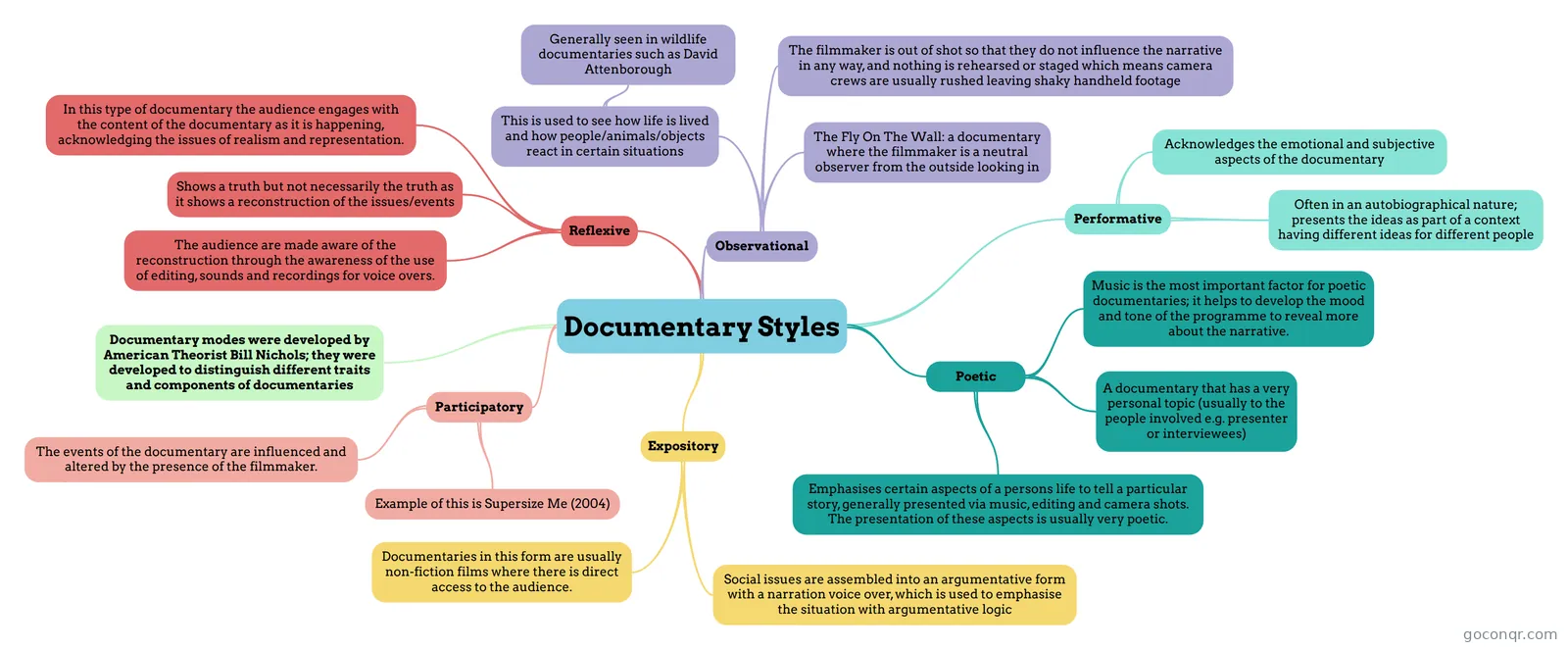 Documentary Styles styles
-
Types of Documentaries FDHRJ
-
DOCUMENTARY AND SPECTATORSHIP
-
Global Warming
-
Life and Death of Marsha P. Johnson (Transexual Issue)
-
Supermensch: The Legend of Shep Gordon
-
intertextuality
-
1_American Masters: Inventing David Geffen
-
Documentary
-
Documentaries VS reality TV.
-
Features of a documentary Features of a documentary
-
Intertextuality Research Used in Documentaries
-
DOCUMENTARY
-
Enter text here
-
video diaries
-
Documentary
-
Dissertation Planning
-
Narrative Structure:Amy
-
BFC: Documentary as a worksof Fiction
-
That Sugar Film
-
Subject (Trawler Fishing)
-
Documentaries and spectatorship
-
BFC: Trusting the filmaker
-
Initial Ideas Mind Map
-
Idea 1
-
Media
-
Documentaries
-
media documentaries
-
CONCEPT:CONCEPT: Documentary form can be utilised in various ways to persuade and inform an audience on a particular issue or problem.
-
1_Initial Ideas Mind Map Media A2
More Documentary resources
About documentary mind maps
GoConqr OriginalUsing documentary mind maps
Mind maps on this page connect documentary ideas with examples and questions. Documentary Genres includes docudrama, while Documentary Modes and Realism considers expectations of non-fiction and reality. Other maps look at spectatorship, intertextuality and individual films.
For a way into representation, start with Documentary Modes and Realism. Follow its branches to see how the map relates documentary to reality. Then use Documentary Genres to look at a different way of grouping documentaries, including docudrama.
Move between formats
As you revise, follow the links between ideas in a map and try to explain them in your own words. Return to a branch if you want to check how its ideas connect. When you want a change from exploring a map, switch to the flashcards on the Documentary unit page.
Choose a map and follow a branch that interests you.
Frequently asked questions
Which mind map could I start with?
Start with Documentary Modes and Realism if you want to explore how documentary relates to reality. For a different starting point, Documentary Genres includes docudrama. Both give you branches to follow, so you can focus on one idea before moving to another map.
Are these mind maps free to use?
Yes. Every resource listed on this page is free to open and study, without an account. The maps were made by GoConqr users rather than by GoConqr. A free account also lets you save quiz scores and make your own quizzes, mind maps, flashcards and notes.
Who can use this collection?
The collection is relevant to school students, university students and professional candidates exploring documentary forms and representation, as well as teachers looking for material. It includes resources associated with A-level Media Studies and A-level Film Studies, alongside material for university-level study.