
Notation and Rhythm mind maps
28 mind maps by 28 users
This page gathers user-made Notation and Rhythm mind maps on musical symbols, note values, tempo and metre. The maps support school students and primary pupils practising these topics, and teachers looking for ready-made material. Explore the collection of over 20 maps and pick a topic to start with.
Mind maps
-
Musical Symbols A mind map of the most frequently used symbols in middle school music.
-
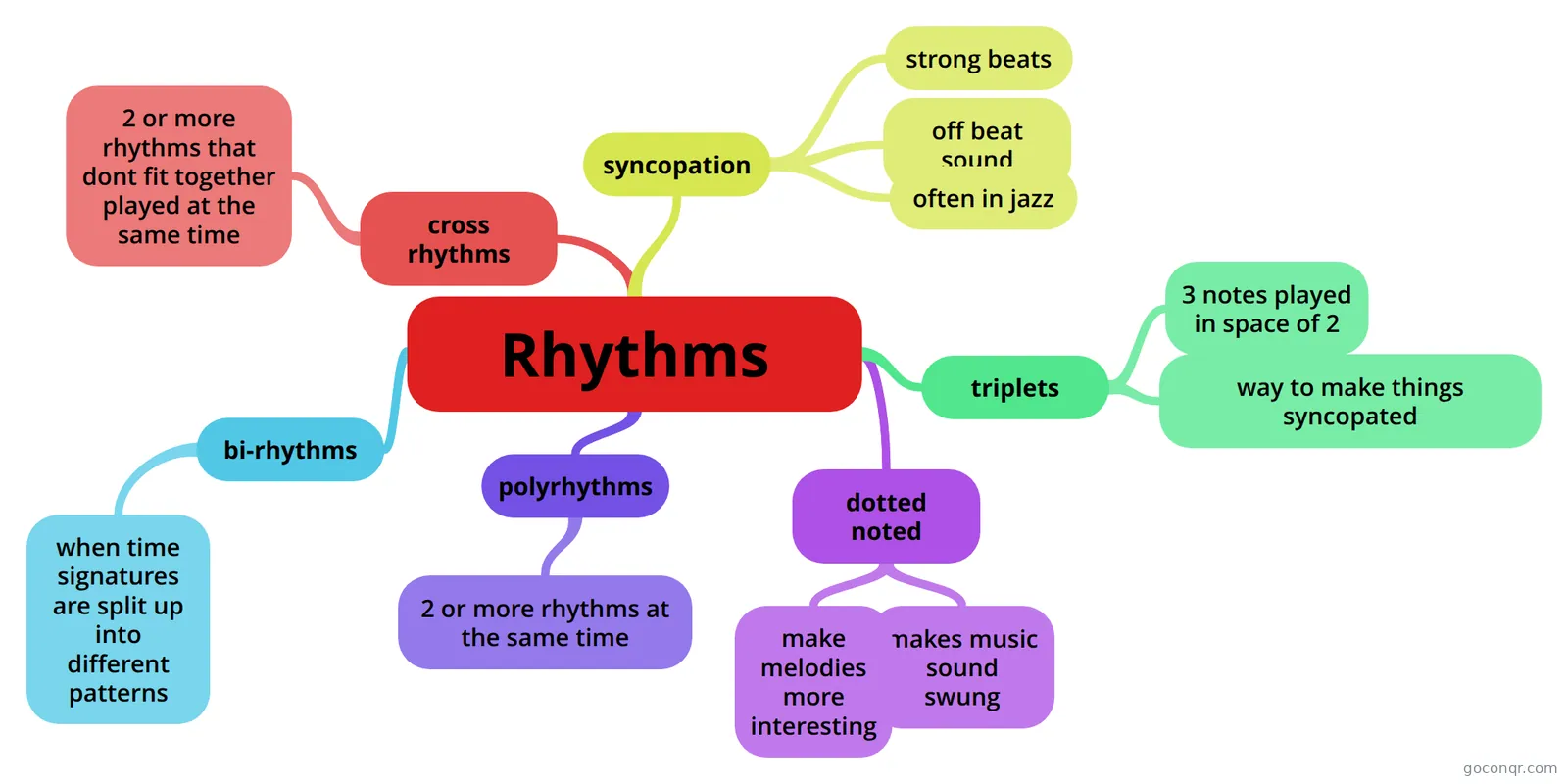 Rhythms aqa exam board
-
GCSE Music AQA Key Words - Tempo, Metre and Rhythm
-
Music - Rhythm and Metre
-
1º term (Music Workshop)
-
Aos1: Rhythm and Metre
-
Music mind map
-
duration
-
Music Literacy
-
Music
-
AOS1 Rhythm and metre music
-
Untitled
-
Musical symbols
-
Metre
-
How Music Works - Rythm
-
Sharps and flats Mind map about definitions between accidentals and key signatures
-
Rhythm & Meter (Aos 1)
-
Music ♫♪♫ Notes on scales
-
Duration
-
Rhytm and metre
-
Music Theory
-
DURATION Duration: note values and rests
-
music
-
Notation Vocab
-
Rhythm
-
Note Values
-
MUSICAL FIGURES
-
Music
More Notation and Rhythm resources
About notation and rhythm mind maps
GoConqr OriginalExplore notation and rhythm mind maps
These maps organise musical ideas into branches. Music mind map brings together clefs, notes and accidentals, while Music - Rhythm and Metre covers time signatures and simple and compound time. Rhythms includes syncopation, triplets and dotted notes.
For a starting point on rhythm, Rhythms offers several connected ideas in one map. For notation, Music mind map gives you clefs and note names to revisit together. Teachers can also use a map as ready-made material for a topic.
Revise with a map
Read one branch at a time, then cover it and recall the terms before checking the map again. Compare branches when you want to see how the ideas are grouped. If you want a different way to practise, the unit page also has flashcards and quizzes. Choose a map and follow a branch that interests you.
Frequently asked questions
Which mind map is a good place to start?
For rhythm, Rhythms brings together syncopation, triplets and dotted notes. If you want to focus on notation, Music mind map groups clefs, notes and accidentals. Either gives you a set of related terms to look through before you move to another map.
Are these mind maps free to use?
Yes. Every resource listed here is free to open and study without an account. The maps were made by GoConqr users. A free account also lets you make your own mind maps, quizzes, flashcards and notes, and save your quiz scores.
Who are these mind maps for?
The collection includes material for school students and primary pupils practising notation and rhythm, as well as teachers looking for ready-made material. It also includes a GCSE Music map on tempo, metre and rhythm. The topics and level vary between maps, so choose one that fits what you are studying.