
Notation and Rhythm
60 resources created by 47 users
This GoConqr page gathers over 200 community-made resources on Notation and Rhythm: quizzes, mind maps, flashcards and notes to revise and practise with.
Top Notation and Rhythm resources
-
Mind map Musical Symbols A mind map of the most frequently used symbols in middle school music.
-
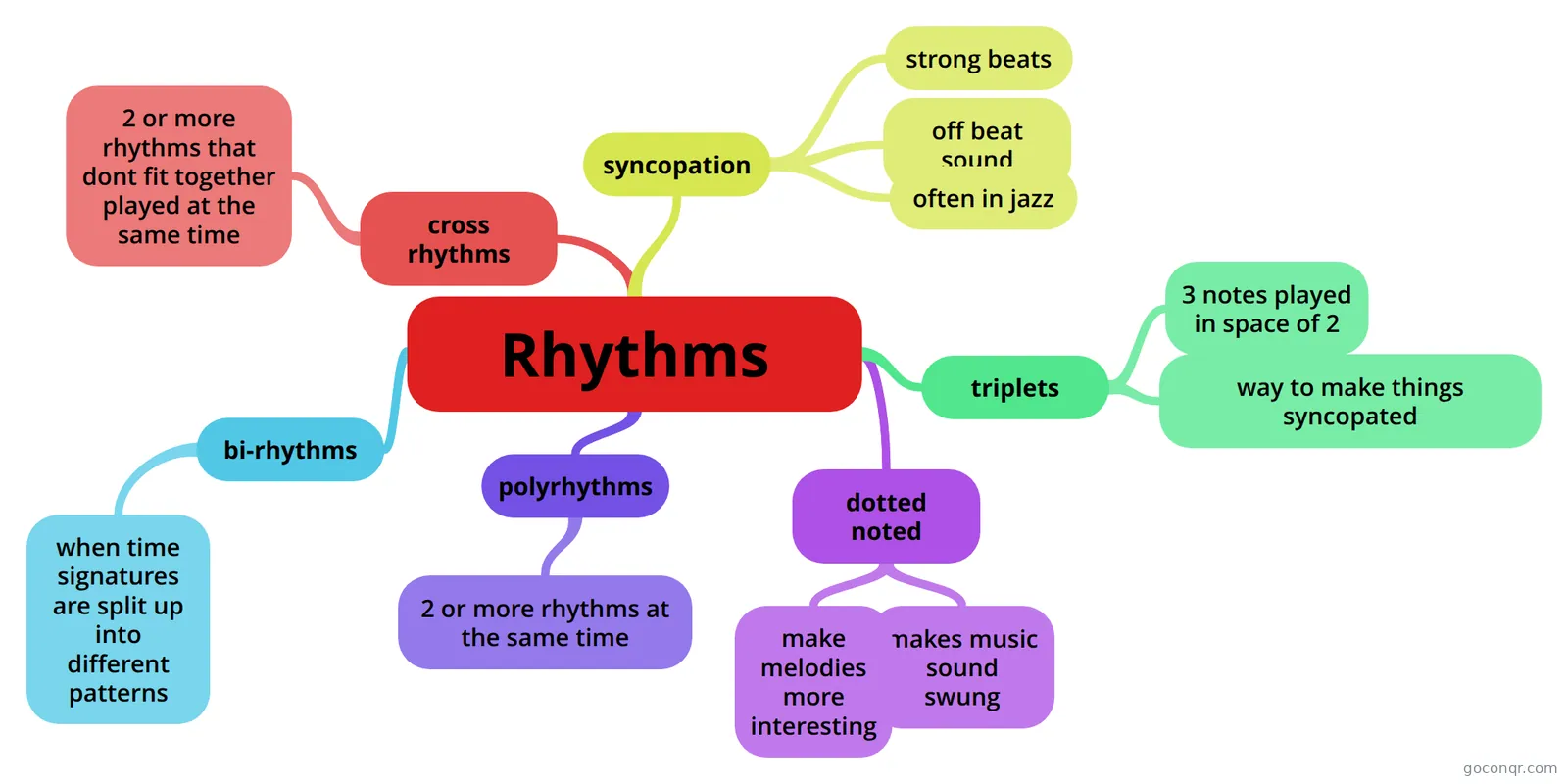 Mind map Rhythms aqa exam board
-
16 cardsADIVINA QUE NOTA, SILENCIO O PALABRA MUSICAL SOY THIS NOTE HAS NOT A STEM.
-
15 cardsMusic Symbols #2 play a section of music again
-
10 questionsFrench Horn Name the Pitch #1 Name the Pitch
-
10 questionsClarinet and Trumpet Name the Pitch #1 Name the Pitch
-
13 cardsRhythm Learning Sequence - Level 1 This is for use with the Rhythm Learning Sequence, as posited by David Newell.
-
23 cardsBass Clef ff
Quizzes
-
10 questionsFrench Horn Name the Pitch #1 Name the Pitch
-
10 questionsClarinet and Trumpet Name the Pitch #1 Name the Pitch
-
12 questionsConcept of Clefs Compare bars X, Y and Z, then choose True or False for the following statement. X and Z are at the same pitch.
-
39 questionsGrade 6 & 7 - Identify the Time Signature Identify the Key Signature
-
22 questions4th Grade Champion Name the note!
-
11 questions002: Note Naming note id
-
10 questionsTHE NOTES: TEST A whole note lasts the same as four quarter notes
-
7 questionsNote Quizzzz How many beats does a MINIM get?
Mind maps
Flashcards
See all 47 flashcards-
16 cardsADIVINA QUE NOTA, SILENCIO O PALABRA MUSICAL SOY THIS NOTE HAS NOT A STEM.
-
15 cardsMusic Symbols #2 play a section of music again
-
13 cardsRhythm Learning Sequence - Level 1 This is for use with the Rhythm Learning Sequence, as posited by David Newell.
-
23 cardsBass Clef ff
-
6 cardsTreble Clef - Above the staff Music
-
8 cardsListen and choose the correct rhythm Rhythmic game with crotchets, quavers and semiquavers.
-
3 cardsMusical Road Map
-
17 cardsB A S S CLEF
More Music topics
About Notation and Rhythm
GoConqr OriginalWhat the page covers
This unit sits in the Foundations of Music strand of Music. It brings together two linked skills: reading notation and understanding rhythm. Most of the material is flashcards, with quizzes and mind maps alongside them, plus a few notes and slide sets.
On the notation side, you will find decks on the treble and bass clefs, such as Treble Clef - Above the staff, Treble Clef - Below the Staff and Bass Clef Note Recognition. The mind map Musical Symbols groups marks for articulation, pitch, rhythm, tempo and dynamics, and shows the staff, bar lines and clefs.
Where to start
- Begin with the mind map Musical Symbols to see the whole picture.
- Move to a clef deck and learn the note names, one line or space at a time.
- Try a naming quiz such as Treble Clef Quiz or Concept of Clefs.
- Turn to rhythm with the mind map Rhythms, then the decks Note Values and NOTES & RESTS style sets such as Notes & Rests.
Rhythm in more detail
The Rhythms mind map covers syncopation, strong and off beats, triplets (three notes played in the space of two) and dotted notes. For counting practice, Rhythm Learning Sequence - Level 1 works through four-beat patterns, and Listen and choose the correct rhythm trains your ear. Quizzes such as Rhythm Counting Test Quiz and Rests let you check what you have learnt.
Some resources use the headings Rhythm and Metre, and some are tied to GCSE Music or SQA Higher Music vocabulary, such as GCSE Music AQA Key Words - Tempo, Metre and Rhythm.
Using quizzes and maps together
Read a mind map first, then close it and take a quiz on the same topic. Wherever you lose marks, go back to the matching map branch or flashcard deck. Teachers can set a deck or quiz as a quick starter or homework, since everything here was made by GoConqr users and is free to open.
When you are ready, choose one topic from the list and work through it from map to quiz.
Frequently asked questions
Which resource should I open first?
Start with the Musical Symbols mind map. It shows the staff, bar lines, clefs, notes, dynamics, tempo and articulation in one place. After that, pick a clef flashcard deck to learn note names, or the Rhythms mind map if counting beats is your main worry.
What do the rhythm mind maps cover?
The Rhythms mind map covers syncopation, strong beats and off beats, triplets, and dotted notes. Other maps look at rhythm and metre, note values and duration. Together they give you the ideas to check against the rhythm quizzes and counting decks.
Are the resources free to use?
Yes. Every resource listed here is free to open, study and take, with no account needed. They were made by GoConqr users rather than by GoConqr itself, so styles and depth vary from one resource to the next.
Which exams do these resources suit?
Some resources mention GCSE Music and SQA Higher Music, including a mind map of key words for tempo, metre and rhythm. Many others are general practice for school students and primary pupils, so check the title and contents to see whether a resource fits your course.
Can I practise note reading on this page?
Yes. There are flashcard decks for treble and bass clef notes, plus quizzes such as Treble Clef Quiz, Parts of music staff and Note Quizzzz. Some quizzes name pitches for instruments like the French horn, clarinet and trumpet.
What if I cannot find what I need?
Try a nearby topic, since clefs, symbols, rests and rhythm overlap across many resources. If something is still missing, you can make your own quiz, mind map, flashcards or notes with a free account, which also saves your quiz scores.