
Software Testing mind maps
189 mind maps by 148 users · Page 1 of 5
This Software Testing page gathers over 180 community-made mind maps, covering testing levels, strategies and test-driven development. University students and professional candidates can use them to review testing concepts, while teachers can find material for lessons. The collection also includes material for school students. Pick a map to start exploring.
Select topic
- Software Testing Principles24
- Software Quality Assurance and Verification11
- Software Testing Process10
- Test Planning and Strategy10
- Software Testing Levels28
- Types of Software Testing19
- Test Design Techniques59
- Manual Testing12
- Test Automation and Tools20
- Agile Testing and Test-Driven Development29
- Mobile App Testing9
- Defect Management8
Mind maps
-
Test-Driven Development
-
Software Testing 2
-
Software Testing
-
MOCKS
-
QA Test level and Testing Types
-
QA FUNDAMENTALS
-
Software Testing [CTF] [07/05/2018]
-
Selenium
-
First Task
-
Analysis/Testing
-
Guardian Command (GC)_1
-
Test Data
-
Evolution of Software Testing
-
3.9 Techniques for Testing
-
Testing techniques mind map
-
3.8.2 Stages of testing
-
test Levels
-
Search-Based Software
-
Test Strategy
-
Techniques For Testing
-
Testing Techniques
-
Software Testing
-
Stages of testing
-
Objectives for TA
-
3.9 Testing techniques
-
testing
-
Techniques for testing
-
Techniques for Testing
-
Philosophy of Testing
-
Techniques for Testing
-
HERRAMIENTAS PARA LAS PRUEBAS DE SW
-
TESTING_1
-
TESTING
-
Unit Tests
-
7 testing principles
-
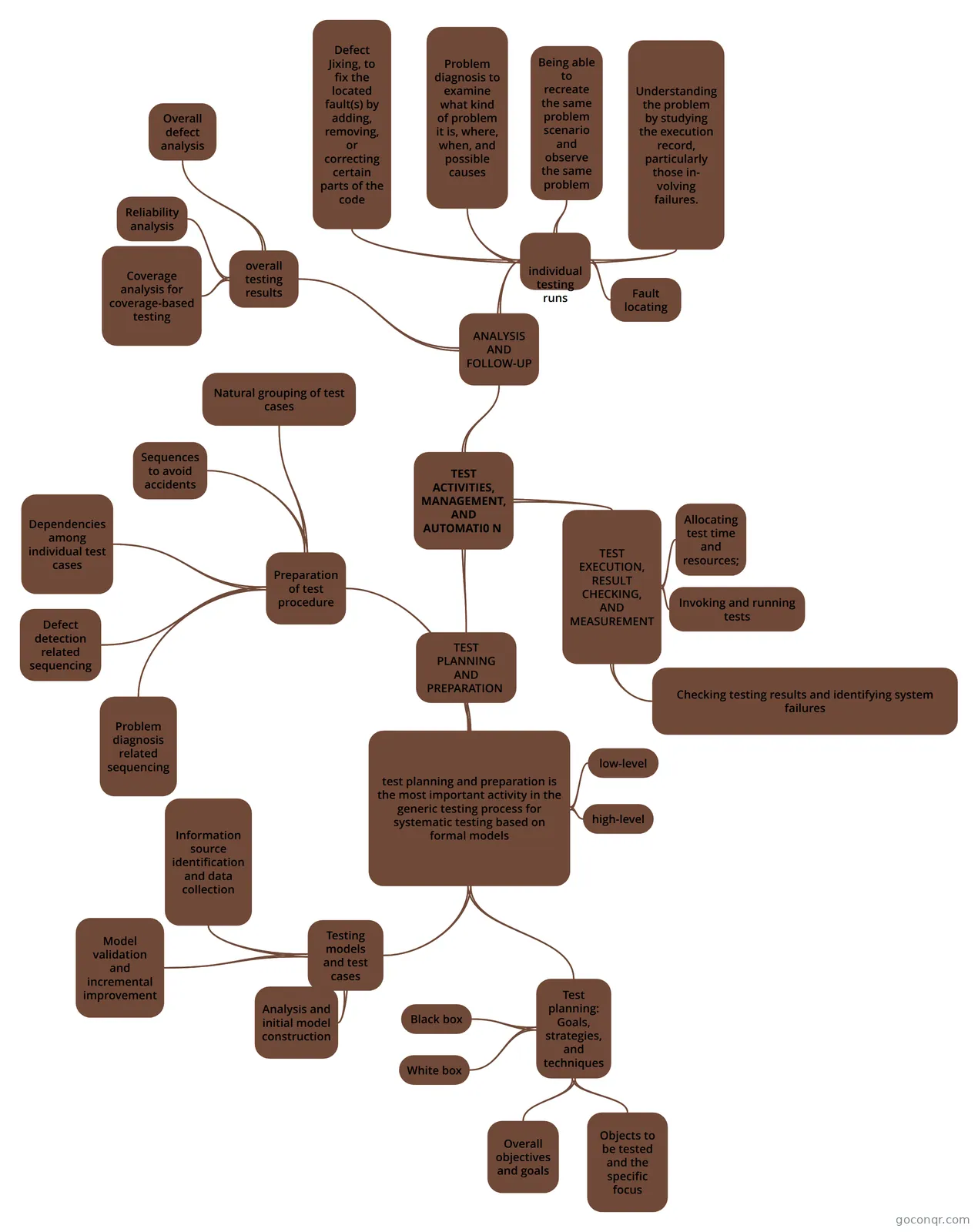 TEST ACTIVITIES, MANAGEMENT, AND AUTOMATI0 N Mapa Mental en Actividades de ensayo ,administración y automatización, creado por Rodny Mendoza en 19/09/2018.
-
Testing
-
Test Activities
-
Testing Services
-
Testing
More Software Testing resources
About software testing mind maps
GoConqr OriginalWhat software testing mind maps cover
The maps bring related ideas together in branches. Testing Levels covers unit, integration, system and acceptance testing. Testing Strategies sets out white box and black box approaches, while Test-Driven Development explores verification and testing.
Other maps look at testing throughout the software life cycle, static techniques and test design techniques. The static techniques map includes the review process and types of review; the test design map includes equivalence partitioning and boundary value analysis.
How to use the maps
Start with Testing Levels if you want an outline of the stages. Read each branch, then try to explain how the levels differ without looking. Use Testing Strategies when you are ready to compare approaches.
For short definitions, switch to the testing flashcards on the unit page. To check your recall, try a unit quiz after reviewing a map. Choose a topic and follow its branches at your own pace.
Frequently asked questions
Which mind map is a useful starting point?
Testing Levels is a useful starting point if you want to review how testing is organised. Its branches cover unit, integration, system and acceptance testing. You can then use Testing Strategies to look at white box and black box approaches in more detail.
Are these mind maps free to use?
Yes. Every resource listed here is free to open and study without an account. The maps were made by GoConqr users. A free account also lets you save quiz scores and make your own quizzes, mind maps, flashcards and notes.
Who can use this collection?
The collection includes material for university students and professional candidates reviewing software testing, as well as teachers looking for lesson material. There are also some resources for school students. Topics range from testing levels and strategies to static techniques and test design.