
Test
Key Concept 2.1 The Development and Codification of Religious and Cultural Traditions
Este test tiene tipos de pregunta que se abren en el reproductor de siempre.
Preguntas del test (13)
1I. Codifications and further developments of existing religious traditions provided a bond among people and an ethical code to live by.
A. Forced migration of Hebrews during Assyrian and Babylonian captivity.
We saw previously that the Hebrews developed a [blank_start]monotheistic[blank_end] faith. As their numbers grew and they became a more [blank_start]organized[blank_end] society, their beliefs, ceremonial laws, history, and hymns became codified into a common body of scripture. This collection of scripture is called the Torah (or Tanakh) and corresponds with what non-Jews call the Old Testament of the Bible. Torah prescribes detailed guidelines covering [blank_start]ethics[blank_end], social and civil [blank_start]relations[blank_end], and even rules about [blank_start]diet[blank_end] and personal [blank_start]hygene[blank_end]. Taken together, the beliefs and practices [blank_start]codified[blank_end] in the Torah formed the religion of Judaism, a monotheistic religion inexorably connected with a specific ethnic group, the Hebrews (or Jews). Central to this religion is the belief that the Hebrews entered into a special [blank_start]covenantal[blank_end] relation with their God through the patriarch Abraham.
These guidelines, compounded with the belief that the creator God had chosen them as a special ethnic group, endowed the Jewish people with a well defined sense of [blank_start]identity[blank_end]. This sense of identity would follow them as foreign empires [blank_start]conquered[blank_end] the Hebrews and led them into [blank_start]captivity[blank_end] (see map at right). As captives of foreign empires, some cultural [blank_start]influence[blank_end] from their host civilizations was inevitable; nevertheless, even as [blank_start]diasporic[blank_end] communities the Hebrews attempted to preserve their identity through ceremonial and cultural [blank_start]traditions[blank_end]. This struggle to avoid [blank_start]assimilation[blank_end] helped maintain their identity but also sometimes brought them into conflict with their host cultures.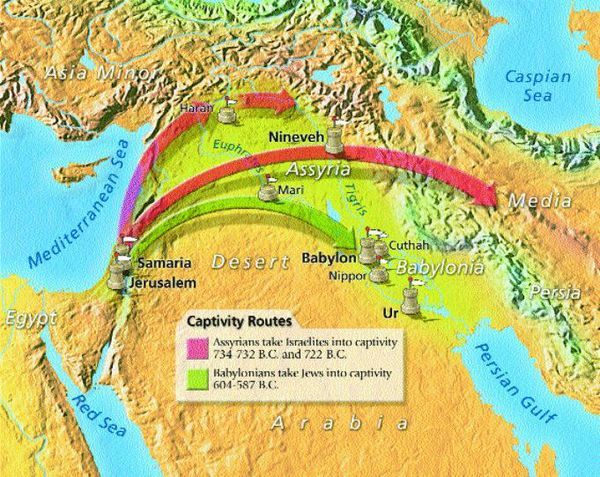
- Amonotheistic
- Borganized
- Cethics
- Drelations
- Ediet
- Fhygene
- Gcodified
- Hcovenantal
- Iidentity
- Jconquered
- Kcaptivity
- Linfluence
- Mdiasporic
- Ntraditions
- Oassimilation
2B. Around this same time (600-500 B.C.E.) the Vedic Period in South Asia was coming to a close. In Key Concept 1.3 we saw that as the [blank_start]Aryans[blank_end] settled down and took up agriculture the system of priestly sacrifices outlined in the [blank_start]Vedas[blank_end] were not as relevant to their [blank_start]sedentary[blank_end] way of life. The reaction against the stale [blank_start]formalism[blank_end] of the Vedic Period begins with the a body of writings known as the [blank_start]Upanishads[blank_end]. The name Upanishads implies one who sits at the feet of a master; we see the shift away from the official [blank_start]priests[blank_end] to an emphasis on wandering [blank_start]mystic[blank_end] teachers or gurus. The Upanishads have less to do with formal rituals and focus instead on reflections about life's meaning and how man is related to the universe. Although the influence of the Vedas would remain strong in South Asia, the Upanishads added ideas about [blank_start]reincarnation[blank_end], karma, and the imperishable atman that resides in every living thing. From the foundations of the Vedas and the philosophical musings of the Upanishads arose the religion of [blank_start]Hinduism[blank_end].
The beginnings of Hinduism are [blank_start]difficult[blank_end] to trace, but the religion originated with the [blank_start]polytheism[blank_end] that the Aryans brought as they began invading the Indian subcontinent sometime after 2000 BCE. Aryan priests recited hymns that told stories and taught values and were eventually written down in The Vedas, the sacred texts of Hinduism. One famous story is The [blank_start]Ramayana[blank_end] that tells about the life and love of Prince Rama and his wife Sita. Another [blank_start]epic[blank_end] story is [blank_start]The Mahabharata[blank_end], which focuses on a war between cousins. Its most famous part is called [blank_start]The Bhagavad Gita[blank_end], which tells how one cousin, Arjuna, overcomes his hesitations to fight his own kin. The stories embody important Hindu values that still guide modern day India.
In the Bhagavad Gita, the warrior [blank_start]Arjuna[blank_end] prays to lord Krishna to spare him the agony of killing people in battle, some of whom he respects and admires. Krishna answers that he must carry out the duties of the warrior [blank_start]caste[blank_end] in which he belongs, thus exemplifying the Hindu concept of dharma.
Hinduism assumes the eternal existence of a universal [blank_start]spirit[blank_end] that guides all life on earth. A piece of the spirit called the [blank_start]atman[blank_end] is trapped inside humans and other living creatures. The most important desire of the atman is to be [blank_start]reunited[blank_end] with the universal spirit, and every aspect of an individual's life is governed by it. When someone dies, their atman may be reunited, but most usually is [blank_start]reborn[blank_end] in a new body. A person's caste membership is a clear [blank_start]indication[blank_end] of how close he or she is to the desired reunion. Some basic tenets of Hinduism are:
[blank_start]Reincarnation[blank_end] - Atman spirits are reborn in different people after one body dies. This rebirth has no beginning and no end, and is part of the larger universal spirit that pervades all of life.
[blank_start]Karma[blank_end] - This widely used word actually refers to the pattern of cause and effect that transcends individual human lives. Whether or not an individual fulfills his/her duties in one life determines what happens in the next.
[blank_start]Dharma[blank_end] - Duties called dharma are attached to each caste position. For example, a warrior's dharma is to fight honorably, and a wife's duty is to serve her husband faithfully. Even the lowliest caste has dharma attached to it. If one fulfills this dharma, the reward is for the atman to be reborn into a [blank_start]higher[blank_end] caste. Only the atman of a member of the highest caste (originally the priests) has the opportunity to be reunited with the universal spirit.
The [blank_start]universal spirit[blank_end] is represented by [blank_start]Brahman[blank_end], a god that takes many different shapes. Two of Brahman's forms are [blank_start]Vishnu[blank_end] the Creator, and [blank_start]Shiva[blank_end] the Destroyer. Hinduism is very difficult to categorize as either polytheistic or monotheistic because of the central belief in the universal spirit. Do each of Brahman's forms represent a different god, or are they all the same? Brahman's forms almost certainly represent different Aryan gods from the religion's early days, but Hinduism eventually unites them all in the belief in Brahman.- AAryans
- BVedas
- Csedentary
- Dformalism
- EUpanishads
- Fpriests
- Gmystic
- Hreincarnation
- IHinduism
- Jdifficult
- Kpolytheism
- LRamayana
- Mepic
- NThe Bhagavad Gita
- OThe Mahabharata
- PArjuna
- Qcaste
- Rspirit
- Satman
- Treunited
- Ureborn
- Vindication
- WReincarnation
- XKarma
- YDharma
- Zhigher
- AAuniversal spirit
- ABBrahman
- ACVishnu
- ADShiva
3II. New belief systems and cultural traditions emerged and spread, often asserting universal truths.
A. Buddha.jpgA new major world religion began in this time period as an offshoot of [blank_start]Hinduism[blank_end]. Buddhism began in India in the [blank_start]Ganges River[blank_end] area during the 6th century BCE. Its founder was [blank_start]Siddhartha Guatama[blank_end], who later became known as the [blank_start]Buddha[blank_end], or the "[blank_start]Enlightened One[blank_end]." Siddhartha was the son of a wealthy Hindu prince who grew up with many advantages in life. However, as a young man he did not find answers to the meaning of life in Hinduism, so he left home to become an [blank_start]ascetic[blank_end], or wandering holy man. His [blank_start]Enlightenment[blank_end] came while sitting under a tree in a Deerfield, and the revelations of that day form the basic tenets of Buddhism:
The Four Noble Truths - 1) All of life is [blank_start]suffering[blank_end]; 2) Suffering is caused by false [blank_start]desires[blank_end] for things that do not bring [blank_start]satisfaction[blank_end]; 3) Suffering may be relieved by removing the [blank_start]desire[blank_end]; 4) Desire may be removed by following the [blank_start]Eightfold Path[blank_end].
The Eightfold Path to Enlightenment - The ultimate goal is to follow the path to [blank_start]nirvana[blank_end], or a state of contentment that occurs when the individual's soul unites with the [blank_start]universal spirit[blank_end]. The eight steps must be achieved [blank_start]one by one[blank_end], starting with a change in [blank_start]thoughts and intentions[blank_end], followed by changes in life style and actions, that [blank_start]prelude[blank_end] a higher thought process through [blank_start]meditation[blank_end]. Eventually, a "breakthrough" occurs when nirvana is achieved that gives the person a whole new understanding of life.
Note that Hinduism supported the continuation of the [blank_start]caste[blank_end] system in India, since castes were an outer reflection of inner purity. For example, placement in a [blank_start]lower[blank_end] caste happened because a person did not fulfill his/her [blank_start]dharma[blank_end] in a previous life. Higher status was a "[blank_start]reward[blank_end]" for good behavior in the past. Although Buddhism, like Hinduism, emphasizes the soul's yearning for understandings on a higher plane, it generally supported the notion that [blank_start]anyone[blank_end] of any [blank_start]social position[blank_end] could follow the Eightfold Path successfully. Buddhists believed that changes in thought processes and life styles brought enlightenment, not the powers of one's caste. Although the Buddha actively spread the new beliefs during his long lifetime, the new religion faced [blank_start]oppression[blank_end] after his death from Hindus who saw it as a threat to the basic social and religious structure that held India together. Buddhism probably survived only because the Mauryan emperor [blank_start]Ashoka[blank_end] converted to it and promoted its practice. However, in the long run, Buddhism did much better in areas where it spread through [blank_start]cultural[blank_end] diffusion, such as Southeast Asia, China, and Japan.- AHinduism
- BGanges River
- CSiddhartha Guatama
- DBuddha
- EEnlightened One
- Fascetic
- GEnlightenment
- Hsuffering
- Idesires
- Jsatisfaction
- Kdesire
- LEightfold Path
- Mnirvana
- Nuniversal spirit
- Othoughts and intentions
- Pone by one
- Qprelude
- Rmeditation
- Scaste
- Tlower
- Udharma
- Vreward
- Wanyone
- Xsocial position
- Yoppression
- ZAshoka
- AAcultural
4B. Three important belief systems (Confucianism, Daoism, and Legalism) emerged in China during the [blank_start]Warring States[blank_end] Period (403-221 BCE) between the [blank_start]Zhou[blank_end] and [blank_start]Han[blank_end] Dynasties. Although the period was politically [blank_start]chaotic[blank_end], it hosted a cultural flowering that left a permanent mark on Chinese history. Confucius Confucius.jpgcontemplated why China had fallen into chaos, and concluded that the [blank_start]Mandate of Heaven[blank_end] had been lost because of poor behavior of not only the Chinese emperor, but all his subjects as well. His plan for reestablishing Chinese society [blank_start]profoundly[blank_end] affected the course of Chinese history and eventually spread to many other areas of Asia as well. He emphasized the importance of [blank_start]harmony, order, and obedience[blank_end] and believed that if five basic relationships were sound, all of [blank_start]society[blank_end] would be, too:
Emperor/subject - the [blank_start]emperor[blank_end] has the responsibility to take care of his subjects, and [blank_start]subjects[blank_end] must obey the emperor
Father/son - the father takes care of the son, and the son obeys the father
Older brother/younger brother - the older brother takes care of the younger brother, who in turn obeys him
Husband/wife - the husband takes care of the wife, who in turn obeys him
Friend/friend -The only relationship that does not assume [blank_start]inequality[blank_end] should be characterized by mutual care and obedience.
Confucius also defined the "[blank_start]superior man[blank_end]" - one who exhibits [blank_start]ren[blank_end] (kindness), [blank_start]li[blank_end] (sense of propriety), and [blank_start]Xiao[blank_end] (filial piety, or loyalty to the family). Confucianism [blank_start]accepted[blank_end] and endorsed inequality as an important part of an [blank_start]ordered[blank_end] society. It confirmed the power of the emperor, but held him [blank_start]responsible[blank_end] for his people, and it reinforced the [blank_start]patriarchal[blank_end] family structure that was already in place in China. Because Confucianism focused on [blank_start]social[blank_end] order and [blank_start]political[blank_end] organization, it is generally seen as a [blank_start]philosophy[blank_end] rather than a [blank_start]religion[blank_end]. Religions are more likely to emphasize [blank_start]spiritual[blank_end] topics, not society and politics.- AWarring States
- BZhou
- CHan
- Dchaotic
- EMandate of Heaven
- Fprofoundly
- Gharmony, order, and obedience
- Hsociety
- Iemperor
- Jsubjects
- Kinequality
- Lsuperior man
- Mren
- Nli
- OXiao
- Paccepted
- Qordered
- Rresponsible
- Spatriarchal
- Tsocial
- Upolitical
- Vphilosophy
- Wreligion
- Xspiritual
5C. The founder of [blank_start]Daoism[blank_end] is believed to have been [blank_start]Laozi[blank_end], a spiritualist who probably lived in the 4th century BCE. The religion centers on the [blank_start]Dao[blank_end] (sometimes referred to as the "[blank_start]Way[blank_end]" or "[blank_start]Path[blank_end]"), the original force of the cosmos that is an [blank_start]eternal[blank_end] and unchanging [blank_start]principle[blank_end] that governs all the workings of the world. The Dao is [blank_start]passive[blank_end] - not [blank_start]active[blank_end], good nor bad - but it just [blank_start]is[blank_end]. It cannot be [blank_start]changed[blank_end], so humans must learn to live with it. According to Daoism, human [blank_start]strivings[blank_end] have brought the world to chaos because they [blank_start]resist[blank_end] the Dao. A chief characteristic is [blank_start]wuwei[blank_end], or a [blank_start]disengagement[blank_end] from the affairs of the world, including government. The [blank_start]less[blank_end] government, the better. Live simply, in harmony with nature. Daoism encourages [blank_start]introspection[blank_end], development of inner [blank_start]contentment[blank_end], and no [blank_start]ambition[blank_end] to change the Dao.
Both Confucianism and Daoism encourage self [blank_start]knowledge[blank_end] and acceptance of the ways things are. However, Confucianism is [blank_start]activist[blank_end] and [blank_start]extroverted[blank_end], and Daoism is [blank_start]reflective[blank_end] and [blank_start]introspective[blank_end]. The same individual may believe in the importance of both belief systems, unlike many people in western societies who think that a person may only adhere to one belief system or another.
- ADaoism
- BLaozi
- CDao
- DWay
- EPath
- Feternal
- Gprinciple
- Hpassive
- Iactive
- Jis
- Kchanged
- Lstrivings
- Mresist
- Nwuwei
- Odisengagement
- Pless
- Qintrospection
- Rcontentment
- Sambition
- Tknowledge
- Uactivist
- Vextroverted
- Wreflective
- Xintrospective
6D. Christianity grew directly out of [blank_start]Judaism[blank_end], with its founder Jesus of Nazareth born and raised as a [blank_start]Jew[blank_end] in the area just east of the [blank_start]Mediterranean Sea[blank_end]. During his lifetime, the area was controlled by [blank_start]Rome[blank_end] as a province in the empire. Christianity originated partly from a long-standing Jewish belief in the coming of a [blank_start]Messiah[blank_end], or a leader who would restore the Jewish kingdom to its former glory days. Jesus' followers saw him as the Messiah who would cleanse the Jewish religion of its rigid and haughty [blank_start]priests[blank_end] and assure life after death to all that followed Christian precepts. In this way, its [blank_start]appeal[blank_end] to ordinary people may be compared to that of Buddhism, as it struggled to emerge from the Hindu caste system. Christianity's broad appeal of the [blank_start]masses[blank_end], as well as deliberate [blank_start]conversion[blank_end] efforts by its early apostles, meant that the religion grew steadily and eventually became the religion with the most followers in the modern world.
Jesus was a [blank_start]prophet[blank_end] and teacher whose followers came to believe that he was the son of God. He advocated a [blank_start]moral code[blank_end] based on love, charity, and humility. His disciples predicted a final judgment day when God would [blank_start]reward[blank_end] the righteous with [blank_start]immortality[blank_end] and condemn sinners to eternal hell. Jesus was arrested and executed by Roman officials because he aroused [blank_start]suspicions[blank_end] among Jewish leaders, and he was seen by many as a dangerous [blank_start]rebel rouser[blank_end]. After his death, his apostles spread the faith. Especially important was [blank_start]Paul[blank_end], a Jew who was familiar with Greco-Roman culture. He explained Christian principles in ways that Greeks and Romans understood, and he established [blank_start]churches[blank_end] all over the eastern end of the Mediterranean, and even as far away as Rome.
Christianity grew steadily in the [blank_start]Roman Empire[blank_end], but not without clashes with Roman authorities. Eventually in the 4th century CE, the Emperor [blank_start]Constantine[blank_end] was converted to Christianity and established a new capital in the eastern city of [blank_start]Byzantium[blank_end], which he renamed [blank_start]Constantinople[blank_end]. As a result, the religion grew [blank_start]west and north[blank_end] from Rome, and also east from Constantinople, greatly extending its reach.
By the end of the classical era, these major belief systems had expanded to many areas of the world, and with the fall of empires in the late classical era, came to be major forces in shaping world history. One major religion - [blank_start]Islam[blank_end] - remained to be established in the 7th century as part of the next great period that extended from 600 to 1450 CE.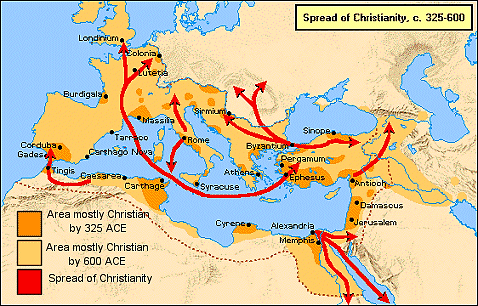
- AJudaism
- BJew
- CMediterranean Sea
- DRome
- EMessiah
- Fpriests
- Gappeal
- Hmasses
- Iconversion
- Jprophet
- Kmoral code
- Lreward
- Mimmortality
- Nsuspicions
- Orebel rouser
- PPaul
- Qchurches
- RRoman Empire
- SConstantine
- TByzantium
- UConstantinople
- Vwest and north
- WIslam
7E. Hellenism is the culture of ancient [blank_start]Greece[blank_end] as spread across the ancient world by Alexander of Macedonia (the Great). Alexander’s father, Phillip of Macedonia, sent his son to Greece where he was a student of [blank_start]Aristotle[blank_end]. There he learned the [blank_start]Hellenistic[blank_end] culture. Although there was much religion in Athens, there was generally no religious caste or priestly order to decide what the official version of any [blank_start]body of knowledge was[blank_end].
This famous Renaissance sketch by [blank_start]Da Vinci[blank_end] exemplifies the Greek emphasis on [blank_start]order, symmetry and balance[blank_end].
As a result, Athens placed a higher premium on [blank_start]individual[blank_end] inquiry than any of the other classical civilizations. Because they believed the world to be [blank_start]rational[blank_end] and symmetrical, the Greeks stressed [blank_start]logic[blank_end] and systematic [blank_start]thinking[blank_end]; western philosophy was born. They were curious about the nature of the world and were not hindered in their attempt to formulate theories about it. The Greeks never did establish a veritable [blank_start]science[blank_end]; they placed too much emphasis on [blank_start]theories[blank_end] without ever subjecting those theories to physical [blank_start]experiments[blank_end]. In other words, they would hold to a [blank_start]hypothesis[blank_end] about the physical world if no logical argument could be found to [blank_start]contradict[blank_end] it; they would never [blank_start]test[blank_end] the hypothesis experimentally. They came up with half of the scientific method.
This [blank_start]culture[blank_end] placed a high regard on symmetry, proportion, and the pursuit of the [blank_start]ideal[blank_end]. Greek statues do not so much depict an individual person as they do [blank_start]celebrate an ideal[blank_end]. (See an excellent video on this HERE.) Most all Greek statues have identical [blank_start]proportions[blank_end] (the height six times the length of the foot; hence our modern measurements). The [blank_start]Parthenon[blank_end] is a model of symmetry and proportionality. For more about the nature of Greek Architecture click HERE.
As these elements of Greek culture became more cosmopolitan with the expanding empire of Alexander the Greek, the resulting culture was called [blank_start]Hellenism[blank_end]. Alexander [blank_start]purposefully[blank_end] attempted to spread this culture (after defeating Persia he ordered ten thousand of his troops to remain in Persia and marry Persian women in order to establish Greek families there.) Hellenism influenced India for a short time as well. But when cultural contact with India ceased, the Greek influence soon disappeared.- AGreece
- BAristotle
- CHellenistic
- Dbody of knowledge was
- EDa Vinci
- Forder, symmetry and balance
- Gindividual
- Hrational
- Ilogic
- Jthinking
- Kscience
- Ltheories
- Mexperiments
- Nhypothesis
- Ocontradict
- Ptest
- Qculture
- Rideal
- Scelebrate an ideal
- Tproportions
- UParthenon
- VHellenism
- Wpurposefully
8III. Belief systems generally reinforced existing social structures while also offering new roles and status to some men and women. For example, Confucianism emphasized filial piety, and some Buddhists and Christians practiced a monastic life.
In the previous time period, the [blank_start]surpluses[blank_end] created by agricultural production first led to social and gender [blank_start]inequalities[blank_end] which in turn were [blank_start]reinforced[blank_end] by laws and codes. Belief systems too affected [blank_start]gender[blank_end] roles in society, and each of the major world religions that was codified during this period had an impact on gender relations. Hinduism, Confucianism and Christianity all encouraged [blank_start]patriarchy[blank_end] (although at differing levels of severity.) The Hindu Laws of Manu taught that a woman is not [blank_start]independent[blank_end] of men at any point in her life:
In childhood a [blank_start]female[blank_end] must be subject to her father, in youth to her husband, when her lord is dead to her sons; a woman must never be independent. She must not seek to [blank_start]separate[blank_end] herself from her father, husband, or sons; by leaving them she would make both (her own and her husband's) families contemptible. She must always be cheerful, clever in (the management of her) household affairs, careful in cleaning her utensils, and economical in expenditure.
--Laws of Manu
The writings of St. Paul in the New Testament of the Christian Bible also reinforced patriarchy, but hold up a husband's [blank_start]obligation[blank_end] to love his wife "as Christ loves the church."
Wives, be subject to your own husbands, as to the Lord. For the husband is the head of the wife, as Christ also is the head of the church. . . [blank_start]Husbands[blank_end], love your wives, just as Christ also loved the church and gave Himself up for her.
--Ephesians 5:22,25
Confucianism teaches a [blank_start]heirarchal[blank_end] family structure and endows the husband with authority over the wife. But like Christianity, this is a soft patriarchy with reciprocal obligations for the hustband, namely that he show respect and be a model of proper behavior in the family. The deep respect for parents and ancestors, called [blank_start]filial piety[blank_end], was also a central tenent of Confucianism.
In its original form Buddhism was unique in this regard. It [blank_start]rejected[blank_end] the caste system on which social inequality was based and taught that both genders had equal access to [blank_start]enlightenment[blank_end]. Thus it was a rare exception to the wide practice of patriarchy in the ancient world. As it spread into east Asia, however, Buddhism absorbed many cultural values of China. In many areas Confucian patriarchy remained the dominant family model.
Some followers of Buddhism and Christianity had tendencies toward [blank_start]asceticism[blank_end], an extreme rejection of the [blank_start]materialistic[blank_end] values of the world, its luxuries, anything extravagant or unnecessary, and all sexual pleasure. Such people avoided all material things except the bare necessities and simplest food. In their attempt to separate themselves from the sensual [blank_start]temptations[blank_end] of the world, some Buddhists and Christians developed [blank_start]monasticism[blank_end], the lifestyle of living as monks in a monastery. Christian monks lived without worldly goods and worked to feed the poor and care for orphans and widows. Buddhist monks purged themselves of desire and aided the weak or poor while striving to attain enlightenment. Although the reality of monasticism could be quite different--the lust for power and wealth can infect every human institution-- ideally, monasteries gave opportunities for both men and women to provide charitable services to the less fortunate.- Asurpluses
- Binequalities
- Creinforced
- Dgender
- Epatriarchy
- Findependent
- Gfemale
- Hseparate
- Iobligation
- JHusbands
- Kheirarchal
- Lfilial piety
- Mrejected
- Nenlightenment
- Oasceticism
- Pmaterialistic
- Qtemptations
- Rmonasticism
9IV. Other religious and cultural traditions, including shamanism, animism, and ancestor veneration, persisted.
A. As the foundations were being laid for what would become the major world [blank_start]religions[blank_end], other less codified beliefs thrived. Some of these beliefs were not religions per se, but rather [blank_start]orientations[blank_end] and practices concerned with [blank_start]spiritual[blank_end] things. [blank_start]Shamanism[blank_end], for example, is not a religion, but a set of practices geared toward manipulating the [blank_start]natural[blank_end] world through rites and ceremonies performed by a [blank_start]shaman[blank_end], an individual thought to have connections with the [blank_start]supernatural[blank_end] forces of the universe.
Closely related to Shamanism is [blank_start]Animism[blank_end] which holds that objects in the material world are inhabited by [blank_start]spirits[blank_end]. In actuality, animism does not generally make a distinction between the physical and spiritual [blank_start]realms[blank_end]. The practice of animism varies widely in different parts of the world.
Both Shamanism and Animism were primarily found [blank_start]outside[blank_end] the areas in which religious traditions were being codified, However, elements of both could be found in major civilizations, particularly among those who did not learn to [blank_start]read[blank_end].- Areligions
- Borientations
- Cspiritual
- DShamanism
- Enatural
- Fshaman
- Gsupernatural
- HAnimism
- Ispirits
- Jrealms
- Koutside
- Lread
10B. Another belief system that existed outside the official codified religions of core civilizations was [blank_start]ancestor worship[blank_end]. In many cultures there is a profound sense of respect given to the [blank_start]elderly[blank_end]. Their many years of life have endowed them with [blank_start]wisdom[blank_end] which they model and transmit to those less [blank_start]experienced[blank_end]. The movement from this practice to the [blank_start]veneration[blank_end] of dead ancestors is only natural given the belief that their [blank_start]spirits[blank_end] live on after death.
The practice of ancestor worship, like that of [blank_start]shamanism and animism[blank_end], varied widely across locations but largely focused on receiving [blank_start]advice[blank_end] from the ancestors about everyday practical matters. In China the ancestors communicated with the living through [blank_start]oracle[blank_end] bones. This process was relatively simple. Possible answers to important questions were written on large [blank_start]bones[blank_end] or turtle plastrons. The [blank_start]cracks[blank_end] that ran through these answers when heat was applied to the bone provided advice from the ancestors, providing they were properly [blank_start]interpreted[blank_end] by a shaman or specially gifted person.
The use of oracle bones had several important results. First of all, they raised the importance of having a [blank_start]written[blank_end] script and having people who could [blank_start]read and write[blank_end]. Secondly, the thousands of oracle bones that survive today (see picture on the left) provide imporant [blank_start]information[blank_end] about early Chinese civilization. The entire [blank_start]dynastic[blank_end] succession of the Shang Dynasty, China's river valley civilization, can be constructed through information found on [blank_start]extant[blank_end] oracle bones.- Aancestor worship
- Belderly
- Cwisdom
- Dexperienced
- Eveneration
- Fspirits
- Gshamanism and animism
- Hadvice
- Ioracle
- Jbones
- Kcracks
- Linterpreted
- Mwritten
- Nread and write
- Oinformation
- Pdynastic
- Qextant
11V. Artistic expressions, including literature and drama, architecture, and sculpture, show distinctive cultural developments.
A. As major religions solidified and [blank_start]matured[blank_end] during this classical age, so did forms of [blank_start]artistic[blank_end] expression. [blank_start]Literary[blank_end] traditions continued to be [blank_start]codified[blank_end]. Some areas developed distinctive forms of art, such as [blank_start]drama[blank_end]. Indeed, for the gift of theater we owe a debt to the ancient [blank_start]Greeks[blank_end]. Today's spectator based activities, from modern Broadway shows, to stadium sports, to religious services, illustrate the [blank_start]influence[blank_end] of Greek theater.
Theater was born out of the [blank_start]religious[blank_end] festivals of the Greek god [blank_start]Dionysus[blank_end]. The worship of Dionysus, which involved erratic, intoxicated dancing under the influence of wine, seems to have been influenced by Central Asian [blank_start]shamanism[blank_end]. The festivals became so sensational that they later drew spectators, and the participants--soon to be called actors--began consciously [blank_start]performing[blank_end] for their [blank_start]audiences[blank_end]. The performances evolved into dramatic [blank_start]recreations[blank_end] of historical situations, [blank_start]comedic[blank_end] portrayals of the human condition, [blank_start]satires[blank_end] of current politicians, and explorations of the [blank_start]tragedies[blank_end] of fate.
Theatrical competitions--probably created to bring cultural unity to the city-states of ancient Greece--reinforced this form of art across the region of Attica (a region of Greece that included Athens.) Even when the cult of Dionysus was made [blank_start]illegal[blank_end], this form of art continued and produced many well known actors and playwrights. [blank_start]Amphitheaters[blank_end] across the Greco-Roman world attest to the popularity of drama.- Amatured
- Bartistic
- CLiterary
- Dcodified
- Edrama
- FGreeks
- Ginfluence
- Hreligious
- IDionysus
- Jshamanism
- Kaudiences
- Lperforming
- Mrecreations
- Nsatires
- Ocomedic
- Ptragedies
- Qillegal
- RAmphitheaters
12B. As [blank_start]literature[blank_end] and other forms of artistic [blank_start]expression[blank_end] were forming, architectural styles were being codified. The Greeks produced distinctive forms of [blank_start]architecture[blank_end] which reflected their values of symmetry, rationalism, and proportionality (See activity on Greek Architecture BELOW.)
Classical [blank_start]Indian[blank_end] architecture reflected the religious and cultural values of [blank_start]Hindu[blank_end] society. The plan of the [blank_start]temple[blank_end] was representative of the order of the [blank_start]cosmos[blank_end]. Although the entire temple is a [blank_start]sacred[blank_end] place, not all rooms are afforded the same level of [blank_start]reverence[blank_end]. The temple complex usually has a courtyard or anteroom though which [blank_start]worshipers[blank_end] first enter. Then, as one enters the temple itself, there are small [blank_start]congregational[blank_end] rooms. Finally,the center, or "[blank_start]womb chamber[blank_end]", is almost always a square and houses the image or [blank_start]representation[blank_end] of the god. This main chamber is the [blank_start]holiest[blank_end] place in the temple and requires quiet reverence and prayer. Thus the temple design reflects [blank_start]spacial[blank_end] hierarchies similar to the hierarchies of the Hindu [blank_start]caste[blank_end] system.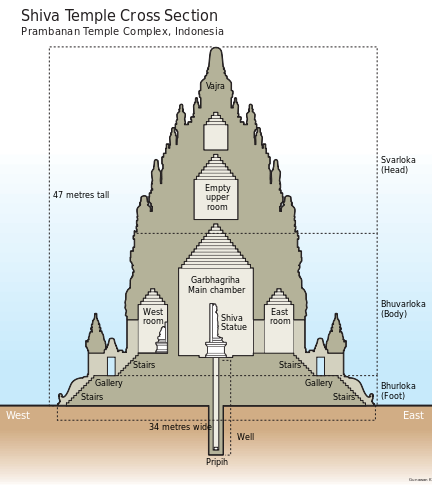
- Aliterature
- Bexpression
- Carchitecture
- DIndian
- EHindu
- Fcosmos
- Gtemple
- Hsacred
- Ireverence
- Jworshipers
- Kcongregational
- Lwomb chamber
- Mrepresentation
- Nholiest
- Ospacial
- Pcaste
13C.
The Kingdom of Bactria was significantly influenced by Hellenistic culture.
There were key interactions during the classical age between [blank_start]societies[blank_end] and these contacts brought significant [blank_start]cultural[blank_end] exchanges. Many of these occurred on the trade [blank_start]routes[blank_end] between civilizations, as seen in Key Concept 2.3 Emergence of Transregional Networks of Communication and Exchange. But [blank_start]invasion[blank_end] also brought cultures in contact and blended important styles and beliefs. After Alexander the Great invaded and then withdrew from [blank_start]Central Asia[blank_end], Greek and Buddhist cultures blended into a unique mixture. In the Hellenistic kingdoms Alexander established in present day Afghanistan and Pakistan (such as Bactria), this [blank_start]hybrid[blank_end] culture can be seen clearly.
Note the Greco-Roman influences in this Buddhist Artwork from Central Asia: the clothing, the wine drinking, and the musical instruments are all elements of Greco-Roman culture that merged with the Buddhist civilization of Central Asia . This syncretism began in the [blank_start]Hellenistic[blank_end] kingdom of Bactria and diffused south to other people, such as the Kushans. However, as contact between the Greek world and Central Asia [blank_start]declined[blank_end], the influence of Greco-Roman culture began to [blank_start]wane[blank_end]. Much of it did not survive the coming of [blank_start]Islam[blank_end] to this region in subsequent centuries.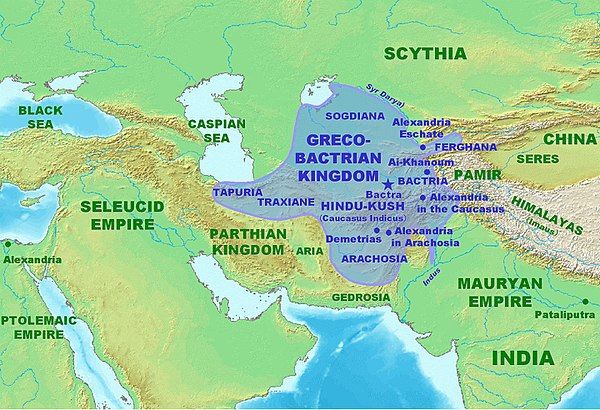
- Asocieties
- Bcultural
- Croutes
- Dinvasion
- ECentral Asia
- Fhybrid
- GHellenistic
- Hdeclined
- Iwane
- JIslam
Información
- Descripción
- AP AP World History Semster 1 Test sobre Key Concept 2.1 The Development and Codification of Religious and Cultural Traditions, creado por Ana Hale el 12/12/2017.
- Autor
- Ana Hale
- Idioma
- English
- Visitas
- 171
- Etiquetas
- Valoración
- Aún sin valoraciones Valora este test