
19511788
Descripción

Test por Caitlin Wringe , actualizado hace más de 1 año

|
Creado por Caitlin Wringe
hace alrededor de 7 años
|
|
Pregunta 1
Pregunta
Match the Strongyle species name to the right image.
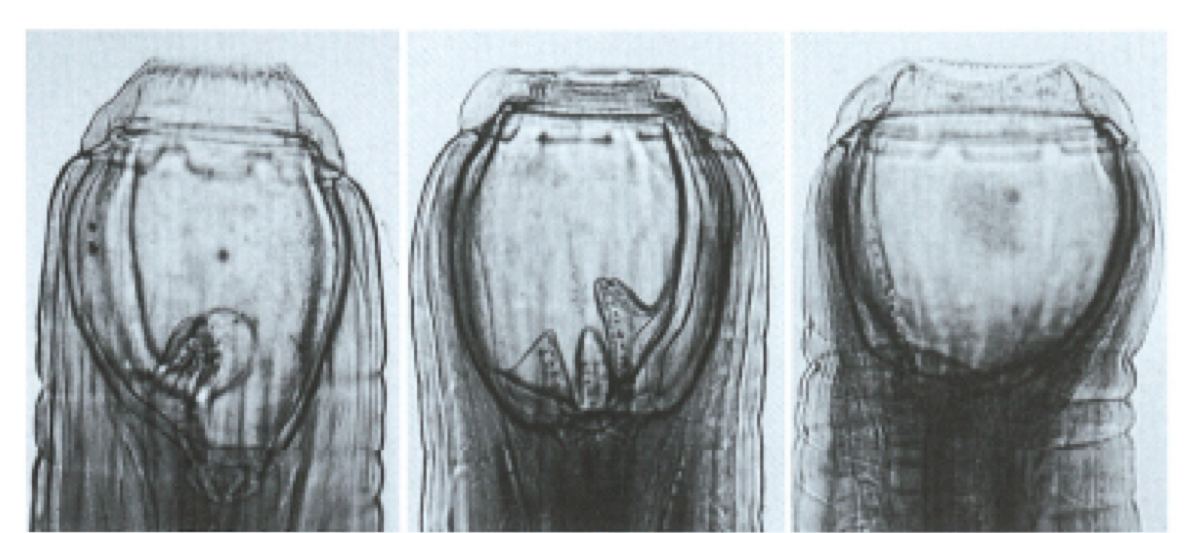
Respuesta
-
S. vulgaris
-
S. vulgarium
-
S. equinus
-
Strongyle edentatus
-
S. edentatus
-
Strongyle equinus
Pregunta 2
Pregunta
Large Strongyles have a direct lifecycle
Respuesta
- True
- False
Pregunta 3
Pregunta
Extensive [blank_start]larval migrations[blank_end] occur through the host.
S. vulgaris: [blank_start]submucosal arteries[blank_end] to the head of the [blank_start]cranial mesenteric artery[blank_end].
S. edentatus: [blank_start]liver[blank_end] and [blank_start]sub-peritoneum[blank_end] of the right flank.
S. equinus: [blank_start]liver[blank_end] and [blank_start]pancreas[blank_end]
Respuesta
-
larval migrations
-
larval moults
-
submucosal arteries
-
pulmonary arteries
-
cranial mesenteric artery
-
caudal mesenteric artery
-
liver
-
lungs
-
sub-peritoneum
-
pleural cavity
-
liver
-
colon
-
pancreas
-
cecum
Pregunta 4
Pregunta
Prepatent periods:
S. vulgaris - [blank_start]6 months[blank_end]
S. edentatus - [blank_start]11 months[blank_end]
S. equinus - [blank_start]9 months[blank_end]
Respuesta
-
6 months
-
9 months
-
11 months
-
6 months
-
9 months
-
11 months
Pregunta 5
Pregunta
Which of the 3 species has the shortest prepatent period?
Respuesta
-
S. vulgaris
-
S. edentatus
-
S. equinus
Pregunta 6
Pregunta
What are the clinical signs and complications that are associated with S. vulgaris?
Respuesta
-
Verminous arteritis
-
Thrombus formation
-
Embolism
-
Aneurism
-
Disruption of blood flow to intestines
-
Colic
Pregunta 7
Pregunta
What are the clinical signs and associated conditions with a S. edentatus infestation?
Respuesta
-
Jaundice
-
Fever
-
Peritonitis
-
Intraperitoneal haemorrhage
-
Colic
-
Anorexia
Pregunta 8
Pregunta
What are the clinical signs and associated conditions with a S. equinus infestation?
Respuesta
-
Colic
-
Anorexia
-
Haemorrhagic tracts in liver, pancreas and intestine
-
Diahorrea
-
Aneurysm
-
Peritonitis
Pregunta 9
Pregunta
Adult worms for al 3 strongyles cause insignificant damage compared to the larval stages.
Respuesta
- True
- False
Pregunta 10
Pregunta
What is the best diagnostic method for detection?
Respuesta
-
Larval culture
-
Fecal float
-
ELISA
-
Baermanns test
Pregunta 11
Pregunta
What anthelmintics are effective against the adult and migratory stages of Strongyle?
Respuesta
-
Ivermectin
-
Moxidectin
-
Pyrantel
-
Fenbendazole
-
Praziquantel
Pregunta 12
Pregunta
What anthelmintics are ONLY effective against the adult stage of Strongyle?
Respuesta
-
Ivermectin
-
Moxidectin
-
Pyrantel
-
Fenbendazole
-
Praziquantel
¿Quieres crear tus propios Tests gratis con GoConqr? Más información.